Lesley Ann Miller/Motorsport Images
Inside CART’s 2001 Texas debacle: The invisible monster
In Part 2 of RACER’s 3-part Inside CART’s 2001 Texas Debacle series, we pick up after the opening day of practice at Texas Motor Speedway concluded with Mauricio Gugelmin’s "three-quarter-miler" crash and drivers privately confiding within each other on the forces that were affecting their bodies [click here to read Part 1].
Down to 25 cars after Gugelmin’s withdrawal, activities resumed Saturday morning as teams went into the third and final practice to prepare for qualifying in the afternoon, and get in the last bits of running in race configuration to ready themselves for Sunday’s Firestone Firehawk 600.
Speeds continued to increase as Team Green’s Paul Tracy moved Friday’s best of 233.539mph to a new height of 236.678mph. It was nearly identical to the all-time qualifying record at the Indianapolis 500 of 236.986mph, set on the giant 2.5-mile oval where the long straights allow for more acceleration before reaching Turns 1 and 3.
By hitting the same 236mph average at TMS while missing a full mile of Indy’s length to rocket into the turns, Tracy reinforced just how much speed was being made in the four Texan corners.
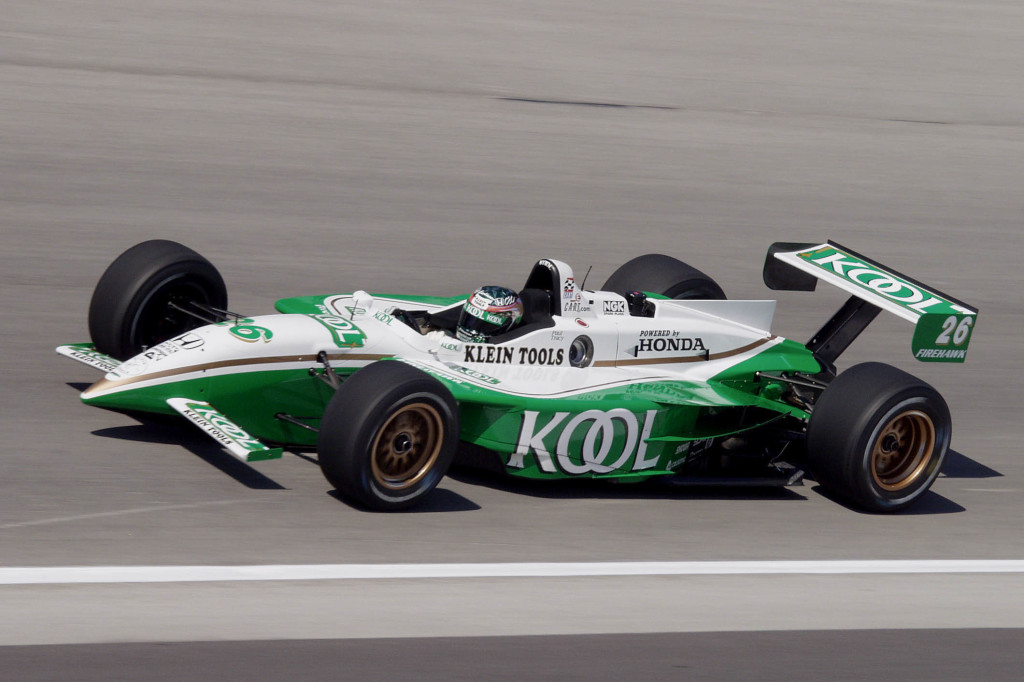
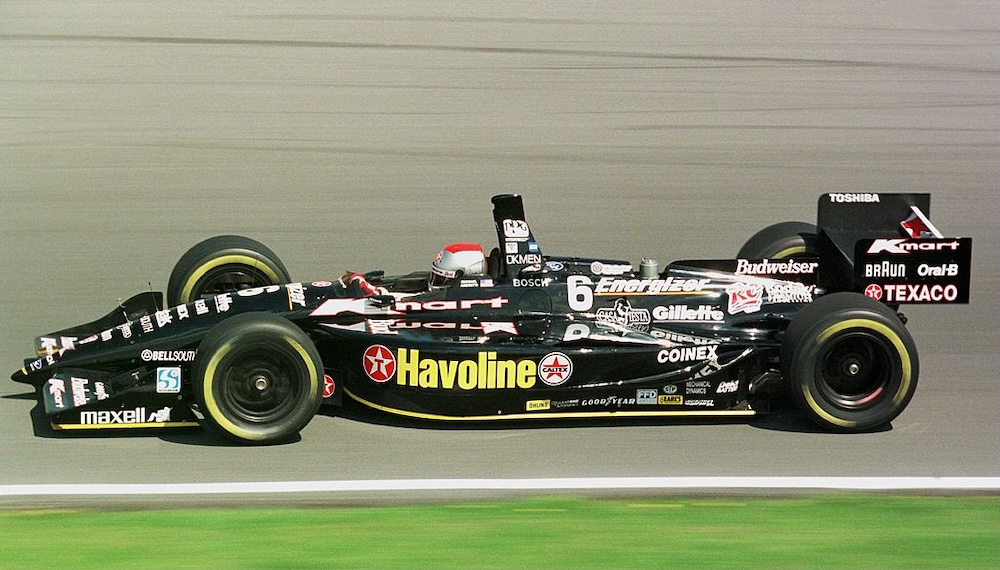
Paul Tracy’s awesome practice lap matched the all-time Indy speed record on a considerably shorter track. Lesley Ann Miller/Motorsport Images
Scott Dixon: It was damn fast, man, like super-fast. Just feeling the compression in the banking and that you could go flat. The combined Gs made it crazy. It was a situation where before you got into the corner, you had to make sure that you took a breath before you got in there, because there was no breathing midway through.
But then also it’s the fact of how long the turn is. At Indy, it's very short, quick, sharp turns. You don't have to think about it for too long. But at Texas it's long corners, and then going at those speeds, you don't have a whole lot of time to really think about what's coming next.
I do remember the feeling (of) just how intense the G loading was. But for me at that point, it kind of felt cool because it was the first time that we were going so hard like that, and I hadn't really grown that part in your mind where you're thinking, "****, I probably shouldn't be doing this."
For the third consecutive practice session, highlighted by Tracy’s unbelievable lap, the entire field took another step up in speed. For more than half the drivers, the third practice outing also came with a worsening of the problems inside the cockpit.
Nic Minassian: The whole lap was flat-out. I remember doing a long run to prepare for the race; I think I did 22 or 25 laps in a row. It was a long run to check the fuel consumption and the tire wear and all that. And I remember being in the car and passing the 15th, 16th lap, and starting to feel a little bit... you don't feel right in the car. You feel a little bit dizzy.
I remember putting my right elbow in the side of the cockpit to hold the steering wheel because the steering was too heavy and my head was squashed on the side of the cockpit. I felt like, "Oh, gosh. That's really rough." So I was forcing myself in the car. "Carry on. Go on. Go, go. You don't feel very well. Go. It's OK. You carry on. You carry on."
Eventually, I remember saying on the radio, "I don't feel too good anymore. I'm going to pass out." So I went to the pits and got out of the car. I couldn't walk straight. I think it was Mike Hull, who was there at the time being the boss of my car, and my engineer, Bill Pappas.
And Bill tells me, "Oh, you did a good job." And I was relieved a little bit because I felt like I was letting the team down, that physically, I couldn't run the car as long as the others, but actually I did. I did run the car very long.
Minassian was fortunate to stop prior to da Matta’s crash in his Newman/Haas Racing Lola-Toyota. Unlike Gugelmin, "Shorty" was not injured. Considering the severe forces involved with the impacts, da Matta was lucky that his car suffered the brunt of the damage and dissipated enough energy to protect its pilot. A fresh Lola-Toyota was readied for da Matta to use in qualifying.
The crisis of confidence taking place inside Minassian likely prevented another Saturday morning crash.
Nic Minassian: I thought, "Look, I'm going to pass out so I better stop, because right now, I have forced my brain to push myself forward. Right now, I'm going to lose it. I'm going to end up squashed at 230 miles an hour in the wall." And I just stopped. To be honest, I felt ashamed about it when I stopped.
I felt ashamed because I thought it was me. I thought I was weak. But then when I stopped and was so dizzy I couldn't walk straight, I felt a bit better about what was happening to me.
The memory of this will stay with me forever. You felt like your face was being pulled out of your helmet in the corners. It's like, "That's mad!"
With three sessions completed and two enormous crashes to clean up, and despite being a day and a half into the event, one troubling item remained: CART had been kept in the dark by its drivers. Some officials like Kneifel had seen some strange things and gotten reports of woozy drivers, but up to that point, all of the frightening tales from inside the cars remained private.
Among the various characters to surface during the Texas CART ordeal, Newman/Haas Racing public relations ace Kathi Lauterbach took a brave step forward in the aftermath of da Matta’s crash. Her decision changed the event’s trajectory and likely spared a number of drivers from calamitous outcomes.
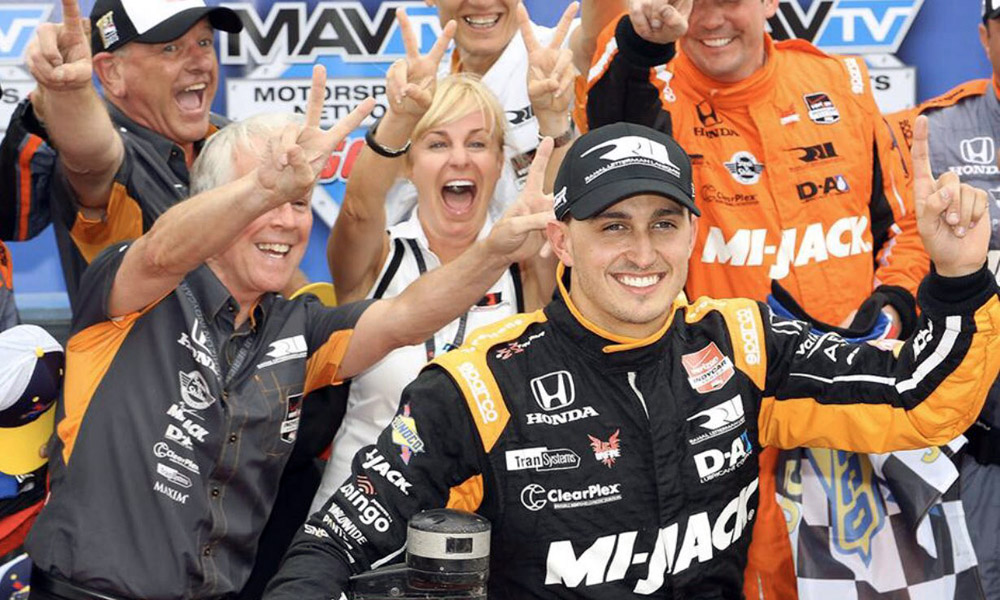
Kathi Lauterbach, here (middle) celebrating Graham Rahal's victory at Fontana in 2015 with Team RLL, is a longtime staple of the IndyCar PR scene but all the drivers owe her a debt for her actions at TMS in 2001. Image courtesy of Kathi Lauterbach via Twitter
Dr. Steven Olvey, CART Medical Director, 1979-2003: Kathi came into our medical unit and she said, "I don't know if I ought to tell you this, but I overheard that a couple of the drivers felt kind of crummy while they were driving. And to the point that they were lightheaded and just didn't feel right and had some visual stuff happening."
It's just remarkable that she had the presence of mind to do that. Until Kathi walked into the medical unit, we didn't have a clue.
Some accounts of the visit to Dr. Olvey suggest Lauterbach gained the information by eavesdropping. She provided clarification that the news came from feedback received directly from her Newman/Haas drivers da Matta and Christian Fittipaldi, and once more while holding a conversation with a team owner.
After the download from Lauterbach, Olvey’s first guess at the cause of the problems went in an interesting direction.
Dr. Steven Olvey: I thought maybe they’d been flying a lot. This can happen with people doing a lot of flying, because the ear canals have little stones that if they're in the right place, doing the right thing, they keep our balance under control. But if they get dislodged and one stone gets in one of the canals that it's not supposed to be in, it can throw you off. I had sent drivers through the years to an ear, nose and throat specialist for this, and they know how to get it fixed. So I thought, "Well, that's probably what this is because it's not that uncommon."
I went and talked to some of the drivers, and they actually felt worse than they usually do with this kind of ear thing. And then I got the idea that it sounded more like it was related to the G levels that they were getting. So I asked one of the team managers at Paul Tracy’s team to see what kind of readings their guys were getting in the cars.
Paul had run 237 miles an hour or something, and the computer said they were getting 3.5 vertical Gs and 5.5 lateral Gs. That seemed pretty high. And we never had a combination like that where you had both vertical and lateral Gs pretty much off the charts.
So I called a friend of mine who used to be the medical director for NASA, Richard Jennings. I called him because he was stationed at NASA in Houston; he works for SpaceX now. I had trouble getting hold of him. He was not at home and his wife said that she wasn't sure where he was going.
As Dr. Olvey chased Dr. Jennings, CART moved into the afternoon’s proceedings with qualifying.
Dr. Steven Olvey: I spent probably two hours trying to track him down, calling his cell phone over and over. All of a sudden, there's a hand on my shoulder and I turn around and look it up and it's him! He just decided to come up and see everybody and he's a big race fan; goes to Indy every year. He said, "You look kind of upset." And I said, "Well, we've got a major issue here. We're not really sure how bad an issue it is or what's going on, but it's just weird. We've got drivers that got sick when they drove, we've had two crashes and we don't have any idea of why the cars crashed. And these are the Gs we're getting."
He looked at the tracing that I had and how high the Gs were. He says, "You've got a big problem." And I said, "OK, what's the big problem?" He says, "Well, it's physiologically not possible to drive with this combination of vertical and lateral Gs. It's worse than any rollercoaster that's ever been built."
After talking to Richard, I knew we had a major problem because he's an expert. Then I got hold of [former chief steward] Wally Dallenbach and Joe Heitzler, the [CART] CEO.
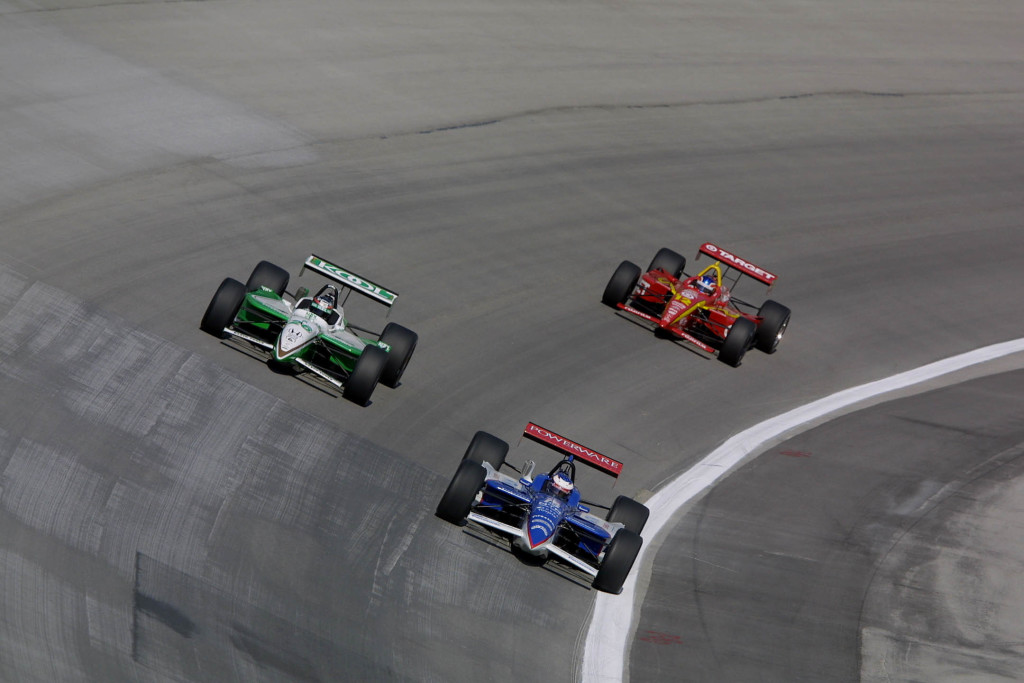
The complexity of the issue facing CART officials was illustrated by the mix of symptoms – or lack of them – encountered by the drivers. Phil Abbott/Motorsport Images
The problem was far from linear. Some drivers were heavily affected by the extreme Gs while others were asymptomatic. It would eventually make achieving a consensus among drivers on how to proceed with the event more challenging than anyone desired.
Kenny Brack: I didn't experience any problems. But I know many other drivers did.
Scott Dixon: I never experienced any of the issues. I never had any of the dizziness or the blacking out.
Max Papis: driver, Team Rahal: It was badass to drive around at 230. I just felt amazing. I loved every lap I did. I loved the feeling of getting squashed in the car vertically, laterally.... If you ask me, I didn't know it was too much for my body, but I was one of the most fit drivers as well. Did it feel weird? Yes, but I guess that it was more weird for other people.
Chris Kneifel, chief steward: When you have a car fly up into the air, that's pretty obvious, right? That's something that is plain to see what we were dealing with. This was something that was an invisible monster, and it was something that was every little bit different to the individual. So it wasn't that you could say it would be in a minute for this guy. This guy's good for five minutes of running, or 10, or maybe it doesn't even happen to this guy but, sooner or later, almost everyone's going to have a problem. And you start to realize how large the magnitude of the situation was.
And the thing was the crashes. It's not that crashes don't happen. Obviously they do. But it was the fact that you look at the data and it's not like the car got loose. It's not like he hit a bump; you look at the steering trace, everything was perfect.
So what happened? The unexplained was happening. It was hard to comprehend, to really get your head around what was going on. But when you take that and you couple it with the fact that the cars were almost doing three laps a minute, it’s just massive, massive speeds we hadn’t seen like that before.
It really boiled down to the human element and so many of the drivers who I had face-to-face conversations with, I could tell by just looking in their eyes. They didn't have to say a word. You could just see it. You knew something was different. And that group of drivers was as upper echelon as there ever was.
Dr. Steven Olvey: I got with Wally and Joe and said, "Guys, we can't run here at these speeds." And they said, "What do you mean?" And I went over it all and I had Richard there talk to him and he said, "You can't keep doing this. It's physiologically possible. You'd have guys blacking out and crashing right and left and it could be a disaster."
Brack, the first CART driver to test at TMS, earned pole position with a 233.447mph performance. Patrick Carpentier, illness notwithstanding, was able to muster enough speed to start second with a 233.345mph blast. And Oriol Servia, driving for the small, upstart Sigma Autosport outfit, was a surprising third at 232.978mph.
All totaled, 21 of the 25 drivers registered laps above 228mph during their short qualifying runs, which soon became a number that was an important piece of the puzzle.
Wally Dallenbach: The threshold that was created at that racetrack with the banking was about 228mph. And up until that speed, it seemed like you could deal with the Gs, but once you got going past 228, people were coming in and not knowing what they were doing. There was the ongoing threat of, are we going too fast here for the body and the brain?
I got together with our doctors and they concluded that this was happening and that the only way to prevent something like was to either slow the cars down, or to wear G suits, and I said we're not going to do that. But they explained that apparently in the medical terms, blood was running away from the brain in this situation -- it was typical of what happens to jet fighters, and that’s why they wear the G suits.
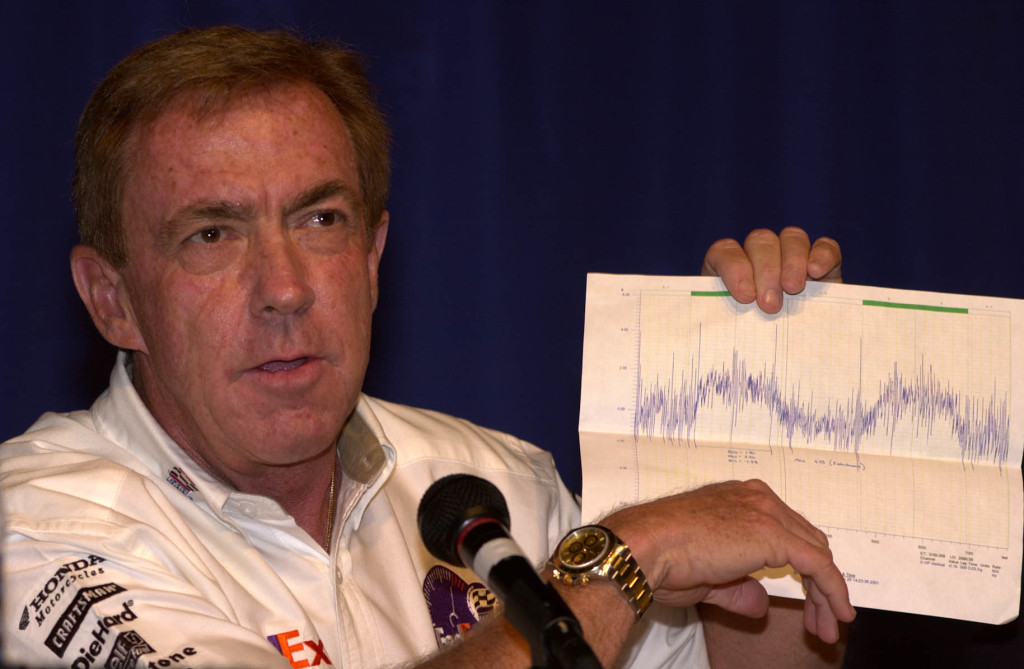
CART Medical Director Dr. Steven Olvey shows a chart with a driver's G-force loading data, illustrating the unusual loads being placed on the drivers at TMS. Michael Levitt/Motorsport Images
Helio Castroneves: First of all, our cars back then, we're talking about 900 horsepower, right? There was no playing around. When you leave the pits, those cars are so strong that you're afraid to touch the throttle. And a place like Texas with huge banking… back then, it wasn't very common to be on huge banking. So we go out, as soon as you get to the banking and you start pushing the throttle a little bit more, a little bit more, little bit more, and things are happening so fast that you don't know what's happening.
All of a sudden, you're just the passenger when you first go flat-out. You’re like, holy crap. And there it was -- we were doing 230, 235 with the draft. Then we start getting confident, comfortable for that top speed. So you start taking wing out to go faster. And that's where the scary part was. You start taking downforce out of the car, and you don't feel anything. It was absolutely stuck. It is just going faster, faster. You’re like, "Oh man, this is tough. This is really tough."
Tom German: race engineer, Gil de Ferran, Team Penske: There's three key points. There's the sustained G loading through the corner. I spent some time on this after the race, reading some of the flight research papers to understand what tests have been done on what fighter pilots do, and what actual data is available on the physical side of this problem.
In a fighter jet, when they talk about the high G loadings, they're almost exclusively talking about vertical Gs relative to the body. It's pulling blood from your brain, down your torso into your legs. So the G suits squeeze your legs, squeeze your torso; all those things are to counteract that migration of blood down out of your brain. And the G loading at Texas is a combination of lateral G loading and vertical G loading. That's the real problem. Nine Gs in an airplane, the fighter pilots see it for a couple seconds, and then they're fine. But they never see it for a couple minutes.
So the first key point is the sustained G loadings through the corners. And perhaps the more important one that gets largely overlooked was the recovery time. At Texas, you have very short recovery times. You're going so fast on the straightaways, loaded up through the corners, you release a little bit down the backstraight, loaded again, the front straight still has a decent amount of G loading on as you're going around there. Your body really doesn't get the chance to recover. So the length of a run becomes a significant factor here.
And if you took some of these research graphs on pilots, they have a chart of "Gs versus time," and there’s a shape to the curve of what’s acceptable and what’s not. The chart shows how the body can take super-high G loads if it’s sustained for a very short period of time. But as your "time sustained" goes up, the body’s G threshold comes down dramatically. And so that, combined with not being able to recover, is what we were seeing in Texas. It was everything the research papers said you should not be doing to the human body.
The culprit had been found. And it was unlike anything TMS or select CART officials expected.
Thrust into an emergency, and with a race to run in front of 60,000 fans in 24 hours, clowns and heroes would begin to emerge behind closed doors as the Saturday evening sun fell behind the grandstands.
Look for the final installment of this series tomorrow.
Presented by:

Marshall Pruett
The 2026 season marks Marshall Pruett's 40th year working in the sport. In his role today for RACER, Pruett covers open-wheel and sports car racing as a writer, reporter, photographer, and filmmaker. In his previous career, he served as a mechanic, engineer, and team manager in a variety of series, including IndyCar, IMSA, and World Challenge.
Read Marshall Pruett's articles
Latest News
Comments
Comments are disabled until you accept Social Networking Cookies. Update cookie preferences
If the dialog doesn't appear, ad-blockers are often the cause; try disabling yours or see our Social Features Support.