Motorsport Images
Inside CART's 2001 Texas debacle: The lead-up
The rookie driver from France didn’t know what to expect from American oval racing.
Part of Target Chip Ganassi Racing’s 2001 changeover from Juan Pablo Montoya and Jimmy Vasser, Nic Minassian had mastered road racing during his pursuit of a Formula 1 career. But when it came to lapping at more than 230mph at Texas Motor Speedway when CART made its inaugural visit to the 1.5-mile oval, Minassian was a neophyte. It made TCGR’s brave and aggressive new hope the perfect foil for all that would take place during one of CART’s most notorious failures.
Stunned by all he encountered on his oval debut, Minassian lacked the experience to know he’d been thrown into a most unusual mechanical tornado. As cars whipped around at blood-draining speeds, most drivers fought the effects of spinning in the world’s fastest washing machine. One driver, overcome by the relentless cornering and gravity’s extreme pull, was briefly lulled to sleep, waking with an urgent need to turn left at 235mph.
“You felt like your face was being pulled out of your helmet in the corners,” Minassian says.
By the time the chapter was closed 20 years ago on the ill-fated Firestone Firehawk 600, law suits had been filed, lifelong grudges were formed, and an indelible stain was left on the sport.
In a three-part series, RACER looks back at what happened when the world’s fastest open-wheel cars went to the wrong track, as told by 12 people who were there.
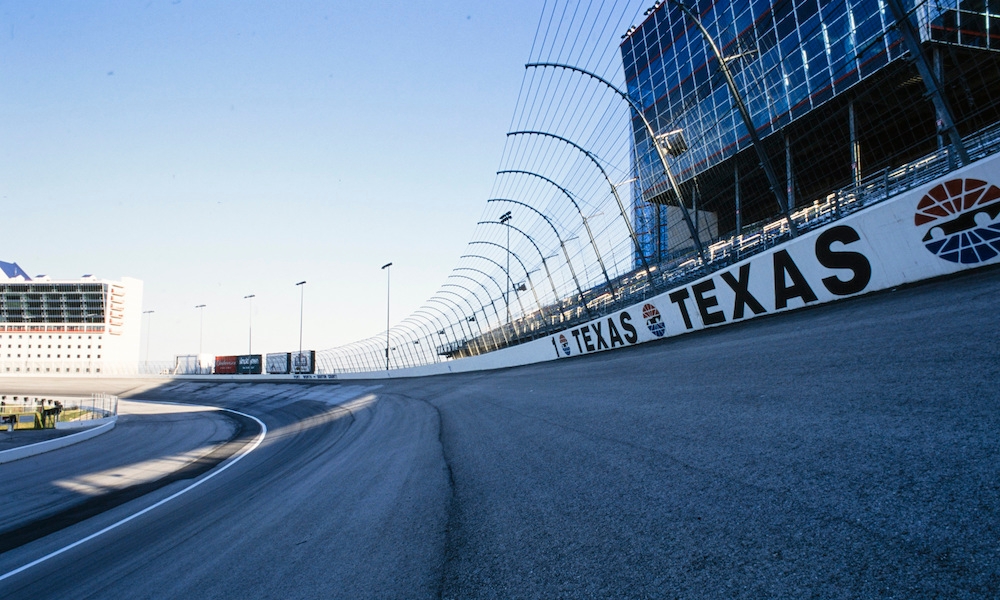
Ready for action in 1997, Texas Motor Speedway launched its inaugural season by playing host to a NASCAR event in April and the brand-new Indy Racing League in June. Massive grandstands packed with fans affirmed the decision by parent company Speedway Motorsports Incorporated to plant its flag in Texas with a big, fast bullring featuring significant banking in the corners. NASCAR and the IRL would become the main attractions at TMS through 2000.
Mike Zizzo, CART VP of Communications 1996-2002, Texas Motor Speedway VP of Communications 2005-2019: There was a ton of excitement considering that we were going to a great facility like that that was fairly new, and you had a great promoter with Eddie Gossage in terms of taking a new event and putting it on a big stage. Dallas-Fort Worth was really booming at the time; it had become a top five market, and that’s why it jumped out as a place CART should look into for a race at Texas Motor Speedway.
Negotiations between CART and TMS opened during the summer of 2000, and CART’s board of directors approved its addition to the 2001 schedule. An event date of April 27-29 was eventually chosen, making TMS the fourth stop on the calendar after opening at Mexico on March 11, moving to Brazil to race on March 25, and Long Beach on April 8.
Chris Kneifel, IndyCar, Sports Car Driver, CART Chief Steward and Director of Competition 2001-2005: I remember when the contract was signed between Texas Speedway and CART, I thought, ‘Oh, that's odd.’ It didn't seem to be the best fit. It had been an IRL race up until then. I guess they were going to have both in the calendar year of 2001, but I thought that was strange. And then I thought a little bit more about it. At the time Bobby Rahal was the interim president of CART and Eddie Gossage was obviously the head of the Texas Speedway, and Bobby and Eddie's relationship goes well back to the Miller days in CART. So (through) he and Eddie's relationship, they were able to make something happen.
Despite the vast technological and performance-related differences between the IRL and CART formulas, the last IRL race of 2000, held over October 13-15 at TMS, gave a glimpse of where the low-tech, all-oval series registered at the track with Greg Ray’s run to pole at 215.352mph in his Team Menard Dallara-Oldsmobile.
Six days before Christmas, Rahal’s CART team ventured south to a frosty Texas where Kenny Brack, an IRL veteran and Indy 500 winner with five TMS starts before moving to its rival series, performed a test that would set the benchmark in his Reynard-Ford/Cosworth for CART’s maiden race on the oval. A number of errors in CART’s approach to preparing itself for TMS followed.
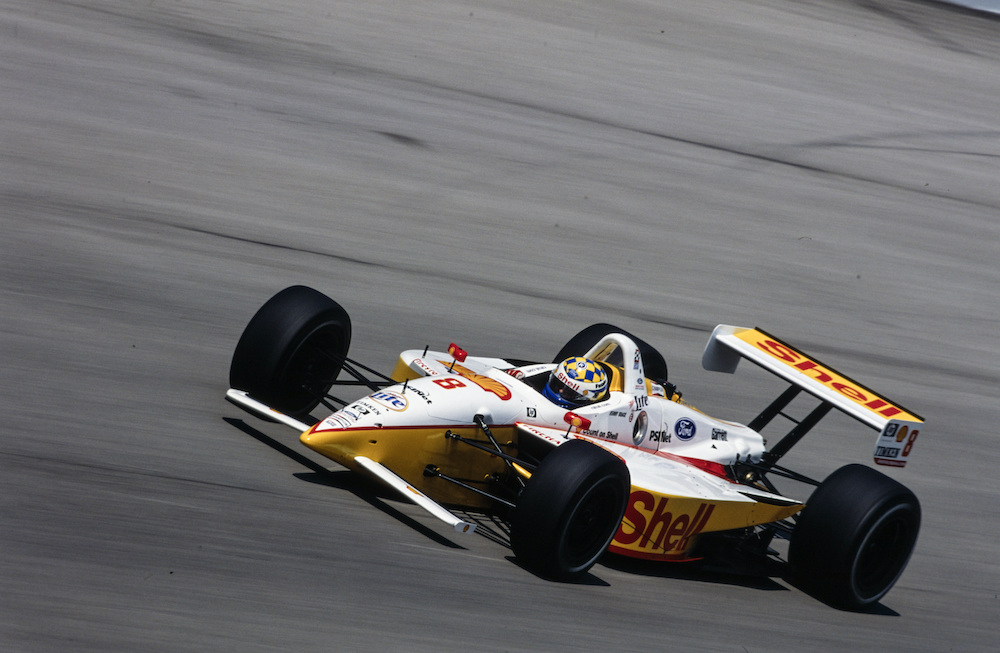
CART's call on TMS's viability was based on a single-car test involving Kenny Brack, in very different conditions to what the field faced when it returned for the race. Motorsport Images
Mike Zizzo: From a competition perspective, we had that one test with Kenny and he only ran high teens, low 220s.
Kenny Brack: We tested there in the wintertime and it felt OK with the level of speeds. It was really windy, and we did not run quali downforce nor a qualifying engine.
Robin Miller: The only test they did was with Rahal and Kenny Brack before signing off on it. And the temperature was nothing compared to when they’d race; it was real cool. And they didn’t do a lot of laps. They didn't give it much of a chance.
Kenny Brack: I remember [name withheld] coming down and asked me how it felt, and I said ‘It’s very windy.’ He said ‘Well, it’s the same for everybody.’ It was, but I was the only one testing…
Mike Zizzo: There were no concerns at all when he ran that test, but it was a limited test. We never ran a full-field test. I know that I was pushing forward selfishly from a PR perspective, and on the track side they wanted to do it as well, because we thought it would be a great preview of what was in store for the fans in Dallas-Fort Worth in terms of what CART was all about. We never got that done.
The first divide on the topic of CART and TMS did not emerge between the series and track: an internal fight developed when CART’s competition department wanted to keep its high-tech, high-speed machines well clear of the oval.
Despite setting a fastest lap in the 221mph range – little more than 6mph faster than Ray’s recent IRL pole – there was no question whether the CART cars, in more representative track conditions, could lap at significantly faster average speeds. Weather records show a high of 46F in Dallas-Forth Worth during Brack’s December 19 test. The same records reveal CART’s opening day of practice at TMS on April 27 was almost double the number, reaching a peak of 81F.
CART’s board, comprised of team owners and executives, listened to the concerns of former Indy car racer Wally Dallenbach, its chief steward of more than 20 years who would groom the incoming Kneifel as his replacement in 2001. Dallenbach’s objections were overruled.
Robin Miller: I remember Wally saying, ‘I just don't know that our cars can run here; I just think they're going to go too fast.’ I remember that like it was yesterday.
Chris Kneifel: Fast-forward however many months later, now I'm chief steward of CART and I mean, I'm barely one month on the job, and I've never been to Texas Speedway before. After the Monterrey, Mexico race (on March 11), we went for a site visit, and I was there with Wally Dallenbach, [CART Logistics VP] Billy Kamphousen, [CART Director of Safety] Lon Bromley, and a few others. I remember going around and Eddie Gossage had all of the big blacked-out Suburbans touring the track, and the first thing that caught my eye was the vertical fence posts were outside the fence, which I thought it was wrong. They were on the track side. The posts were on the track side of the fence.
Kneifel’s concerns about the exposed steel poles atop the outer walls would soon prove to be well-founded, but his series wouldn’t bear the scars. During additional private tests conducted at TMS by CART teams prior to the race, and the running on Friday and Saturday at the event, drivers who crashed were fortunate to avoid climbing the walls and hitting them.
Chris Kneifel: I asked to stop the Suburban, I walked up the incredibly steep banking and I'm thinking, ‘Holy crap, I can't believe that this is the way it is. Obviously this isn't going to change any time soon.’ I had some concerns just with the fence.
Just over one month later, those fears were validated at the Texas IRL race. Riding over the back of a car that blew its engine between Turns 1 and 2, Sam Schmidt Motorsports driver Davey Hamilton’s Dallara-Oldsmobile struck a pole on the exit of Turn 2 while flying sideways, cleaving the front of the tub off near his knees. The Idahoan's feet and bones in his lower extremities were pulverized.
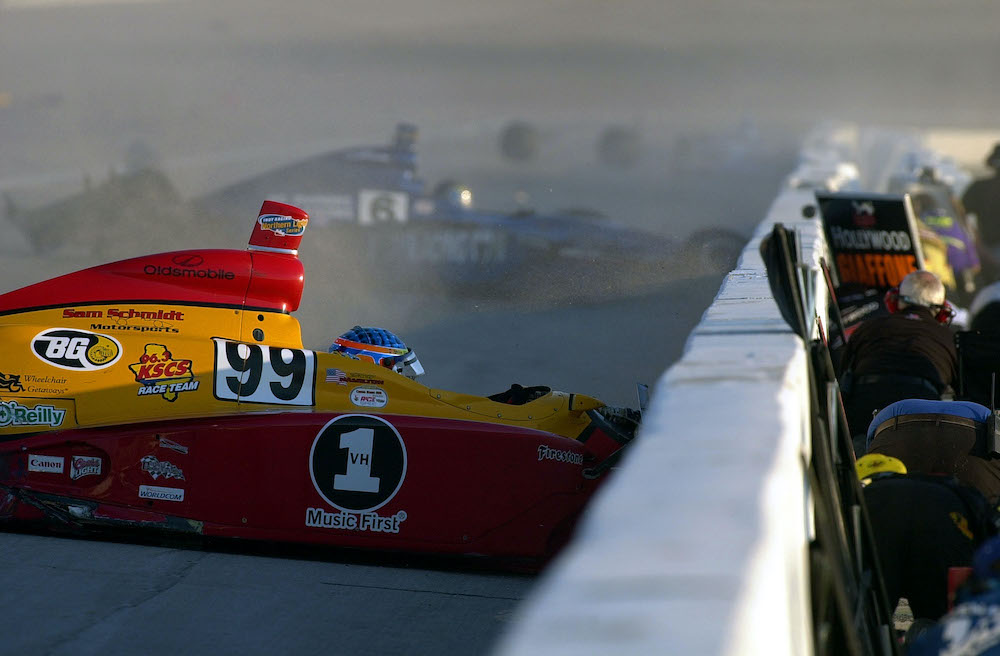
Kneifel's fears about the Texas fences were validated when Davey Hamilton suffered leg injuries in an IRL crash at the track shortly after CART's initial inspection. Motorsport Images
Adding to Dallenbach’s protests, warnings from a few CART drivers who took part in the early 2001 tests were met with no intent to change the series’ plan to race at TMS. Average speeds crept to the 225-226mph range for some who tested using the performance specifications outlined by CART for the upcoming event. Along with Ford/Cosworth, Honda and Toyota poured untold millions into their 2.65-liter turbocharged V8 engine programs each season. Easily eclipsing anything the 700hp naturally-aspirated IRL V8 motors could make during that period, one of the CART engine builders estimates a safe 900hp being on tap for its drivers while spinning to peak RPMs of 15,800 at Texas.
CART’s chassis and aerodynamic formula offered further performance advantages, as the cars manufactured by Lola and Reynard made prodigious downforce even in oval trim. The series attempted to slow the cars by mandating the use of the Hanford Device, a vertical plate mounted to the back of the rear wings that acted like a small parachute for a leading car while opening a large hole in the air for trailing cars to zoom past on longer straights.
From Brack’s unrepresentative test in mismatched ambient conditions, to the ignoring of pleas from others who tested, went faster, and were convinced the ferocious speeds were not a good match for the track, to forming the event’s technical regulations without a wider sampling of cars and data, multiple warning signs were missed.
Chris Kneifel: We're up in race control, and high atop in the ovals you're typically perched above the grandstands and could see the full track. As the first practice started and cars were pulling out, I thought to myself, ‘Holy crap, it's hard to watch these cars.’ You're trying to follow one car and it's hard to even focus just doing that. To think that they're basically out there doing three laps in a minute is nuts in itself. We’re talking 22-23 second per lap. On a oval that’s 1.5 miles. So they’re covering almost 4.5 miles in a minute. Think about that one. The speeds are massively high, and they're just getting faster and faster and faster.
Looking down on pit lane, Kneifel and the other members of race control began to see and hear the first evidence of a problem.
Chris Kneifel: We started hearing little dribbles of information coming over the radios from the pit lane about a driver got out of his car after a 10-lap run and lost his balance, seemed to not have his equilibrium. We saw things where drivers entered the pit lane and missed their pit box – disoriented enough that they didn't see where they were supposed to turn into their pit box. And so it was mounting.
Mo Nunn Racing’s Tony Kanaan topped the session with a lap of 233.539mph. Although Ray’s IRL pole was set on his own, and the fastest CART drivers had the benefit of aerodynamic tows on that Friday morning, it was hard to ignore the 18.187mph difference.
As the first session came to an end, a series of bizarre episodes were witnessed as drivers began climbing from their cars. Forsythe Racing’s Patrick Carpentier, dealing with the flu, vomited on pit lane. In the moment, it was assumed his illness was the cause.
Oriol Servia: driver, Sigma Autosport: There was something, a force, a speed that I just could not get used to.
Nic Minassian: At first, it felt like what was happening was normal. I felt that physically, I couldn't do it, rather than the car was too much for that track. Because I was a rookie, I felt like I was not able to say anything in the car because it wasn't right for a rookie to say that he's not able to do what he's been told to do.
I remember feeling the force in the car. Your head was being pulled off and your mouth was deformed. It was really something else. Those cars were like monsters. Then there is this thing that you don't usually have when you feel sick. But I wasn't sick. It's just the speed that made me sick, and that you cannot really control it. All you tell yourself is like, ‘Is it me? Is it normal?' So you push yourself. You dig a bit deeper. You say, "OK, I've got to job to do. I've got to do it and I'm a rookie. If I don't, I look stupid.’ That's how silly it was in my head.
Oriol Servia: I remember, and this is before even feeling dizzy or anything, just being on track, during practice, you would feel the Gs and all that, but this was first time that a guy would slow to go to the pits and everything was a close call. You couldn’t react fast enough. For some reason, the brain – at least mine – was not processing fast enough to adjust to what was coming at me at that speed.
Then we realized it wasn't the actual speed of going 230 average at Texas; it was like the brain was not getting enough juice to process normally. Honestly, I remember like if it was today. I was trying to look up far ahead like I always do on ovals, and I still didn't have enough time to anticipate what was happening. The brain wasn't just processing it. That was the bottom line. When we started doing longer runs, we all realized that there was something really wrong.
I didn't really get dizzy while driving, but the second I would come into the pits, the world was all of a sudden spinning around and you had to breathe hard to regain yourself, like almost when you feel like your blood sugar is low and you have to sit down and breathe to get control of yourself.
Helio Castroneves: driver, Team Penske: After the first session, I was like, man, I'm kind of dizzy. There was a lot of doubt in my mind at that moment.
The second and final practice session got underway on Friday, and it’s here where every person interviewed cited the same event that shook the CART paddock.
Chris Kneifel: The one that caught everyone's attention was Gugelmin.
Dr. Steven Olvey: We had two big crashes that weekend. The first one was Mauricio Gugelmin and the other was Cristiano da Matta. They were two crashes that nobody understood. The drivers had no idea. When you looked at the video, they weren't in any trouble. And when the mechanics looked at the cars, there was nothing that broke on the car, like a wheel rim or a shock or anything. And they both crashed.
Mauricio was really lucky. His crash was really severe. Mauricio could have been hurt badly, but he just lucked out where he hit the wall. The car was pretty substantial, and Mauricio is pretty substantial, so he got through the thing without being hurt, but it could have been real bad. He was 66 Gs at the first hit in Turn 2 and then went all the way down to the third turn and hit the wall again at 113 Gs. The reason why Gugelmin crashed was a mystery to everybody; we hadn't figured out why.
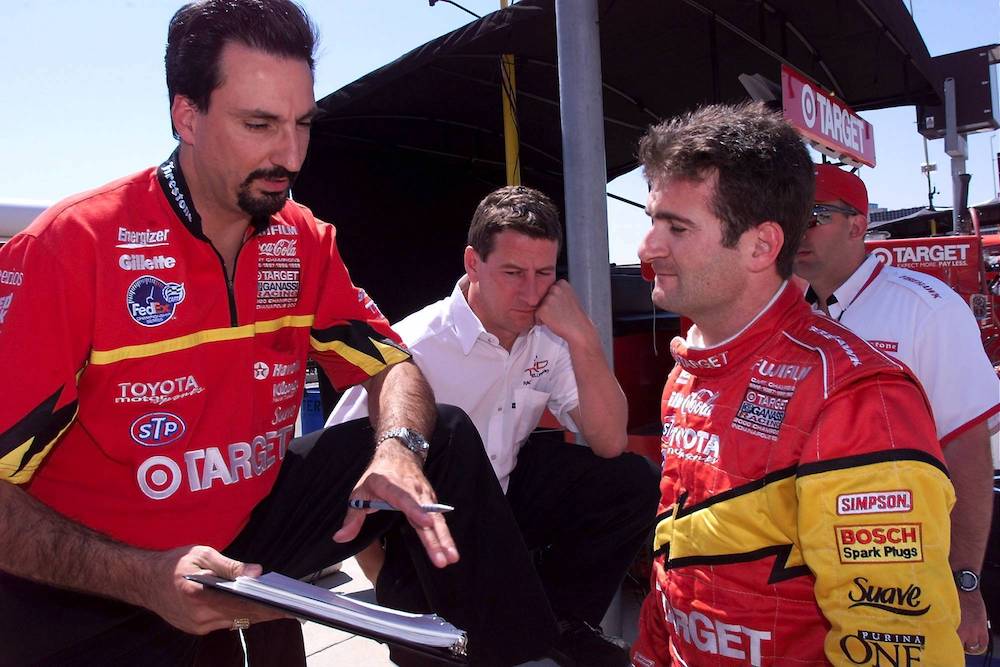
As an oval novice, Minassian initially thought that the sensations he was struggling with simply came with the territory. Motorsport Images
Robin Miller: I was standing right there on the inside when he crashed and it was like nothing I’d ever heard. It kept going on and on. It was a crash for the ages. Olvey and [Dr. Terry] Trammel jumped over the fence and here's this car; I don't think it had any wheels left on it. And Gugelmin, the first thing he said to Olvey and Trammel was, ‘I tried to get this thing as close to you guys as I could!’
To have that presence of mind... I mean, he was ****ing bruised. It didn't break anything, but it bruised him from head to toe. And then da Matta’s crash was almost as spectacular. You were just like, ‘Holy ****ing cow. The thing never stopped crashing.’
Helio Castroneves: I was on track at the time and saw the marks from the crash at Turn 2, and he was like a pinball crashing back and forth down the track and the marks kept going.
Scott Dixon: driver, Pacwest Racing: Probably the strongest memory I have is going and seeing my teammate Mo Gugelmin that night in the hospital. He was already black and blue.
Chris Kneifel: He lost control of his car in the middle of Turn 2 and ended up three-quarters of a mile away by pit entrance. Wally Dallenbach always called Speedway crashes ‘quarter-milers.’ So you had a crash at Indy, you crash at Michigan, crash at California Speedway, he called them ‘quarter-milers’ because that’s how far it would be from where the guy crashed to where he came to a stop. Well, with Gugelmin, this was a ‘three-quarter-miler,' just to put a little context on it. Unbelievable.
And just the ferociousness and the power, the speed of it. He had some very large high-G impacts, all of them just ricocheted him and kicked him down the road further. So the fact that he literally had a body full of bruises, but no other significant injuries, that was certainly a blessing. But the guy had three enormous crashes all in one.
The crash broke the front of Gugelmin's Reynard chassis away from the car, exposing his feet. As Dr. Olvey recounts in his book Rapid Response, stopping short of the infield wall at Turn 4 saved his lower legs from being damaged. But the visuals of the enormous crash stunned many of his fellow drivers. Gulgelmin did not take part in the rest of the event.
After the second session reached the checkered flag, more drivers gathered privately to compare notes on their experiences behind the steering wheel.
Scott Dixon: I remember the intensity of seeing some of the looks on some the older guy's faces, like why this was just stupid. I remember looking at some of their reactions and I'm like, ‘****, this is not good.’ But I was just waiting for the team to tell me what to do. I was 20 or 21, and not very smart.
Helio Castroneves: I remember hearing Patrick Carpentier saying he kind of blacked out, and a lot of people saying ‘I don't know what happened. I don't know what happened.’
Oriol Servia: As a race car driver, nine times out of 10 fans ask you, ‘How does it feel to go so fast?’ And usually, it's the same answer. ‘Yeah, it's fast, but you get used to it right away, you've been doing it all your life, etc.’ Plus, even when I talked about the fastest I've ever been in a car, it was at Fontana in 2002 in a race. I hit a top speed of 257mph. So when I talk about that, and people ask me how it feels, I always say, ‘Well, funny enough, it feels slow because every movement at that speed is like being in a plane. It's very slow. Your hands move very slowly, the car reacts very slowly, you set up for the corner, and it turns.’ Even when you're fighting another car at that speed, maybe you were passing a guy that is 256, so it's a 1mph difference. Everything happens slow, right?
When you lose control is when you realize the speed and how fast the wall comes to you. Driving normally, speed is really not a factor in our minds. It really is not. You're used to it. Texas was the first time that I felt different.
Look for the second installment of this series tomorrow
Marshall Pruett
The 2026 season marks Marshall Pruett's 40th year working in the sport. In his role today for RACER, Pruett covers open-wheel and sports car racing as a writer, reporter, photographer, and filmmaker. In his previous career, he served as a mechanic, engineer, and team manager in a variety of series, including IndyCar, IMSA, and World Challenge.
Read Marshall Pruett's articles
Latest News
Comments
Comments are disabled until you accept Social Networking Cookies. Update cookie preferences
If the dialog doesn't appear, ad-blockers are often the cause; try disabling yours or see our Social Features Support.