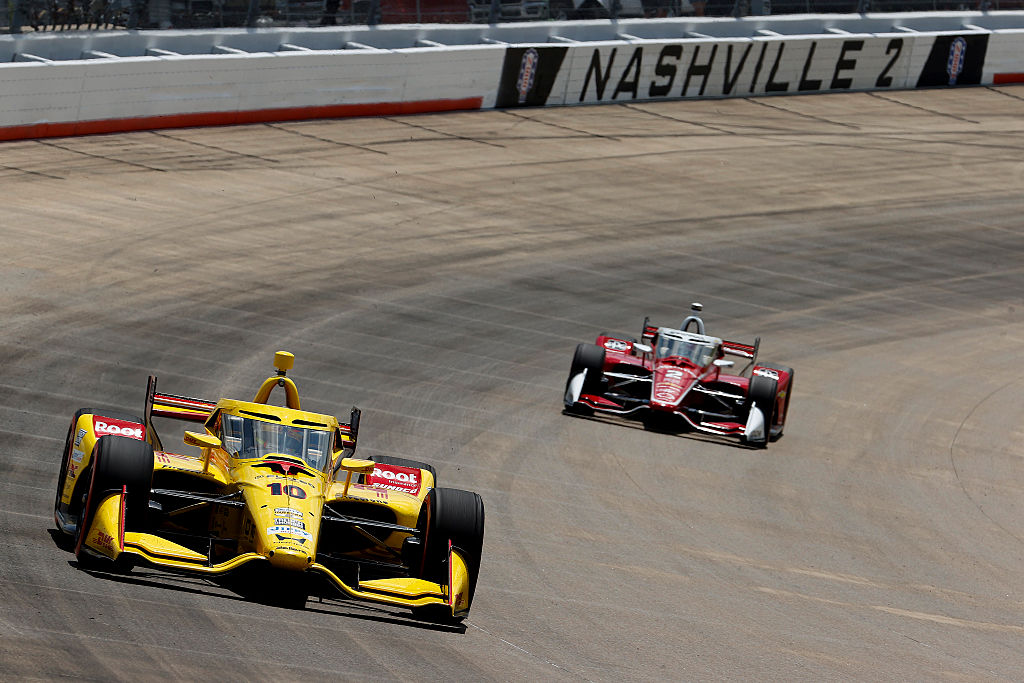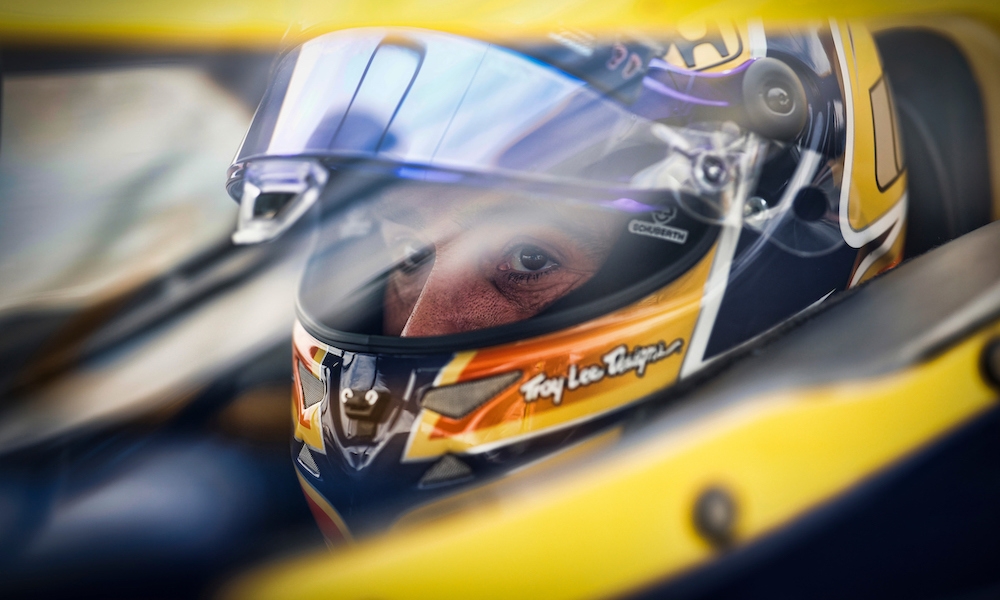
Michael Levitt/Lumen Digital
INSIGHT: Jimmie Johnson hits reset
Dario Franchitti was standing on the hill overlooking WeatherTech Raceway Laguna Seca’s Turn 4 as his student came into view.
The four-time IndyCar champion locked onto the No. 48 Honda and tracked its forward movement as Jimmie Johnson flicked through the gears and approached the sweeping right-hander. Peering down, the Scot was searching for where Johnson would place the car on entry to Turn 4, all while listening to discern the point where his 45-year-old understudy would lift leading into a corner that isn’t taken at full throttle.
With a long straight leading to Turn 5 waiting on the other side, getting it right at Turn 4 is an important part of each lap. Any mistakes get paid for with a slower run down the straight, and that’s where Johnson’s progress in early February was being judged.
Franchitti was mostly pleased with the outcome on that lap, noting how his charge was building confidence by carrying speed farther into the turn, and using more authority on the way out, hammering the throttle as he continued to feed steering input into the car. Once through Turn 4, it was obvious to the eyes and ears that Johnson’s pauses between applications of speed were growing shorter.
Three months prior, on Johnson’s testing debut at Laguna Seca, the inaction was just as easy to spot. Through the infield turns, his corner-entry lifts came earlier. They were followed by prolonged coasting in the turns and waiting for the car to be pointed mostly straight before returning to the throttle. Both acts conspired against his lap times and spoke to a fundamental lack of confidence. The seven-time NASCAR champion was at the base of tall mountain to climb.
On his February return to Monterey, the driver from November was nearly unrecognizable, and that’s by design. Franchitti has been instrumental in helping all of CGR’s drivers since retiring at the end of 2013. But Johnson’s transformation into an IndyCar road course racer is an altogether different project.
TAKING TURNS
Johnson’s journey is centered on becoming the best IndyCar driver possible, but the collaboration with Franchitti brings a secondary theme into play, and in the three-time Indy 500 winner's case, it involves repaying a favor from back in the day.
At the end of 2007, the new IndyCar Series champion and first-time Indy 500 winner decided it was time to reinvent himself as Chip Ganassi Racing’s newest NASCAR driver. Franchitti had a pal waiting to lend support as Hendrick Motorsports’ back-to-back champion Jimmie Johnson offered whatever help he could to the open-wheeler who wanted to become a stock car driver.
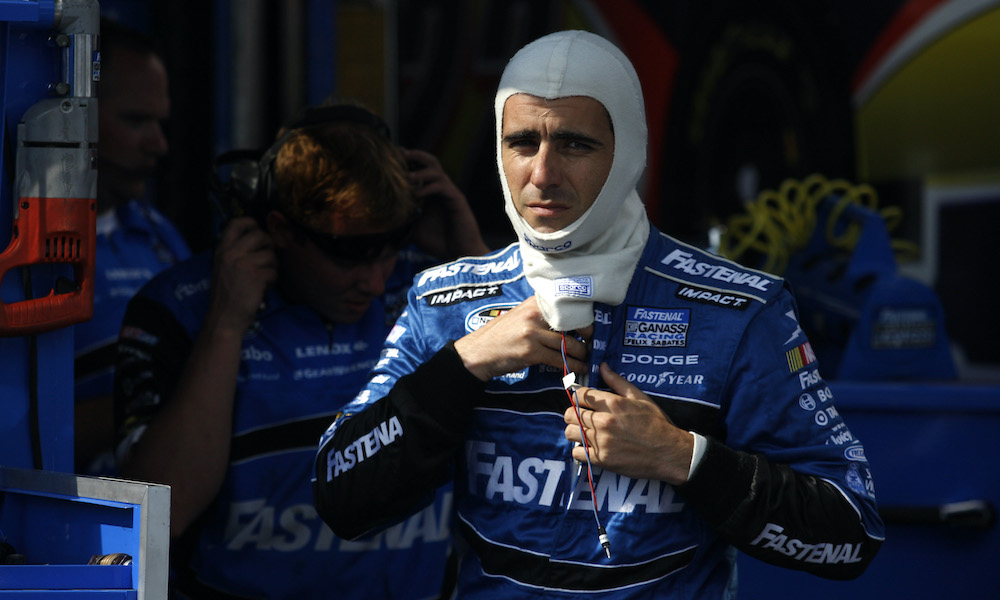
When Dario Franchitti moved to NASCAR in 2008, Johnson was quick to offer advice and support. Fast-forward to now, and those roles have reversed. Motorsport Images
“When he came to NASCAR, I was so excited for him,” Johnson tells RACER. “I know he had a couple of big crashes in IndyCar and he was very excited to have a look on the ovals. And I know he was excited to have a roll cage above his head. Honestly, I just tried to help. I was, of course, also busy doing my thing.
“He is very well-versed in vehicle dynamics and understanding what's going on. He was trying to connect the sensations he was used to, and find a common ground between NASCAR and IndyCar and how to identify those sensations. How to use them to his advantage. How to adjust the car. And here we are, all this time later, and that’s exactly what I’m trying to do, but in the opposite direction, and Dario’s here helping me connect the same dots.”
Franchitti’s humbling experiences during that abbreviated 2008 Sprint Cup season have helped the two to connect on a deeper level. As he said at the time, getting the most out of a Cup car on an oval required forgetting almost everything he’d learned in IndyCar.
“The feeling that he had for those type of Cup cars, at that point, I didn't really possess,” Franchitti says. “It was funny, because when we spoke really in depth about driving styles and what he did in a Cup car, and what was the fast style, he would say, ‘You need to do this, and when it does that, you need do this other thing.’ And I’d go, ‘Mate…I have no idea what you're talking about.’
Taking a page from his IndyCar mentor, Johnson’s been busy jettisoning the knowledge he amassed in NASCAR to benefit his open-wheel conversion.
“At one of his early IndyCar tests where you could see all the things that make him special in NASCAR, I turned around and said, ‘Well, now I know why I was so **** in a Cup car!’" says Franchitti. "We had a good laugh about it because it's such a different style over there.”
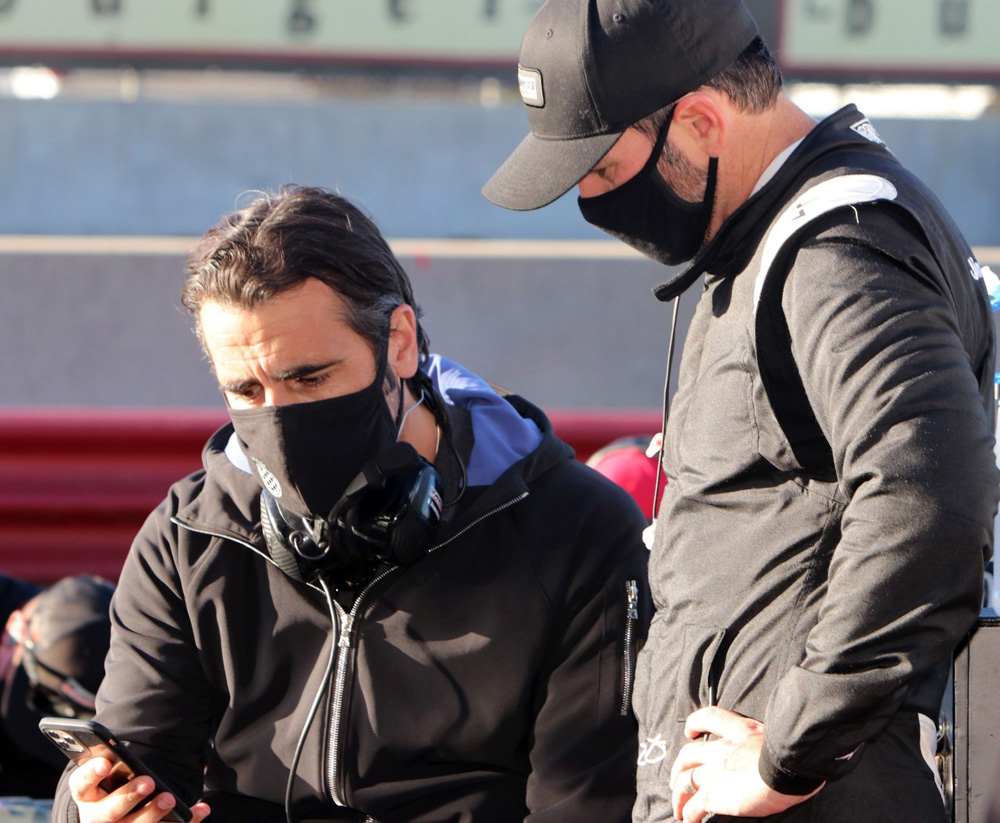
Franchitti (left) and Johnson crunch the numbers during testing. Image by Marshall Pruett
So far, the changeover process has been everything Johnson was hoping for with CGR.
“It's just the best fit for me to have the environment I need,” he says. “To relax, to hear honest feedback, and for me to give honest opinions and honest reads on what I'm experiencing so that I can cover as much ground in a short period of time. Dario is fully vested in me, and so is the team in trying to help me. They understand how critical that role is, and are really giving him the tools that he needs to do the job.
“Ultimately, I still have the hunger to learn. That's what makes this so exciting right now, is that I'm just learning so much. And also the experience of this car. It is the most intense and aggressive vehicle I've ever driven. As a guy who likes to go fast, that's just damn fun. Like there is nothing else. Even the Formula 1 car I tested was more tame than this animal. This thing is so raw and so violent that you feel like, ‘I'm being a race car driver right now!’ It’s all I've ever wanted to do.”
BACK TO SCHOOL
With their roles reversed, Franchitti has focused his energies on turning Johnson’s 20-plus years of Cup sensibilities into the style needed to excel across IndyCar's road and street courses races.
Where the Cup car’s high weight and lack of downforce befuddled Franchitti, Johnson’s challenge is coming to terms with the opposite dynamics. Encyclopedic knowledge gained while herding stock cars around ovals won’t help in a light and powerful Dallara DW12-Honda that buries its Firestone tires into the ground with nearly 5000 pounds of downforce.
“So with Jimmie, we formed these different plans, where were we going to go testing, what's going to happen. Then we talk about the big things and then we sort of focused down onto the more the minutia,” Franchitti says.
“We realized with IndyCar’s limited testing, we had to get him on track more often, so we got a F4 deal together. And then he’s been doing prototypes in IMSA, so it’s the repetitions that have really mattered. Every time he gets in the car, we've narrowed that focus down to finding smaller and smaller things, and he's gotten closer and closer to the ultimate pace by doing it.
“Then we do a debrief after every test, and then another with his race engineer Eric Cowden, who's been just an absolute gem in this program. He's been so good for Jimmie because he's just so patient and the way he explains a situation; there's just no ego with Eric. He's bloody amazing. So we have those chats about, ‘OK, this is what happened last time here, what do we need to learn this time?’”
Trips to the site of this weekend’s season-opening IndyCar race at Barber Motorsports Park, and a pair of trips to Laguna Seca, where the penultimate round will be held in September, proved to be extraordinarily valuable for Johnson.
“With this new surface that they've put down in Barber, it's a massive commitment track,” Franchitti says. “He went right at it at that last test; then we went to Laguna, and it’s night and day difference where the car’s sliding around the whole time. The track surface there is older than me! And he's got to learn how an IndyCar deals with places with lots of grip and also with no grip.
“You've got to bear in mind that in a stock car, the tires have got those big sidewalls and there's a lot of movement in the sidewalls, a lot of movement in the rear suspension. And the IndyCar doesn't have those soft and squishy things. So he’s getting used to the signals that the IndyCar is giving him, and interpreting those signals correctly. But don’t forget the car is talking to him one way at Barber and in a totally different way at Laguna. It’s not one thing to learn; it’s new variables at every track he goes.”
ALWAYS ON
As Johnson’s IndyCar knowledge base continues to grow, Franchitti has become accustomed to keeping both of his phones charged and ready for incoming calls at odd hours.
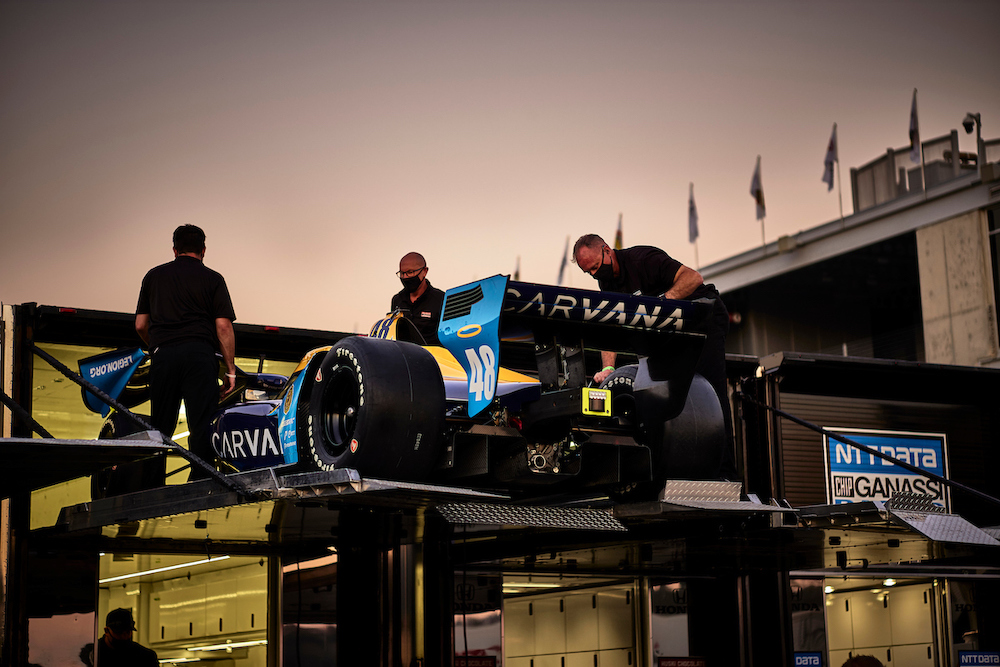
There will be a time when the No.48 comes off the truck ready to fight among the top 10, but for now, the mission is simply to flatten Johnson's IndyCar learning curve. Levitt/Lumen
“I’ll be somewhere in Europe, and he’ll phone me at 10 o'clock in the morning – my time,” he says. "I'm like, ‘Jimmie, it's 5:00 a.m. your time… go to bed,’ and he’ll go, ‘Yeah, I couldn't sleep, so I'm in the gym. Can we talk about…’ He wants to know everything about the car. And then we have these long conversations about ‘What does a race weekend look like?’
“He's used to a NASCAR race weekend and the flow of, ‘When do you get there? Where should we stay? How do the meetings happen? When do we do the track walks? What can I expect from session to session with the track evolution?’
“In NASCAR, when the track rubbers in, you want to go where the rubber isn’t. 'The Goodyear tires don't like rubber.’ I'm like, ‘Ooh, but the Firestones love rubber, mate. You're going to get an extra set as a rookie. You're going to go out first, you're going to sweep the track, and you're going to be on a different plan in learning where your tires are happiest out there.’ And he soaks it all up, whatever hour it is.”
KEEP WRITING
During his IndyCar training regimen, Johnson has picked up on of the many things Franchitti was known for throughout his driving career.
“In NASCAR, I could see Dario’s work ethic and the brain power, but since we weren’t teammates, I didn't know about all the note-taking,” he says. “And now, spending more time with him as I have... I mean, you name the year, the day, he'll pull out notes from Detroit Grand Prix practice session 2 he wrote 10 years ago, or whatever. He has these volumes of **** he pulls out, and you're like, ‘Holy cow…what is wrong with you?’”
Friendly jabs aside, Johnson’s professor continues to marvel at the rookie’s dedication to a daunting task.
“His level of commitment is unbelievable and it's brilliant to see,” Franchitti says. “I've never questioned it. Just never have to worry. He's one of those guys who works as hard as anybody in the team. Right now, with his experience level, that's all you can ask. And he's getting closer and closer to the limits.
“He’ll tell you, ‘I love to challenge myself every day.’ I really believe that's what he's doing, and we as a team don't give him any breaks. I push him as hard, if not harder, than anyone else, because I know he's got the mental capacity to digest what I'm telling him. He's amazing that way.
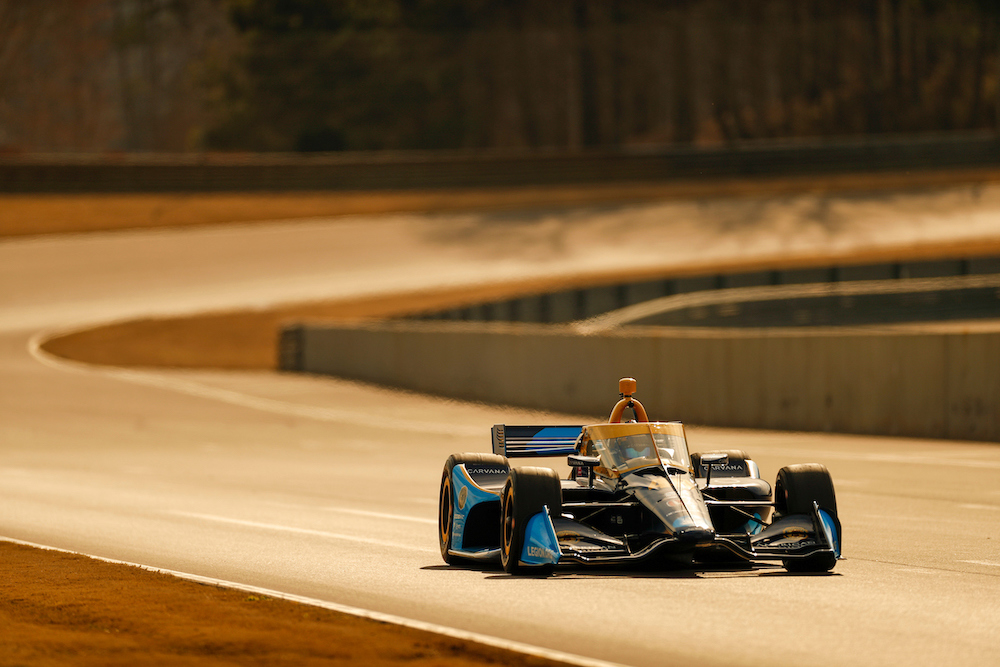
Different road and street courses have different characteristics, so what Johnson learns at one track might not correspond to another. Levitt/Lumen
“You tell him to do something, and he does it. You tell him, ‘Hey, try this at this corner, try that at that corner,’ and he'll go out and try three different things in five laps. And you're like, ‘OK, which one worked?’ He’ll say, ‘Well, if I did this, this happened. If I did this, that happened. If I did this other thing, this happened, and I prefer the second option.’ The more times he’s on track, the more he’s learning from what we tell him, but also from what he’s discovering on his own. It’s so cool to see.”
NOT BEHIND, OR EQUAL, BUT AHEAD
If you strip away everything Johnson needs to learn this year as an IndyCar driver, he’s left with one goal: To get ahead of the No. 48 Honda.
Watch onboard footage from his teammate Scott Dixon, or a young star like Pato O’Ward, and there’s nothing about the car’s behavior that surprises either driver as they rocket into and out of tricky corners. Their cars might understeer, or start to slide, and thanks to their skills and vast road racing experience, both know what to expect before it happens and apply countermeasures with their hands or feet to prevent it from becoming a problem or hurting their lap times.
It’s referred to as being ‘ahead of the car,’ the intuition of knowing what’s to come and reacting before it happens. It’s also what separates the goods from greats. And it’s not something a Hall of Fame NASCAR driver is going to master in a handful of pre-season tests.
“I want to say I'm probably halfway there,” Johnson acknowledges. “The reason I say halfway is because I was able to get within five or six tenths of my teammates at the last Barber test. So, backstory: We wanted to end the day on two long runs so that I could run the car out of fuel, practice a pit stop, go through the whole routine. So when we all put new tires on mid-afternoon, I was five to six tenths off. That, to me, was such a massive victory.
“I was two or three seconds off my own teammates at my first Barber test. So going back there, I was so damn happy that I had closed the gap and was in the same bracket with those guys, running by myself. But I still haven't done a race start, (or) done a restart. I've never been on Firestone reds. I've never had a qualifying session. I've never driven on a street circuit. I still have so much to discover yet. I feel I'm getting closer to the single-lap pace, and it's coming. But there's still a world ahead of me to figure out before I feel like I’m on top of the car.”
HOPING FOR LOVE BUT READY FOR HATE
Fractions of time, often in the hundredths and thousandths of a second, tend to separate IndyCar drivers who qualify inside the Firestone Fast 12, and again when the Fast Six is set in the final knockout round. Even for a guy who went from being multiple seconds off the front-running pace late last year to only a handful of tenths away, the hardest part of the journey is just beginning.
Over his 14 races, Johnson will look to shrink the lap time deficit, but miracles would be required for the gap to get down to the hundredths and thousandths where the lifelong road racers play. There’s no mystery as to the outcomes that await this rookie in 2021: He’s going to get hammered in every session by a field of road racing specialists, which he knew and accepted before signing with CGR.
He also knows to expect plenty of negativity on social media and in comments sections if his name is at the bottom of the speed charts.
“I really feel like it's on me to be as real and as authentic as I have ever been in my career,” Johnson says. “I feel like I will be able to do so, because I have nothing to prove. I've spent a career worrying about all those things. It's going to be hard not to worry, and I don't want to say that's not going to happen, but I think there's a real opportunity for me to really be as truthful as I can and as honest as I can, through the good and the bad. And I'm comfortable with that.
“The people that truly are fans, or people that are watching and respect the process and respect the fact that I'm still eager to learn and eager to drive and all that stuff, I think there's a real story in. But I've got to be realistic; when I'm not on the pace, or I make a mistake, I need to own up to that.
“At the same time, I need to own up to the fact that this is so different and I still have so much to learn. I hope it's a minimum of two years I’m here. Three would be better, and four would be better yet. I have no idea where opportunities will take me and where CGR will be in three or four years, but I know each year I'm out there, I will get better and better and better.
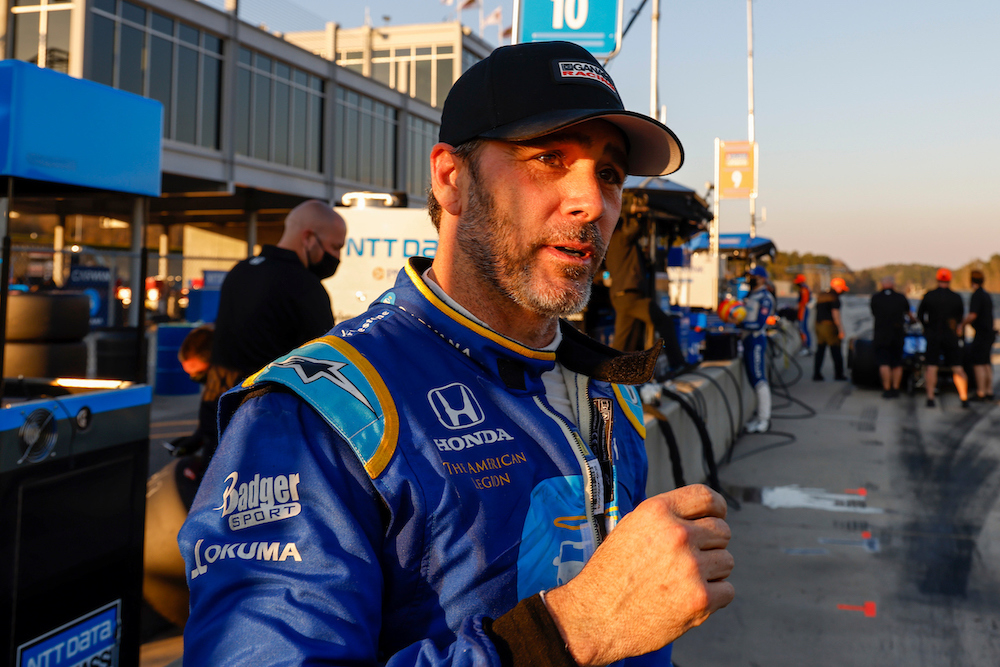
Seven Cup titles, 100% humility. "I really feel like it's on me to be as real and as authentic as I have ever been in my career," Johnson says. Levitt/Lumen
“There will be people who will want to hate and criticize what we’re doing, and you’re never going to get around that. All I can do is use my digital platforms to be real about this process and articulate what it’s like and hope that’s enough for everybody.”
SETTING EXPECTATIONS
Barring a few welcome surprises this year, Johnson’s second season as an IndyCar driver is where his true capabilities will start to be revealed.
“I think we knew the first half of the year was always going to be tough because how steep the learning curve is,” Franchitti says. “All the things he’s never done, the tracks he’s never seen... I think people know what he’s up against. But he also came to St. Pete with me so we could do a couple of laps, get driven round in the pace car, and then walk the circuit at night together. He flew to St. Pete just to do that last year to prepare mentally for racing there this year.
“That’s his level of commitment, but he’s still got to do his first lap in an IndyCar there. So to expect him to be in the front half of the field is a big ask. And nobody's going to give him an easy time. None of the other drivers will, because they're just not built that way. Nobody's going to say, ‘Oh, Jimmie, you're a great guy. I loved watching you in NASCAR, please, take the corner from me.’ It just doesn't work like that. But he's a tough cookie. I think by the second half of the season, we can start annoying some people.”
MONTEREY MISSION STATEMENT
The new season is here and one of racing’s biggest names is ready to write a new chapter with a good buddy as his coach, CGR as his team, and new sponsors in Carvana and American Legion ready to tell his story. We don’t know how the chapter will end, but Franchitti appreciates the purity and spirit Johnson has brought to the adventure.
“When you've got a driver who, the first time he goes by the pits at Laguna Seca, comes on the radio and says, ‘This is awesome!’…yeah, and people still wonder why is Jimmie doing it?” he says. “When I first met him, Jimmie was just a normal guy, and seven championships later, he hasn't changed. If they listened to that radio conversation at Laguna, they’d know. And he's actually done it at two different tests, and I bet it won’t be the last time we hear it this year. It's like, ‘OK, that's why he's doing it.’”
Marshall Pruett
The 2026 season marks Marshall Pruett's 40th year working in the sport. In his role today for RACER, Pruett covers open-wheel and sports car racing as a writer, reporter, photographer, and filmmaker. In his previous career, he served as a mechanic, engineer, and team manager in a variety of series, including IndyCar, IMSA, and World Challenge.
Read Marshall Pruett's articles
Latest News

Comments
Comments are disabled until you accept Social Networking Cookies. Update cookie preferences
If the dialog doesn't appear, ad-blockers are often the cause; try disabling yours or see our Social Features Support.