Image by Andre/Motorsport Images
STRAW: How much can we trust the F1 form guide?
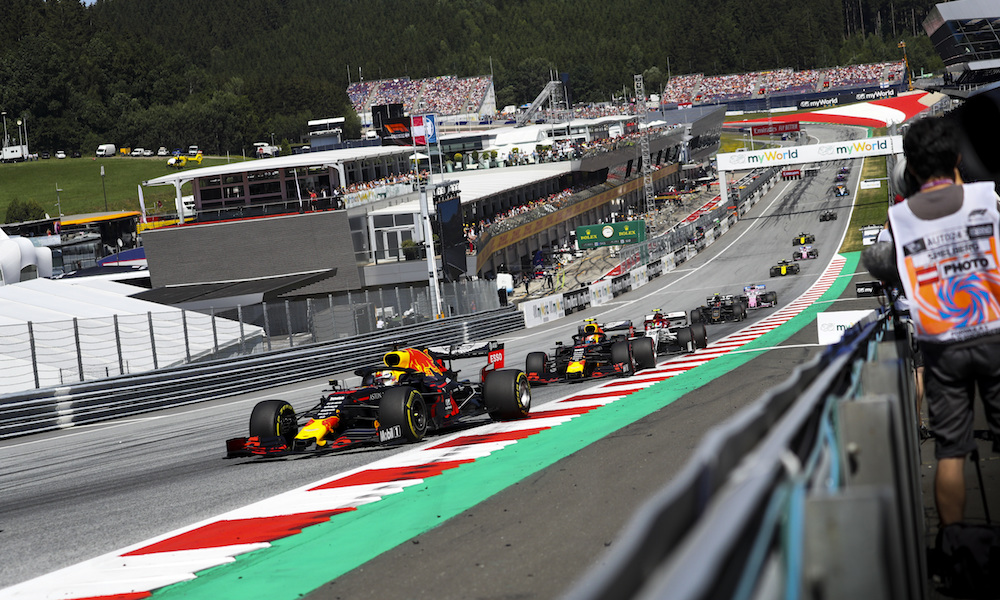
The confirmation of the 2020 Formula 1 calendar, or the first eight races in Europe at least, led to suggestions it could be advantage Red Bull in the early stages of the world championship fight. Given, Max Verstappen has won the last two grands prix at the Red Bull Ring, which hosts the first two races, as well as taking pole position and coming within five laps of winning at the Hungaroring, which hosts race three, in 2019.
The Red Bull Ring is certainly a track Red Bull enjoys – and why wouldn’t it? It’s Red Bull supremo Dietrich Mateschitz’s circuit, and he has business interests all over the surrounding areas, so it is the definition of the home race even for a team that is based in the UK. But while it is a Red Bull track in one way, it’s not actually one that overtly favors its historical car characteristics.
The Hungaroring is a circuit that is well-suited to the DNA that courses through the Red Bull, although curiously it has only actually won there twice – with Mark Webber in 2010, and Daniel Ricciardo four years later.
But history is a limited indicator of future form. Yes, the 2020 cars are very much an evolution of their predecessors so there will characteristics that carry over directly, while in the longer-term, the performance profile of each team’s car does reflect their mindset, methodology and culture. But race wins are not always the product of performance, and the history in this case is a little misleading.
Mercedes technical director James Allison was asked about this on a recent episode of the F1 Nation podcast.
“There’s no doubt that Max is going to be a formidable opponent for us this year,” said Allison. “Ferrari did show glimpses of some form in pre-season testing, so we would imagine that Max will again be strong in Austria because Red Bull are always super pumped-up there, and they’ve got a bit of a track record.
“But equally… our campaign in Austria last year was hampered by our own mistakes on the cooling side, which meant that we were chugging round way off the actual pace of the car. And the year before, we were hampered by unreliability and rather clumsy moves around the safety car.
“So we’re all looking forward to getting to Austria and maybe showing a bit more of what we’re capable of than the slight underperformance that we’ve put in in the previous two seasons. And Hungary, well I think it will be a ding-dong. But it was a good result for us there last year.”
Allison has characterized the three case study races in question well. In Austria 2018, at the start of lap 13 Lewis Hamilton and Valtteri Bottas ran first and second for Mercedes after having locked out the front row. But Bottas suffered a hydraulic failure, and despite his best efforts to park in a safe spot, brought out the safety car. Mercedes dithered, failing to call Hamilton in and compromising his strategy, and handing the initiative to Red Bull. For good measure, Hamilton then retired to make this one of only two double-DNFs for Mercedes in the 1.6-litre V6 turbo hybrid era.
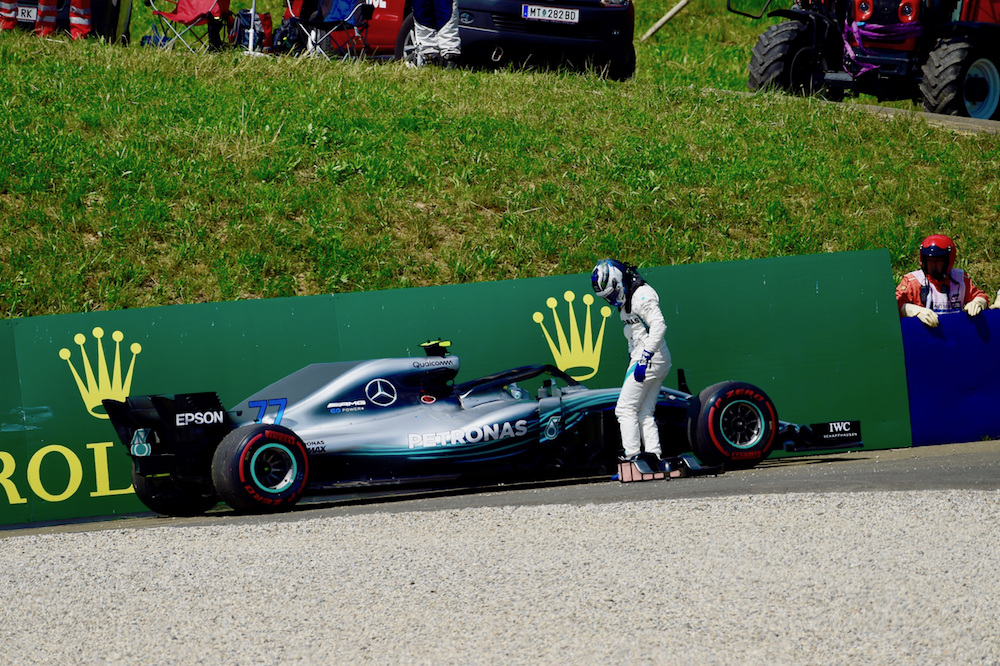
Red Bull's recent hot streak in Austria has been due in some part to a string of Mercedes mishaps at the track. Image by Andre/Motorsport Images
The cooling error Allison refers to in 2019 dates back to the design phase of the car where a data-input error, combined with failsafe systems not picking up the error, led to the Mercedes W10’s cooling potential being lower than needed. In Austria, it was around 43 degrees Fahrenheit too hot and Hamilton and Bottas really did have to, as Allison suggests, chug round. This left Verstappen to charge to victory after a late and controversial pass on Charles Leclerc’s Ferrari.
Red Bull and Verstappen certainly won those two races, but it required the assistance of the faster Mercedes team to do so. Cast your mind back further, and Mercedes won the previous four races at the Red Bull Ring. While it’s a circuit that invites errors and can create unusual circumstances – something that is encouraging for the opposition – history suggests there’s no reason why Mercedes can’t have the fastest car there. After all, the cooling blunder will not be repeated.
The Hungaroring is a more interesting case, but even last year’s race weekend was a little misleading. Verstappen did take pole position, but this was the race after Mercedes introduced an upgrade package that made it a little harder to keep the rear tires alive at their peak over a qualifying lap. This held back both drivers in qualifying, while Verstappen and Red Bull got the most from their package.
In the race, Mercedes had the speed and Hamilton pressured Verstappen until the team pulled off the perfect strategy move by bringing him in for a second stop. The combination of the grip advantage and the pace of the car meant Verstappen was a sitting duck late on. There was no way for Red Bull to have covered that second pitstop gambit, but it would have found that race far easier to win had it genuinely had a pace advantage in the race, which it didn’t.
None of this means Red Bull hasn’t got a chance. While pre-season testing (for those who can remember back that far) suggested Mercedes holds all the aces, Red Bull did look fast in fits and starts. But how big a threat it poses in Austria and Hungary will depend entirely on the underlying performance of the car. If it’s a better car than the Mercedes, then it certainly can win those races. If it’s at a similar level to the Mercedes, perhaps the Hungaroring’s configuration will help it, but there’s no reason to expect Red Bull to storm to three consecutive victories if the Mercedes is fundamentally the quickest car overall.
If we look a little further down the calendar, the case for the Red Bull advantage further loses integrity. Silverstone is a Mercedes track, one where it has dominated since 2014. Only once, when Hamilton started on pole position, lost the lead to Sebastian Vettel off the line and then was punted into a spin by Kimi Raikkonen, has Mercedes failed to win. So that’s two races on Mercedes territory. Then comes Barcelona, where Mercedes had its biggest pace advantage of all in relative terms last year.
Beyond that, Spa and Monza are hardly happy hunting grounds for Red Bull in recent years, its last victory at either coming in the 2014 Belgian Grand Prix for Ricciardo after Mercedes pairing Hamilton and Nico Rosberg clashed. But again, they are good venues for Mercedes. Even last year, it had stronger race pace than the polesitting Ferrari of Leclerc, despite losing out on Sunday.
Beyond that, it’s difficult to know exactly what the calendar will be made up of. The Singapore Grand Prix is looking unlikely to take place, which is good news for Mercedes given that it’s an outlier circuit where it has sometimes struggled, but has nonetheless won four out of the last six races. But Mercedes has at least a very good record at every track since 2014 simply because it has had the strongest package for the majority of the time.
But what we don’t know is exactly how the 2020 cars stack up. We’re basing any judgment on the six days of pre-season testing that finished over three months before the season starts properly on July 6. Tentatively, we have Mercedes as favorites, Red Bull as second-best and Ferrari struggling, but time has passed since then. While the F1 factories have been closed for a total of 63 days in the interim, work will have been ongoing and likely every car will have new-specification parts, even if they were only the same ones planned for the Australian Grand Prix. So we can expect some shifts in performance.
What could play a big part this year is reliability and readiness. F1 teams will unavoidably be undercooked when they get to Austria. Even though the team bases have reopened, none of them are at full capacity, and various measures to prevent the spread of COVID-19 mean things are very different to how they once were. Even simple, procedural things like pitstop practice, which happens very regularly when the race team is at base, will have been difficult to maintain.
So that means all teams could be more vulnerable to mistakes. And if Mercedes really does have the strongest car, that means it, too, is more prone to an Austria 2018-type scenario. But as you’d expect from the team, it’s taking its preparations very seriously, which is why it is running for two days at Silverstone on Tuesday and Wednesday this week with a 2018 car (the most recent specification permitted by the regulations). Not only will Bottas and Hamilton have a day each behind the wheel, but the team will be familiarizing itself with all of the special protocols and equipment being used to minimize the risk of COVID-19. Therefore, the chance of a rusty team with some unfamiliar ways of working shooting itself in the foot is reduced.
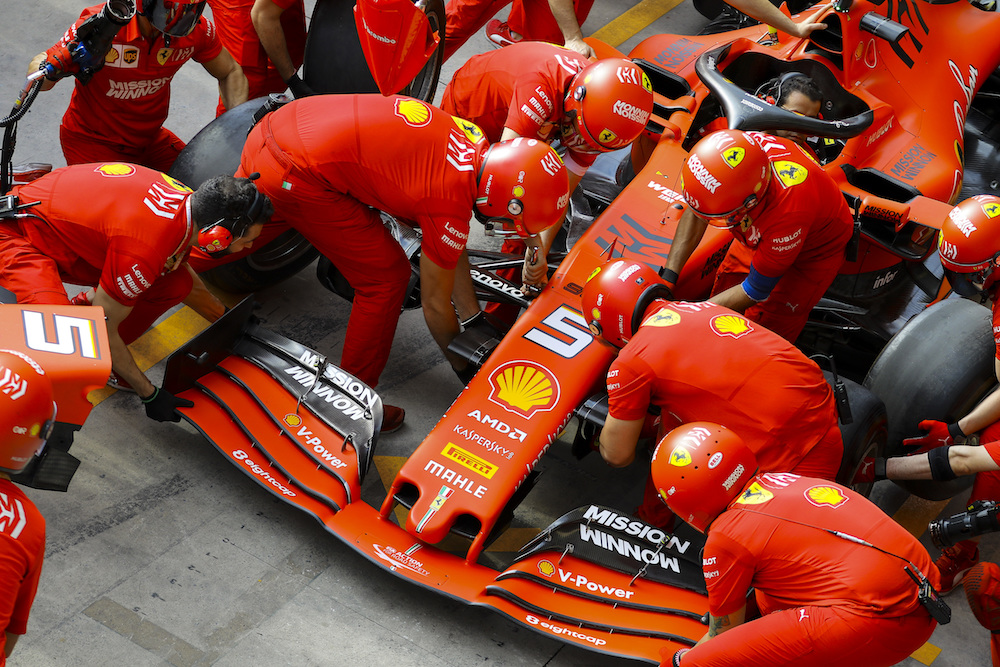
The knock-on effects of the COVID-19 shutdowns reach all the way to areas like pitstop practice. Image by Andre/Motorsport Images
Mercedes is not the only team that will do this, as it’s an obvious move for any team with similar capability. But there’s a reason it’s the best team of this era of F1 – and you could argue of any era – and that’s because it is, on average, best at dealing with the range of situations presented to it.
But there are risks. Team principal Toto Wolff has warned of the need to ensure cars get to the finish early on. This is always the case, but given the interruption to the normal operation of teams, it’s inevitable that there’s a greater chance of such problems. And with uncertainty over how many races there are – 18 are aspired to, 15 is probably F1’s minimum target and only eight are actually needed to constitute a championship according to the F1 Sporting Regulations – the negative impact of a DNF will be greater than in a ‘normal’ 22-race season. Retire from one of 22 races and that’s 4.5% of your points opportunity lost – but retire from one of 15, and it’s 6.7%.
“I think reliability is going to be a fundamental part of the opening races,” said Wolff. “The cars have come out of the container straight from Australia, there is not a lot of time for them on the dynos, we will be using every session to learn.
“The reduced race calendar is a challenge for everybody, and again, I think that the team that has the quickest car and the most reliable package will win the championship.”
That final sentence is stating the obvious. While there will be performance variation based on the performance sensitivities of the circuit, it’s almost invariably the strongest car package that wins the title. You have to go back to 2012 for the last time a driver came close to the title in not the best package courtesy of Fernando Alonso’s stunning performances for Ferrari.
As Allison put it when asked in that same F1 Nation interview whether the choice of circuits for the calendar favored anyone – “yeah, it will favor the fastest car”.
It might sound like a glib answer, but it’s the truth. And based on current evidence, that will be Mercedes. And if Red Bull can win in Austria and Hungary, chances are it will be indicative not of ‘helpful’ circuits, but that it potentially does have the favored car.

Edd Straw
Edd Straw is a Formula 1 journalist and broadcaster, and regular contributor to RACER magazine. He started his career in motorsport journalism at Autosport in 2002, reporting on a wide range of international motorsport before covering grand prix racing from 2008, as well as putting in stints as editor and editor-in-chief before moving on at the end of 2019. A familiar face both in the F1 paddock, and watching the cars trackside, his analytical approach has become his trademark, having had the privilege of watching all of the great grand prix drivers and teams of the 21st century in action - as well has having a keen interest in the history of motorsport. He was also once a keen amateur racing driver whose achievements are better measured in enjoyment than silverware.
Read Edd Straw's articles
Latest News
Comments
Comments are disabled until you accept Social Networking Cookies. Update cookie preferences
If the dialog doesn't appear, ad-blockers are often the cause; try disabling yours or see our Social Features Support.