Image by Galstad/LAT
PRUETT: Why are this year's IndyCar rookies so good? Ask their engineers
Felix Rosenqvist has never met 99 percent. Colton Herta is a chameleon. Patricio O’Ward is a hunter/killer. Santino Ferrucci lives for the minutia.
If you want to know the things that make a driver special, speak to their race engineers and driver coaches. It’s through the men and women who work the closest with the best in the NTT IndyCar Series – and in this case, the shockingly good rookie class of 2019 – where one can unlock the codes to a rather special group.
Taking a step back from lap times and race results, it’s in the little behavioral traits and glimpses of extraordinary talent where the first hints of future success is being demonstrated.
FELIX ROSENQVIST
Julian Robertson has been Chip Ganassi Racing’s engineering anchor for decades. The byproduct of the Briton’s disciplined curiosity comes in the form of countless wins and championships, as everyone from Michael Andretti to Juan Montoya to Scott Dixon have benefited from his mechanical wizardry.
As the team’s longstanding technical director, and since 2018 in his return to race engineering, Robertson has appraised all manner of talent at CGR. In overseeing Felix Rosenqvist’s No. 10 Honda, he's observed mannerisms familiar to him from watching the team’s greats.
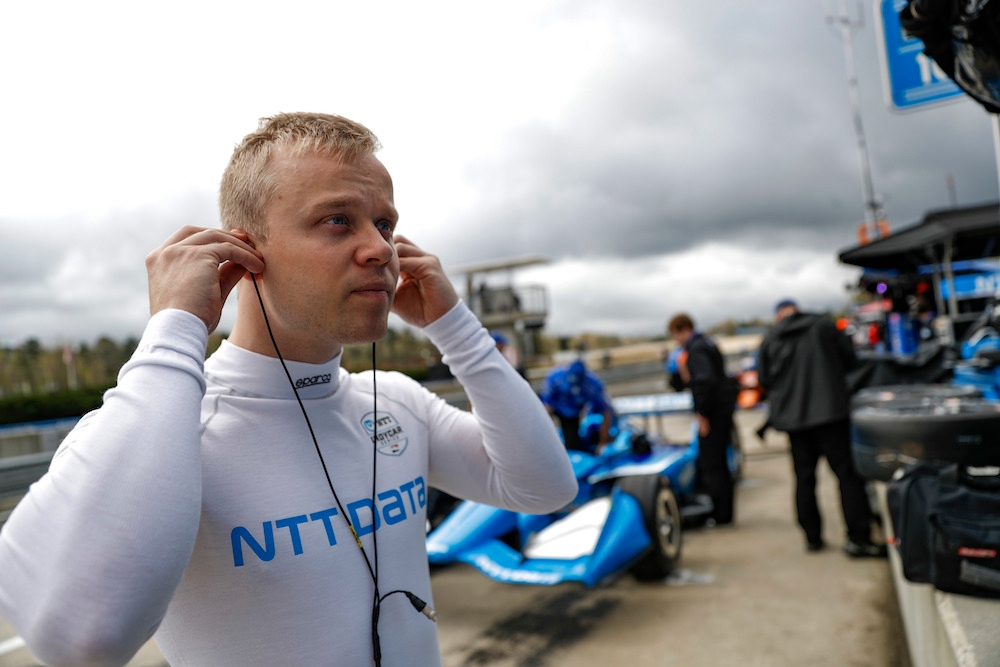
Rosenquist is always on the attack, says engineer Robertson. Image by Levitt/LAT
“He drives absolutely on the limit, as they all do,” Robertson tells RACER. “Anybody at the front is driving on the limit all the time, and searching for those few extra tenths. And he's one of those guys. He's certainly paying attention to all the little details, particularly like tire management and all that kind of thing; he's very switched on. He’s aware of how everything can affect the car, and making sure he maximizes everything he can do.”
Robertson describes the 27-year-old Swede as someone who does not differentiate between practice, qualifying, or the race when it comes to effort and exertion. On a basic level, drivers are always trying to lap as quickly as possible, but few are capable of finding and living on the limit for prolonged stretches. It’s bursts of blazing speed, surrounded by something more comfortable, albeit only a percent or two to the safe side of danger. But Rosenqvist operates in a constant state of attack.
“Like all the fast guys, he’s always on the edge, trying to put laps together,” Robertson continued. “So, he's always trying to put the perfect lap together, and he always thinks he can go faster than whatever he just did. Which is one of the reasons we keep going faster. He's always pushing for it. He's our man.”
As the man charged with helping Rosenqvist to restore the 1-2 punch it last had when he was Scott Dixon's teammate, Dario Franchitti has been gifted the closest thing to a finished product in this rookie class. He believes Ganassi’s reigning series champion and its newest driver are both crafted from the same hard-to-define ingredients.
“Felix has driven a load of different cars and that gives him a fairly unique perspective as a rookie,” says the three-time Indy 500 winner. “Each one of the guys I’ve worked with has been different in terms of personality, the way they drive the car, and what they want from the car – that’s from rookies to old Mr. Five-Time Champion (Dixon).
“It’s a bit of a cop-out to say it like this, but Felix just has a certain ‘something’ in terms of speed, feel and feedback that makes him a little different – just like Scott. He’s got the best teammate, because Dix is the benchmark. Not only does Scott have those traits to a ridiculously high level, but he works his arse off too, reminding Felix – if he ever needs it – that talent is not enough.”
COLTON HERTA
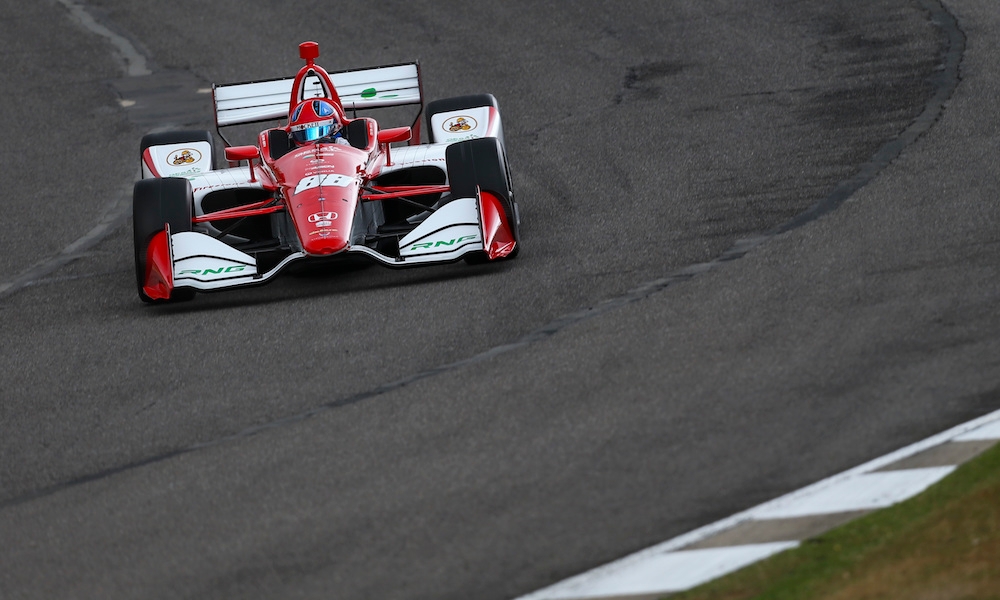
Colton Herta is authoring a new standard for don't-call-it-a-rookie campaigns.
The brand-new 19-year-old could easily be mistaken for 16 or 17, which makes for an interesting juxtaposition of age and appearance. Outside the car, he’s clearly a teen. Inside the car, he behaves like a battle-hardened pro.
Strip the colors from his No. 88 Harding Steinbrenner Racing Honda and the paint from Herta’s helmet, and it would be hard to tell the Californian’s average performance from IndyCar’s most accomplished veterans. His fitting right in among the big names, from the outset, has been the greatest surprise.
It’s in this latter area where his race engineer, Nathan O'Rourke, whose talents have shipped plenty of drivers to Victory Lane, says Herta stands out from the rookie crowd.
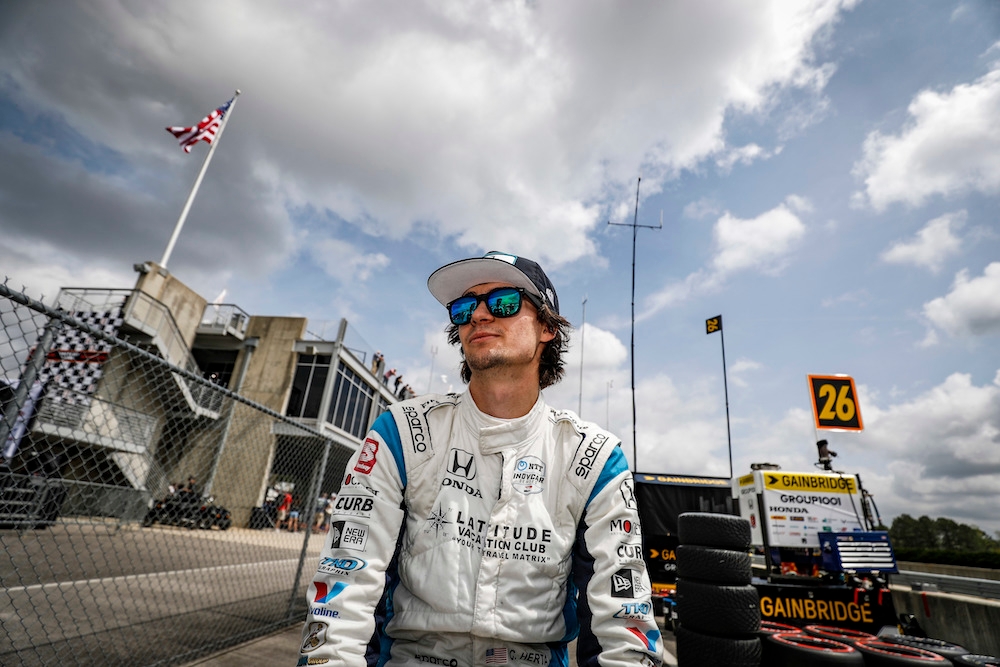
Colton Herta is mature – and fast – beyond his years, according to engineer Nathan O'Rourke. Image by Levitt/LAT
“Well, he obviously has a ton of talent; that's pretty clear, and everybody's seen that by now,” he remarks. “But I think what's impressed me most so far, and the quality that it takes some drivers a long time to develop, is adaptability. From the first run [at COTA in Spring Training], we put seven laps of fuel in the car, and said, ‘Work up to it, man. We know it might take you a while. You've never done this before.’
“And his fastest lap of his first outing in an IndyCar at COTA was his first one. He just kept running in the same time over and over and over again. So I figured there’s something going on here – maybe he doesn't like the setup, because he wasn’t really improving on lap time? He was like, 'No, I was really surprised, too. I just figured it out right away.' That gave us a lot of confidence going forward. He found the peak immediately and stayed there.”
Where many rookies stumble when adversity strikes or an imbalanced chassis makes driving harder than expected, O’Rourke is astounded by Herta’s ability to avoid the traditional pitfalls and continue delivering the goods.
“That's always what's scary for rookies – it’s that things always change,” he says. “I think what makes champions good and what makes really good drivers is when things don't go as they expect. The guys who adapt to that change the quickest are the ones who do the best job. As young as he is, at this age to have that type of adaptability, it's scary.”
Despite working together for the first time just two months ago, Herta and O’Rourke have found instant chemistry as driver and engineer. It’s another area where the man in charge of Herta's chassis setups gives credit to the second-generation phenom.
“Most of it goes to him, to be honest,” he says. “I think that chemistry, as we define it, comes down to them knowing that they need to go faster. That's something that takes some guys a while, especially, a lot of times with rookies. IndyCars just understeer. You're never going to get them to stop understeering. And a lot of times, rookies get so caught up in trying to fix that, they hurt themselves. They end up with a car that's too loose, and they're uncompetitive.
“Where with him, I think he's been really aware of what he needs to go faster. When we give it to him, he goes faster. We haven’t, so far, gotten off track. That's pretty cool.
"The whole chemistry thing is a lot easier when they know what they need to go faster, and that makes our job easier as engineers. It’s the kind of thing to expect from the veterans, not really from a rookie.”
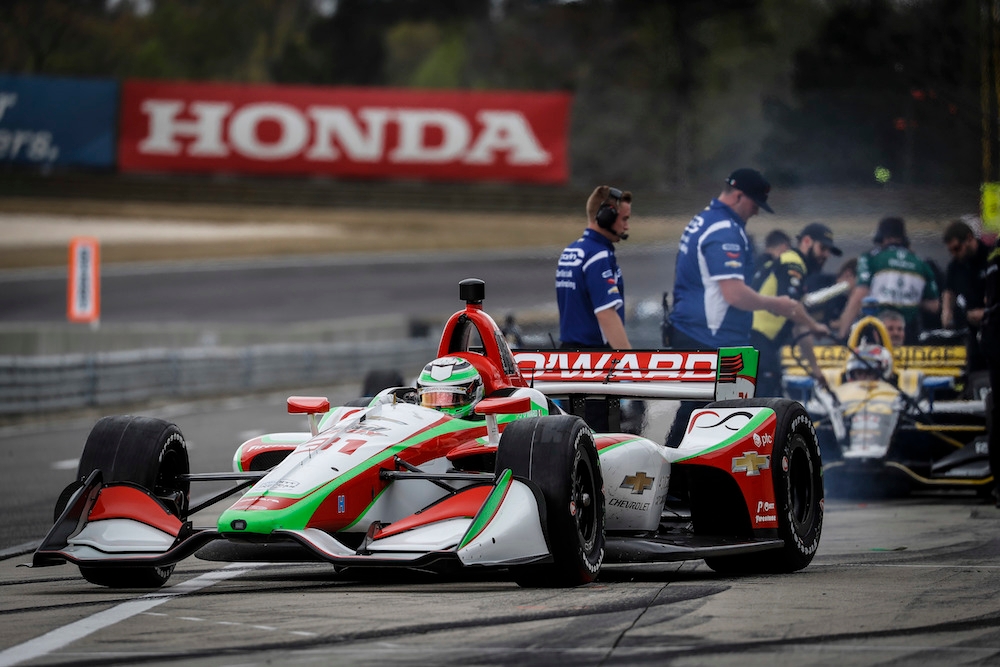
Image by Levitt/LAT
PATO O'WARD
Engineers are generally hesitant to heap praise on young drivers. It’s the thing of not wanting to over-inflate egos, to ensure the hunger to improve doesn’t wane.
Carlin Racing’s Matt Greasley doesn’t have to worry about such things with his new driver Patricio O’Ward.
The reigning Indy Lights champion, making a late start to the season after joining the team for the second round in Austin, is the catalyst Carlin’s been missing in IndyCar. For Greasley, whose past experience with the team spans all kinds of European open-wheel ladder series, the Mexican conjures memories of a certain Canadian he previously engineered at Carlin.
“He’s a very mature 19 in the car, and outside the car, he’s lifted the team,” Greasley said. “After Practice 2 at COTA, when he’d had a first run on red tires, I mentioned to someone he reminded me of a young Robert Wickens, back in the World Series by Renault days. I worked with Robert in A1GP, then he came and did World Series with us. Very similar traits. Very big commitment in high-speed corners – it’s phenomenal – and what he demands out of the team and the car struck me early on. That’s encouraging from our side.”
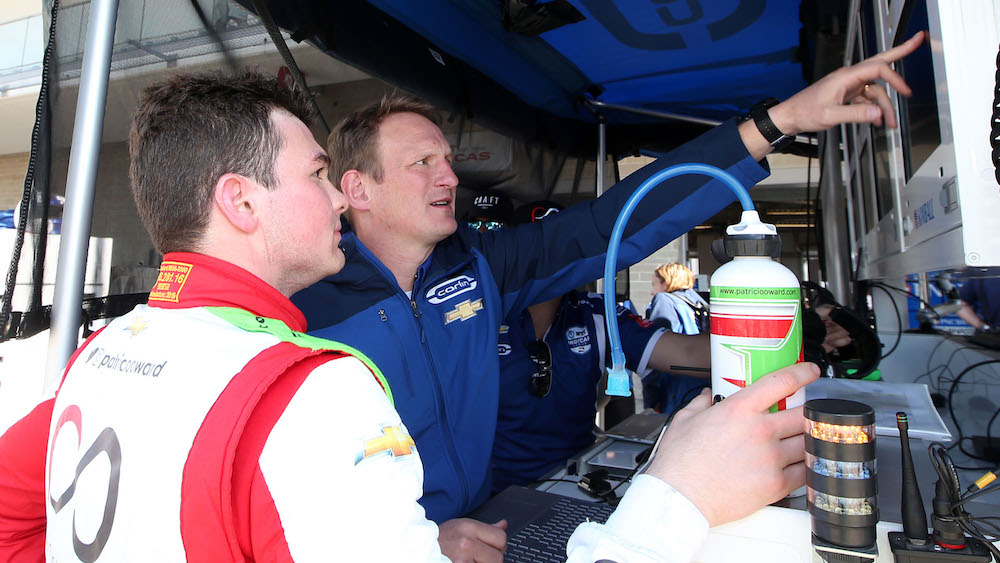
High praise: O'Ward reminds Carlin engineer Matt Greasley of a young Robert Wickens. Image by Marshall Pruett
Akin to Franchitti finding a few early parallels between Rosenqvist and Dixon, Greasley’s firsthand experience with Wickens and the commonalities he’s linked to O’Ward speak volumes for Pato’s potential. If speed is the through-line connecting IndyCar’s rookies, the willingness to make that speed while sliding sideways is another shared aspect within the quartet.
For O’Ward, whose aggression and innate passing skills have become a show of their own, fast-twitch muscle fiber is key to controlling a car that’s rarely pointed in one direction.
“For me, a trait we see now with the young drivers is rotation,” Greasley says. “It’s oversteer, in some respects. In the slower and medium-speed corners, they want a lot of heave – as much as the cars can take. They get to the apex, and the car is pretty straight, so less steering lock and load; then get to the power quicker. The focus is on the rear, making the car turn for them.
“It isn’t always nice that way in the high-speed, but the hand speed is amazing. All these kids – they’re not afraid of oversteer at all. Is that a trait they’re developing because they didn’t drive the old IndyCar bodywork that had gobs of downforce, so they’re comfortable with the back of the car moving around quite a lot? I don’t know, but that’s what we see Pato doing instinctively.”
O’Ward is as confident as rookies come. It isn’t arrogance, or smugness; it’s part of his natural composition. With that amplified self-belief, his cocksure personality could either backfire in a well-traveled team like Carlin, or serve to inspire and drive the IndyCar operation forward. In "Patty," Greasley has met a rookie who thinks and acts like a team leader. And that’s exactly what Carlin has needed on the road and street courses.
“The good thing is we still have Charlie Kimball in the car for the ovals and the feedback he gives us is really strong. Then the youngster comes in and wags the car’s tail, finds the limit and beyond,” Greasley says. “That always makes an engineer’s job easier. It lifts the spirit, but we’ve always been a team that pushes hard and drags things along. It’s just good to see the fruits of your labor returned. We’ve made gains over the winter, and it was interesting to see how Patty brought himself along at COTA."
The competitive fire in O’Ward, which lives in all of IndyCar’s perennial championship contenders, transformed Carlin into a serious force within one round. The sophomore IndyCar team, propelled by an uncompromising 19-year-old, is now expected to have the Chevy-powered No. 31 fighting inside the top 10. It’s a testament to how much timing matters in a series when the right driver lands with the right team.
“We didn’t change the car much in his first race weekend with us, but session by session, he got better and got to his limits,” Greasley adds. “We had to keep reminding him that others had been there for two days of testing and to trust himself, it would come; but he wants to win every session. He’s very hard on himself.
"That’s what reminds me most of a young Wickens. He knows what he wants from himself, wants from the car, and he pushes very hard so you quickly find the deficiencies in the car’s setup. That really helps us to get there quicker.”
SANTINO FERRUCCI
Michael Cannon won five races with a young American by the name of A.J. Allmendinger when he joined the Player’s/Forsythe team four rounds into the 2006 Champ Car season. More young talent would flourish under his care in recent years at Dale Coyne Racing, where Conor Daly, Ed Jones, and most recently, Santino Ferrucci have developed under the Canadian’s steady watch.
Hard to impress after a life spent in the sport, Cannon marvels at the what his pint-size rookie from Connecticut brings to the No. 19 Honda program.
“He is through and through a professional race car driver,” Cannon says. “Yeah, he's 20 years old, but he spent a long enough time go-karting and in junior formulas over in Europe to be effective right away when he got here.”
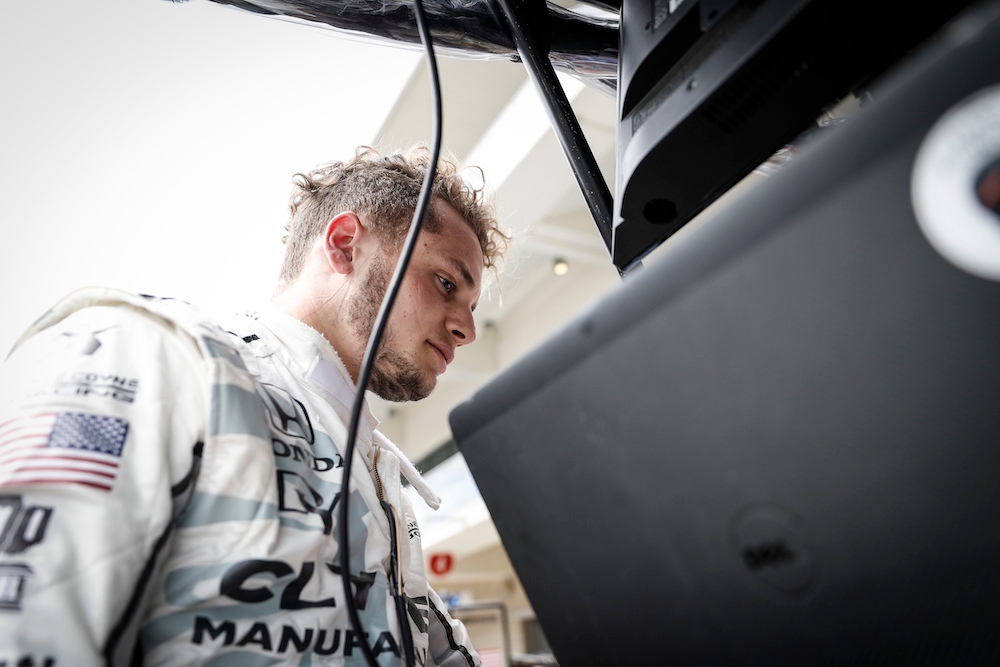
Ferrucci: "Engaging, enthusiastic and a very complete driver at age 20," says Carlin Racing's Cannon. Image by Levitt/LAT
Ferrucci typifies the modern high-end IndyCar rookie. Where some of the young drivers Cannon has worked with have needed a long leash and lots of time to fill the major holes in their game, Ferrucci is more complete at the age of 20 than many of his predecessors. Intensive junior open-wheel efforts in Europe, on-track and simulator testing with the Haas Formula 1 team, and a general commitment to eliminating weaknesses has produced a version of Ferrucci who – along with his rookie rivals – looks nothing like a first-year IndyCar driver.
“He's a guy that takes this very, very seriously,” Cannon says. “There’s no malaise or taking his time to warm up to things. At the same time, he's got a lovely personality. He's engaging. He's enthusiastic. He's young enough to be my grandson, which is kind of sobering. But, no, he's good to work with. He has a good feel for the race car. And he's very much keen to learn more. So, technically, he's got quite good feedback. He's got a tremendous appreciation as to how a tire works, as do a lot of those guys who come over from Europe.”
Cannon has already seen Ferrucci turn his attention to maximizing some of the smaller tasks required to be a front-running IndyCar driver. It speaks to the incredible development curve some rookies are able to handle.
“Probably – and the casual observer may not even think of this – but his in-laps and his out-laps and his time from being in the limiter on pit lane speed and going down to zero when he pits is remarkable,” he says. “That's a mark of a true professional. And I have just reviewed the current pit stop reports, the timing reports from the COTA race, and he's in the top percentile for some of those. That's pretty bloody impressive for somebody 20 years old. That's a skill that you typically have to hammer into these guys, and he came to us already well-disciplined on one of the lesser-appreciated skills.
“And look at what he did at St. Petersburg. I know that the team that finished behind us (Meyer Shank Racing’s Jack Harvey) were confident that their driver needed to challenge Santino because they thought Santino would run out of fuel and fail to finish the race. And we asked Santino to make speed while saving fuel, which was new for him, and he did an excellent job. And surprise, surprise, he finished ninth, ahead of the other driver.”
Ferrucci’s pace has been noteworthy in the opening rounds. To make his mark, stronger finishes will be required to remain in the 2019 rookie conversation.
“He's 20, he's completely fearless,” Cannon says. “And he is going against a rookie crop that is equally fearless. Circling back, he's very much a complete race car driver, which is becoming the norm at his age, it seems. That's something that came to him ingrained. He's so vastly experienced while still being so young.
"But I don't envy the work necessary for him to stand out in this crowd this year. This is probably the best rookie field I can think of.”
Marshall Pruett
The 2026 season marks Marshall Pruett's 40th year working in the sport. In his role today for RACER, Pruett covers open-wheel and sports car racing as a writer, reporter, photographer, and filmmaker. In his previous career, he served as a mechanic, engineer, and team manager in a variety of series, including IndyCar, IMSA, and World Challenge.
Read Marshall Pruett's articles
Latest News
Comments
Comments are disabled until you accept Social Networking Cookies. Update cookie preferences
If the dialog doesn't appear, ad-blockers are often the cause; try disabling yours or see our Social Features Support.