Image by IndyCar
INSIGHT: So, you want to put on an IndyCar race?
Good car counts, a talented field, a cool-looking car, an energized new series sponsor, and a full-time broadcast partner: IndyCar heads into 2019 with a spring in its step.
There’s still work to be done, starting with the perennial quest for a stable calendar that hits all the sweet spots in celebrating the diversity of venues that IndyCar competes on – and ensuring that those venues are viable enough to become permanent fixtures.
But have IndyCar’s current feel-good vibes trickled over into the business of actually getting people through the gates at a race weekend? To find out, RACER spoke to a group of track promoters representing a cross-section of circuit configurations, geography, and experience. We deliberately left out IMS, because the job of promoting a race at Indy is its own beast, and much of what applies there might not be relevant to other events. And besides, if the Speedway were to ever fall of the schedule, then IndyCar would frankly have bigger problems than a gap in the calendar at the end of May. Instead, this is about the other events: the races that help ensure that IndyCar can run a full championship.
The promoters who generously shared their time (while in the middle of a track build, in one case) were:
Curtis Francois (Owner and CEO, Gateway Motorsports Park)
Chris Blair (Executive VP and General Manager, Gateway Motorsports Park)
Eddie Gossage (President, Texas Motor Speedway)
Jim Michaelian (CEO, Long Beach Grand Prix)
Kevin Savoree (President and CEO, Savoree Green Racing Promotions; promoter for St Petersburg, Toronto, Mid-Ohio and Portland)
Gene Hallman (President and CEO of Bruno Event Team, promoter at Barber Motorsports Park)
There is a widespread perception that IndyCar is on an upswing. Is that changing the job of selling the race to fans?
EDDIE GOSSAGE: I can’t tell you that we’re really seeing it in ticket sales, but what we are seeing is that the fans who are engaged with IndyCar are really engaged – more than they were 10 or 15 years ago. It seems that there is more chatter about it on the social media platforms than there used to be. If you say something and you’re either inaccurate or you leave out IndyCar, you’ll get called out on it on social media. And those kinds of things didn’t used to happen.
Clearly IndyCar is trending up, there’s this positive vibe about it, and that’s hard to create – it has to happen on its own. So it’s trending in the right direction and that’s a positive for all of us in the sport. Our company, Speedway Motorsports, has probably invested more than anybody other than the Hulman-George family in IndyCar – more than any sponsor, more than any team, more than any TV network. So we’re thrilled to see it growing, and hopefully it will continue to trend upwards. We rode along and paid our dues when it was down, and hopefully we’ll get to ride it for a good, long time while it goes up and gets bigger and better.
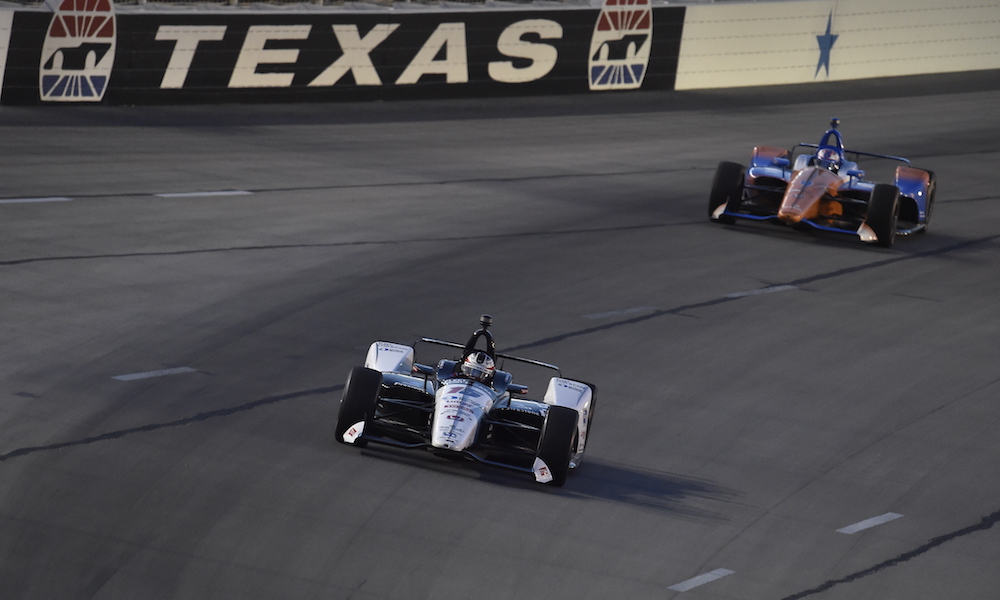
Texas has been an oval mainstay for more than two decades. Image by IndyCar
CURTIS FRANCOIS: It’s hard to speculate because we began hosting our event in 2017. Obviously the success of the 100th running of the Indy 500 was a catalyst for bringing the sport back into the spotlight. When you combine that with the proactive approach of Jay Frye and Mark Miles, it just seems that the timing was right.
KEVIN SAVOREE: Early on right now, we’re not seeing that [connection between IndyCar momentum and sales]. But as the lead-off race with the Firestone Grand Prix of St Petersburg, we might sometimes be in advance of some of that. But I think in general, the statement that the series has some health is accurate. Obviously a barometer of that is car count, and that number has kind of bounced all over the place since last season about what that’s going to look like. And while it’s not quite as high as may have been forecast early on, it’s still a strong field. I think we’re looking at 23 cars, so that’s obviously one gauge.
And then for IndyCar to be able to land the replacement sponsor in NTT is obviously a positive. Here in St Pete the verdict is out as to whether NBC Sports can deliver the same eyeballs as ABC. We’ll know that on Monday. I do believe longer-term that that [TV deal] will hopefully be a positive. The ball’s in their court. It’s a great product, and we’ll see.
GENE HALLMAN: IndyCar clearly has momentum, and that has helped us here with race fans locally. We monitor the TV ratings closely for IndyCar on a national basis to see if we’re drawing the IndyCar audience in this community and in this state, and clearly the trend has been upward. So fans are coming out, maybe not quite sure what to expect, sampling the product, and then to a certain extent, they’re becoming IndyCar fans, which is what both IndyCar and ourselves want.
So our local ticket sales have been on the uptick, and sponsorships have been on the uptick. We’re very pleased with what we’ve seen over the course of the 10 years. There has been quite a lot of change, and obviously there has been a huge amount of change within the motorsports industry. But I am very pleased with where we sit, and am looking forward to a long path forward with IndyCar at Barber Motorsports Park.
JIM MICHAELIAN: As a promoter you always want to be able to showcase series that are in an ascending mode, and creating a buzz, and achieving new heights with what they’re producing both on the track and off the track. For us now, I think IndyCar certainly fits that criteria. It can’t help but be beneficial not only to us, but to our spectator base and attendees, because when they are knowledgeable enough about the series and understand that there is some positivity that has wrapped itself into the series going into the 2019 season, that has to be an encouraging note for them, and also something that has an attraction for sponsors. And since it’s the headline event here, it’s obviously beneficial for us to be able to go to them with a package that’s led by an ascending NTT Data IndyCar Series. So yeah, there are benefits that include virtually all of the constituents at our circuit.
Eddie Gossage tries to sell fans on the visceral thrills of seeing IndyCar in the flesh. Image by IndyCar
How do you convert that positivity into ticket sales?
EDDIE GOSSAGE: That’s a tough thing, because all sports are struggling with that. The competition with watching from home, where you’ve got your big screen, and there’s never a line for the bathroom, and concessions are cheaper…
The live sports world – in all sports – is trying to figure out what it is that fans want in a live experience. Nothing matches the live experience. TV slows down race cars – they look slower on television than they do in real life. And since speed is the calling card of IndyCar, there is nothing that can match being there in person. So we are trying with special promotions, and ticket packages – two for $79, and you get a scanner and two headsets with that so you can listen to the conversations (between drivers and pitwall) – things like that to try to make it affordable for the fans. We’re the only professional sports and entertainment venue in Dallas-Fort Worth that doesn’t charge for parking. The Dallas Cowboys charge $75 to park your car every game, whether that’s pre-season, regular season. We don’t do those things. We’re trying to make it affordable for fans, and families in particular, to come.
GENE HALLMAN: One of the interesting things over the past 10 years has been the growth in digital targeting of specific groups of people. When we first started, digital was in its infancy; we relied on a more traditional means of communicating our message. And we still rely on television, radio and outdoor, but the digital aspect has become so sophisticated.
We start six weeks out, targeting IndyCar fans in the eastern half of the United Staes. And we say, ‘if you’re an IndyCar fan, Barber Motorsports Park is a bucket list stop for you’. And then the message becomes one of a combination of great racing and a social event, because embedded within our event we have the Ferris wheel, the Kids’ Zone, we have a wine festival, and this year we’re going to have an art festival with 50 artists from across the state selling their artwork. Friday night, for the first time, we’re going to have a 5k on the track, and four or five of the drivers have said that they’ll run it. So what we’re doing is growing different elements of the event to hook in people who might not otherwise be inclined to come and watch an IndyCar event, because we believe that if they come and sample it, they’ll come back.
KEVIN SAVOREE: We have some pretty strict positions that we follow when we’re working through our race event strategy and we live by those, and those policies and procedures have served us well. Our job here in St Pete and Mid-Ohio and Toronto and now Portland for the second year is to create that local enthusiasm and bring fans out. We’ve got a great marketing and PR team, and they work so hard on getting the message out, and I believe that most of the teams, drivers, sponsors and so on understand that when they come to our venues, they’re going to see a great show.
We use a lot of metrics to measure what works and what doesn’t work, and our guys do a great job of that. It’s one of those things that’s part-science, part-art. It does vary from city to city; you just have to listen to those numbers and follow them.
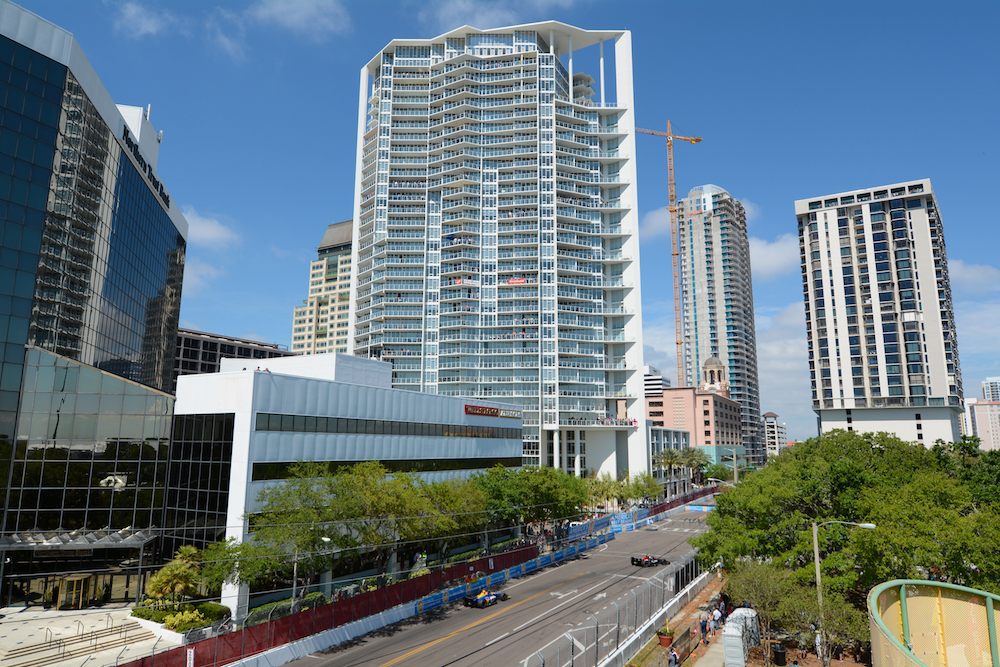
Figuring out how to make an event work is part-science, part-art, says Kevin Savoree. Image by IndyCar
What about working with other races on a joint-ticket arrangement?
EDDIE GOSSAGE: Bobby Epstein [CEO, COTA] and I have talked about that. The thing is that their race is in the spring and our race is in the summer, so there is a pretty wide gap between the two. I’ll be honest, I think they’ve been working so hard getting things prepared for their first IndyCar race that we haven’t had the opportunity to talk about it again. But I know we’d be open to it, and in my conversations with Bobby, I think he’d be open to it. I wouldn’t be surprised to see that happen down the road.
How viable would an IndyCar/NASCAR Cup double-header be? And at places where NASCAR wouldn’t work, what are the benefits of a double-billing with IMSA?
EDDIE GOSSAGE: IndyCar and NASCAR together would be very desirable. It would be exciting, and I’d want to try it. I’ve brought it up on a number of other occasions before and it’s been shot down by the folks at NASCAR. But I think there’s a different management running things at NASCAR now, and it’s something that I’m going to run up the flagpole again to see if there’s any interest. That would be a spectacular weekend. The argument has always been ‘this series doesn’t want to be compared to that series’, but I’ve never heard that. I’ve just been told no, we run NASCAR races, and that’s what we run on that weekend. But I think it’s still worth a shot, because I saw where [NASCAR President] Steve Phelps said that they’d be open to talking about it. I’ve got to be honest, when I read that I felt like he was talking to me because we’ve broached the subject so many times before.
JIM MICHAELIAN: In many ways it’s more important for us to run IndyCar and IMSA together now than ever before [ED: due to Acura’s arrival as the LBGP’s new title sponsor], because you have Honda’s involvement in IndyCar and Acura’s involvement in IMSA, so they both have a [racing] presence here. But equally important is that combination – open-wheel cars and high-performance sports cars is a very attractive package in southern California.
Those are all aspirational cars. Being able to showcase them, not just on the track, but in displays in the paddock, creates a really strong vibe here. And what makes that package so attractive to our fans is that when you throw that in with Robby Gordon’s trucks, and drifting, there is a whole menu of different types of racing vehicles – deliberately so. They look different, they sound different, the racing is different. We’re not sitting here and running… God bless them, but this is not the Road to Indy, and you’ve got half-size, three-quarter size, full-size, and they all look about the same. What we do here is different.
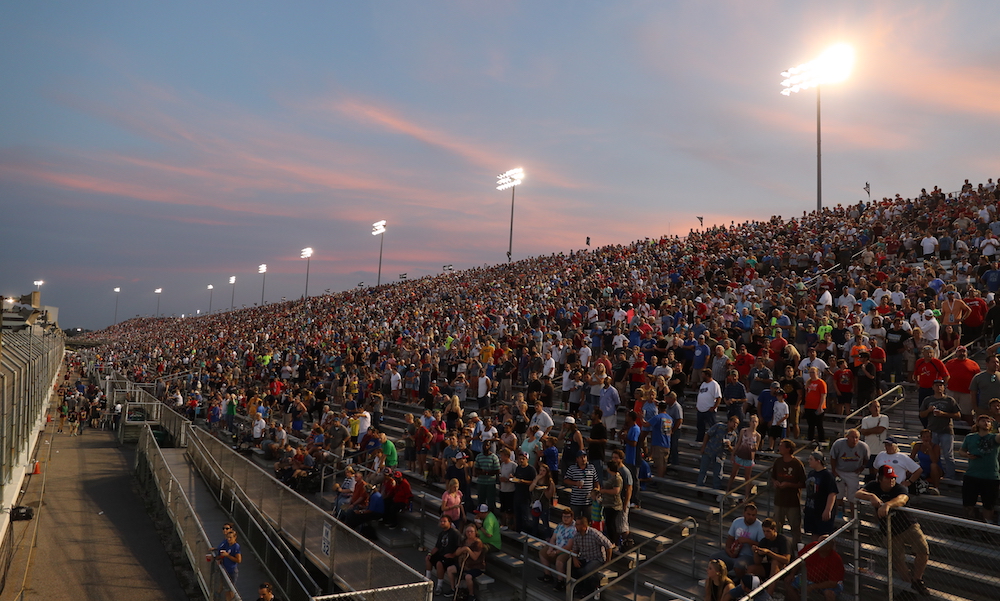
Gateway packs the stands by packing its weekend schedule and giving fans plenty to see. Image by IndyCar
In the last few years we’ve lost Fontana, Milwaukee and Phoenix from the schedule. On the flipside, Gateway has come along and seems to be doing something right. What’s the secret sauce for making ovals work?
CHRIS BLAIR: One of the first things we noticed in traveling to other races is the importance of giving the fans a full slate of activities. If you look at the road courses, you see that there are multiple support races leading up to the IndyCar finale. Fans get a lot for their ticket, and there are lots of things to see and do. That’s a struggle when it comes to oval racing. We are fortunate in that our track lends to the perfect size for classes such as the Indy Lights, Pro 2000, K&N Series and the Vintage cars. If you get much bigger than that, then some of those classes just can’t run.
We always wondered why you would go to some of the oval races and there would be these huge gaps in action. None of the fans want to come out early while the track is down for pace car and two-seater rides. They want racing action. We decided to take the best aspect of the road course and street races, and apply it to our event. That was a tremendous piece to the success of the first two events. We’ve relied heavily on feedback we obtained through our fan surveys and have tried to deliver.
The next step for all of us is if we can get TV to capture how much fun the fans are having during the pre-race and the other things that took place earlier in the day. Why break away from the national anthem, pre-race fireworks and flyovers to show a driver cooking segment? We need to show the fans having fun, and hope it encourages fans to attend themselves.
CURTIS FRANCOIS: I’m a strong believer in date equity and the right time to have the event. If it’s summertime in St. Louis, then it needs to be a Saturday night shootout under the lights. That was something we emphasized to IndyCar from day one.
Another important aspect for us is our relation to other markets where IndyCar is strong. We are only 3.5 hours from the Indianapolis Motor Speedway. We have a huge short-track open-wheel market in our area. Instead of focusing locally, we cast a wide net to hit Indy, Kansas City, Louisville and the smaller markets. Our selling point is that our race is a short drive away.
We’ve also put a huge emphasis on the local business community. We keep chipping away to get more and more businesses to use the event as an opportunity for employee and customer appreciation events. We are trying to build the entire race week as a staple of summertime in St Louis. It takes a few years to build date equity, and we are going to keep working on this project.
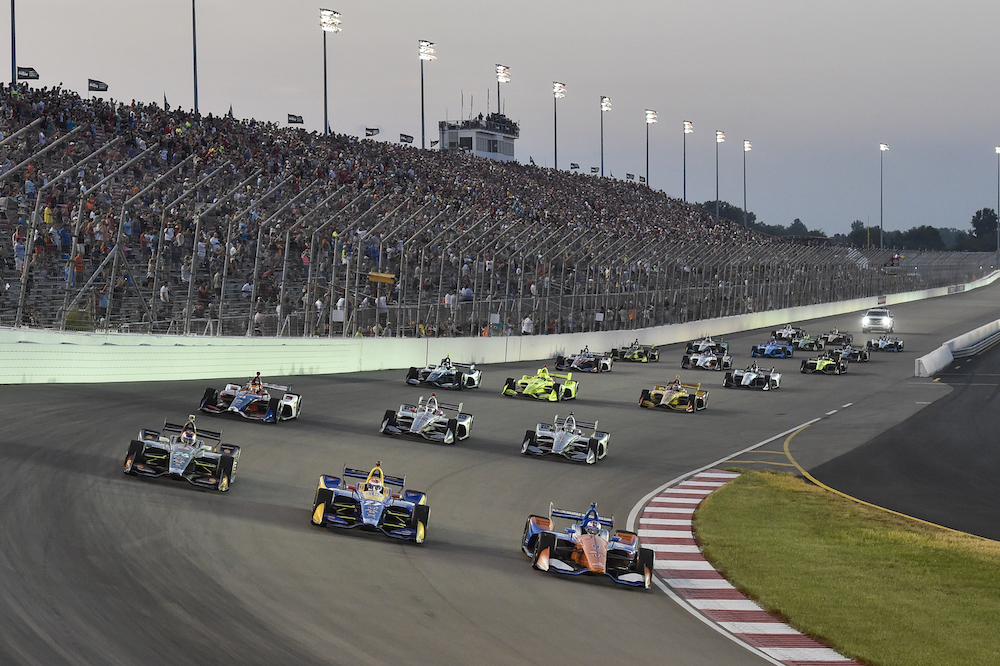
Could a mid-week race ever be viable? Depends who you ask. Image by IndyCar
EDDIE GOSSAGE: There is a tremendous IndyCar heritage in our state, so I think that helped us get started 23 seasons ago. And we’ve run an extraordinary number of IndyCar races in that time – I want to say it’s more than 30. But after Indy, we’re the longest continuously-running IndyCar race. Some could argue Long Beach and cite record books, but they didn’t run Indy cars – they ran Champ Cars. Those are two different cars. I love the Long Beach Grand Prix and Jim Michaelian, and I take notes from Jim, because he’s a tremendous promoter. But the fact of the matter is that they didn’t run IndyCars for a period of time. So we’re the longest continuous-running IndyCar venue outside of Indianapolis Motor Speedway. That has something to do with it.
Date equity, two weeks after the Indy 500 - people have always known that. So many things factor into it. But there was such excitement when we opened the doors in 1997, and the quality of the racing here … there have been exceptions, but you’re almost guaranteed a photo finish at Texas. And that’s just spectacular. You’ve got to have great competition, and IndyCar has given us that.
Could a mid-week race ever work?
KEVIN SAVOREE: I would probably not be a believer in that. I guess there could be exceptions, but I think that would present a lot of hills to climb – maybe a bridge too far. It’s what you’re trying to balance between fan attendance, local awareness, that festival atmosphere that hopefully we get at our events. And then you get into the issue of families, kids… maybe when you get into summer you get a way around that, but people love that weekend getaway, and some of our marketing plans revolve around that staycation-type idea. At Mid-Ohio that works really, really well. So I’m not sure about the midweek thing.
CHRIS BLAIR: It could work, but everything would have to align perfectly. Unlike other series, one of the biggest draws for IndyCar is the open access to the paddock, and it becomes more of an all-day experience. It would be tough to cram it all in to a short window and give the fans a great experience. It would depend on the market, and the TV package would need to be very supportive of the event.
CURTIS FRANCOIS: Another important aspect would be location. You need to be in an area where fans understand how mid-week events work. If you are in a location where fans are close to the major metro area, are used to attending NBA or NHL games, and you can deliver a quality experience between 7 and 10 p.m. then it could work. And, it needs to be on flagship NBC to really shine the spotlight on the sport.
EDDIE GOSSAGE: I’m not going to be the first to step out there. I think you’ll see it in NASCAR in the next couple of seasons, a midweek race, and it might end up being like Monday night football in 1970: ‘A football game on Monday night? That’s crazy!’ Except that it became the hottest thing in sports for quite a long time. But the numbers are so big to stage an event of this nature that you cannot afford to make a mistake, because if you make a mistake it costs you millions of dollars.
It’s funny, we hear about how the teams are struggling and we’ve got to help the poor teams, and there are certainly teams that are struggling. But there is a much longer list of promoters that have come and gone because they can’t make it. There’s a three-legged stool that makes this thing work – there’s teams, tracks, and the sanctioning body. And if any one of them isn’t succeeding, then the series won’t succeed. We need stability with the promoters just like we need stability with the teams. And as long as we have promoters dropping out… they can talk about how we’ve got more promoters knocking on the door wanting races than we’ve got races, [but] I’m not seeing that.
So it does the series no good to go and do a different race that’s going to fail. You’ve got to be smart and do business with people that are good at what they do, and that’s why it’s important that promoters like Jim Michaelian, or Green Savoree, or Texas Motor Speedway, or whoever, that you treat them well. The others have come and gone; you’d better be loyal to those that have been loyal to you. Longevity with the promoters is what gives the series stability, and it’s unstable as long as you’ve got Baltimore, and Boston, and on and on and on, falling by the wayside. Nobody wants to fail, but if you fail, you’ve got to be able to be in business the next day.
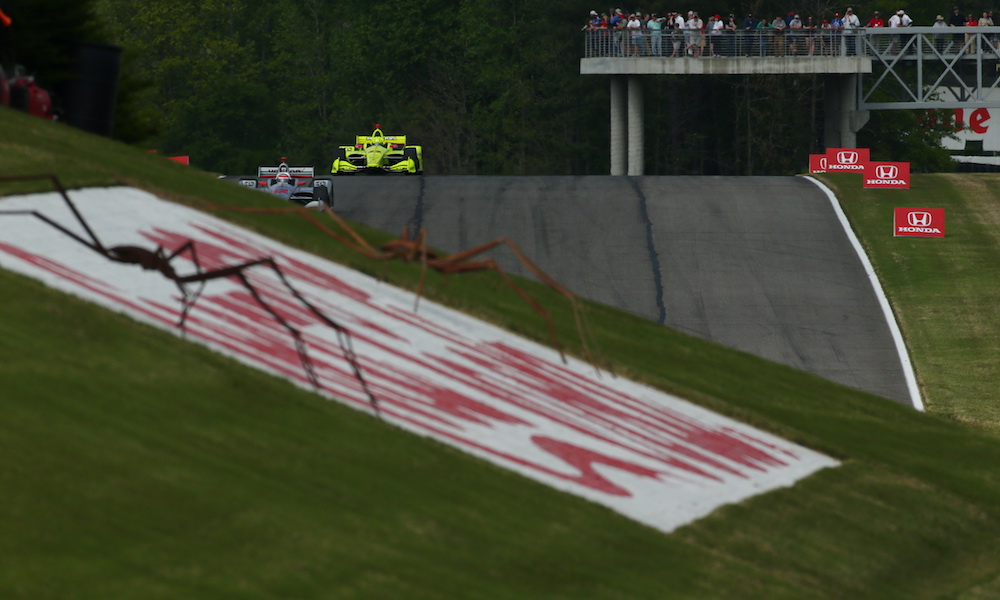
Want to make an IndyCar road course work in NASCAR's backyard? Start with an awesome venue. Image by IndyCar
How much do IndyCar’s own marketing efforts overlap with yours?
GENE HALLMAN: We collaborate a great deal with IndyCar on marketing, and we go and visit them in Indianapolis and sit down with their marketing teams and share idea, and I believe we’re actually giving them some thought leadership, and they indeed give us a great deal. Especially in this area of digital targeting, but also in creative things, which particular drivers have the highest appeal and which ones to push… Josef Newgarden is a natural here in Birmingham because of his Nashville roots. Helio Castroneves isn’t racing this year, but after being our first winner he was very popular for many years.
So we work closely with the series on our marketing efforts, and I tell you, in my business I deal with a lot of sanctioning bodies, from the NCAA, to the Southeastern Conference, to the PGA Tour, the LPGA, the USTA, and frankly the best sanctioning body I work with is IndyCar. They get it the most, in terms of working with… so many times it’s a push and pull relationship when you as a promoter are dealing with a sanctioning body. It is not that way at all with IndyCar. You call them and it’s a collaboration, a partnership. It’s been a very good relationship. I’m very comfortable with Mark Miles and his team.
What can other events learn from yours?
GENE HALLMAN: It’s hard to replicate our facility, but creating the different tentacles of the event to try and draw in non-race fans and try to turn them into race fans. We sold 100 cases of wine last year, and Sunday was a rain-out. And it’s not our primary purpose to sell wine. We keep developing these different aspects. The Grand Marshal has been the face of our event – we’ve had Bart Starr, Joe Namath, Bo Jackson, last year we had Channing Tatum. And that Grand Marshal creates and appeal and draws in someone who might not otherwise be drawn to the IndyCar message. So appealing to all folks… like parents – we allow kids 15 and under to get in free, because if they’re 15 and under they can’t drive, so somebody’s got to bring them. And they’ll have to buy tickets. It fits right in with the park theme – to have art, wine, the Museum, kids activities, and then the great racing.
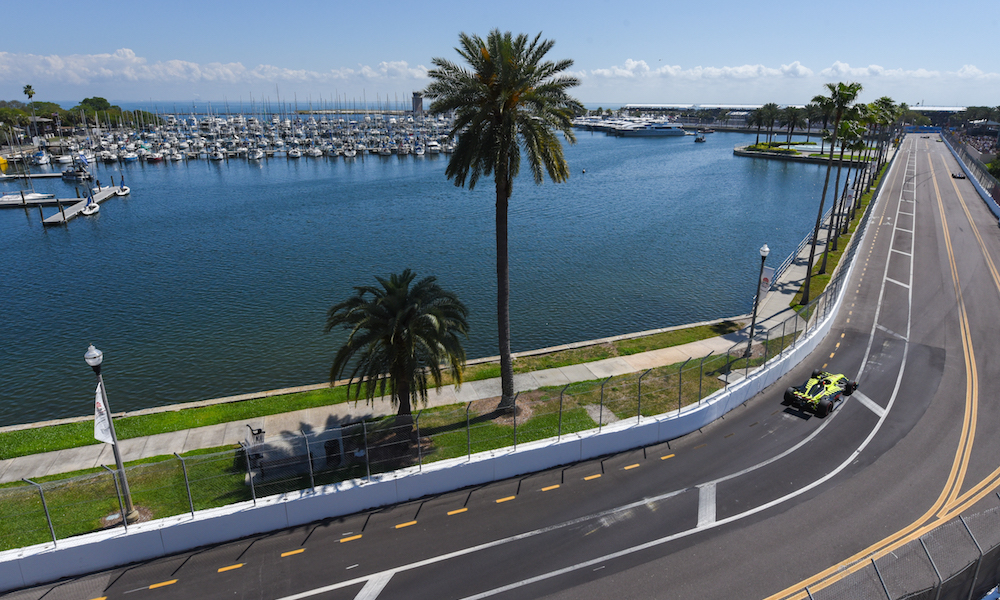
JIM MICHAELIAN: Putting on a street race is difficult, for lots of reasons. One, it requires a tremendous coordination between the host, which is in most cases the city, and the promoter. Two, you have to have a venue that is attractive, and we’ve said that around here for years. In theory you could run a street race anywhere there’s a street that’s wide enough, and can accommodate the paddock and do all those things. But to get the crowd you want, the people you want, and then as a product of that, the sponsors you want and the coverage you want, you need to do it in an environment that’s attractive. You need people to say, ‘You know what, that sounds like a cool place to go. I’d like to go there and see the races’. Or in some cases, ‘I don’t care if I see the races, it just sounds like a neat place to be at’.
Then putting together the operating team… and that’s really important. We have people who have been here for 20, 30, 40 years. This isn’t one of those things where you open the gates and let people in and then shut the gates when they go. You’re building a city within a city. And how that’s done is critical in terms of people’s perception of whether the event is a success or not.
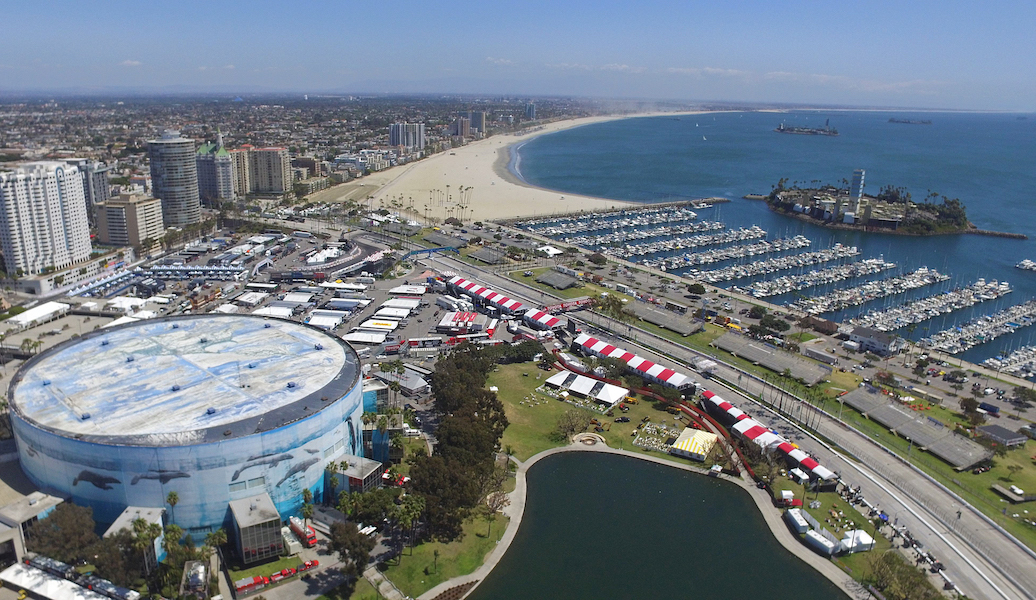
Long Beach is a benchmark for street events. Image by IndyCar
And lastly, you need to have the financial resources to make it work, because those first few years are difficult unless you have tremendous resources – which most people don’t. Those first few years, it’s very difficult to make any money at all. You have to survive for two or three years, and then the event starts to grow in terms of its attractiveness, and people’s awareness, and sponsors wanting to be involved. And then as time goes on, then you get the potential to start turning it into a financial success. But until that time… these events cost a significant amount of money, and you have to be able to put on a successful event, because unlike a permanent circuit, you can’t reopen in two weeks and put on a club race or a track day. We don’t have that. When Sunday night is done, we’re done as far as the event is concerned. Although since we’ve acquired so many assets over the years, we have a whole special events division that takes all those assets the rest of the year and uses them, whether for a volleyball or a concert. Just a couple of weeks ago, we put all of the seats out for the Academy Awards in front of the Dolby Theatre. So in some ways, it’s a little analogous to having a permanent circuit and being able to generate additional business. But in most cases, you’re pretty well dependent on that one street event to incur not only all of the revenue, but also to cover all of your overhead for the rest of the year.
KEVIN SAVOREE: People – fans, event-goers – want to be entertained. They want to come out, enjoy some food, enjoy the camaraderie, see the sights, hear the sounds, have the kids drive in a simulator or get to walk through the paddock… those are the things that create lasting memories of an event. For me, there’s nothing like the start of a car race. It’s just so special. Kim [Green] and I have such a thrill, such an excitement, for every one of them. Every one of them is going to be different; every one is going to make its own history, and that’s the part that we love. And once fans see that, they’re going to come back. And in the markets we’re in, that’s come to bear.
Mark Glendenning
Read Mark Glendenning's articles
Latest News
Comments
Comments are disabled until you accept Social Networking Cookies. Update cookie preferences
If the dialog doesn't appear, ad-blockers are often the cause; try disabling yours or see our Social Features Support.