INSIGHT: Inside NASCAR’s inspection process
Inspection. As a noun in the dictionary, it’s a simple word with just as simple meaning. However, inspection in NASCAR is far from simple and never does mention of the word bring the warm and fuzzies to those who must cope with it.
When it comes to the Optical Scanning Station (OSS), inspection has brought a new set of challenges to race teams.
“It kind of changed everything and it took a while I think for everybody to figure it out,” Joe Gibbs Racing crew chief Cole Pearn told RACER of the OSS process.
Alan Gustafson of the No. 9 Hendrick Motorsports team said the OSS is not as straightforward as one might imagine. Fellow crew chief Chad Knaus of the No. 24 team agreed.
It has been one year now since NASCAR rolled out its latest and greatest inspection tool. The OSS replaced the Laser Inspection Station (LIS) and claw template station. Praised for getting teams through the processes much quicker, the OSS is a more thorough piece of equipment.
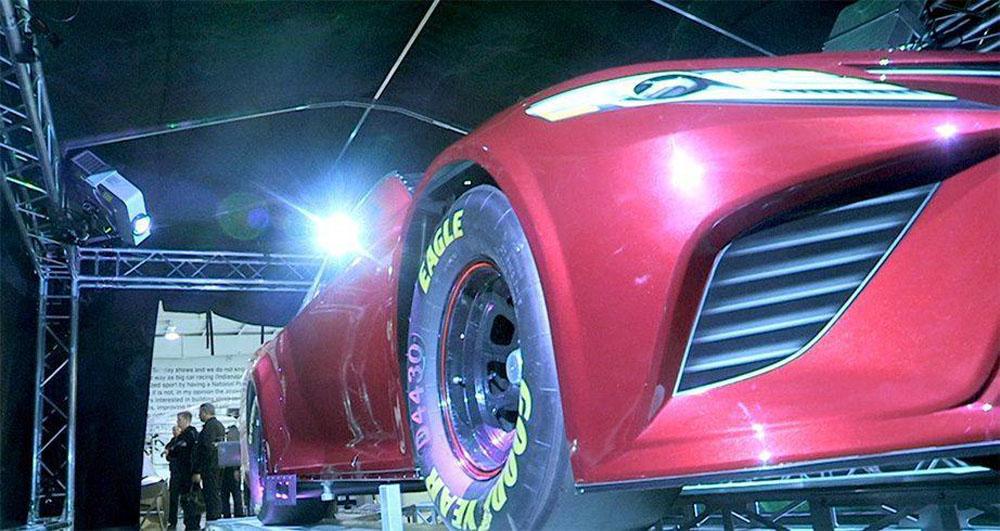
Set up in a black tent, the OSS consists of 16 cameras and eight projectors that create a 3D heat map of the vehicle. Green is good. Any other color requires a closer look for what could be out of compliance.
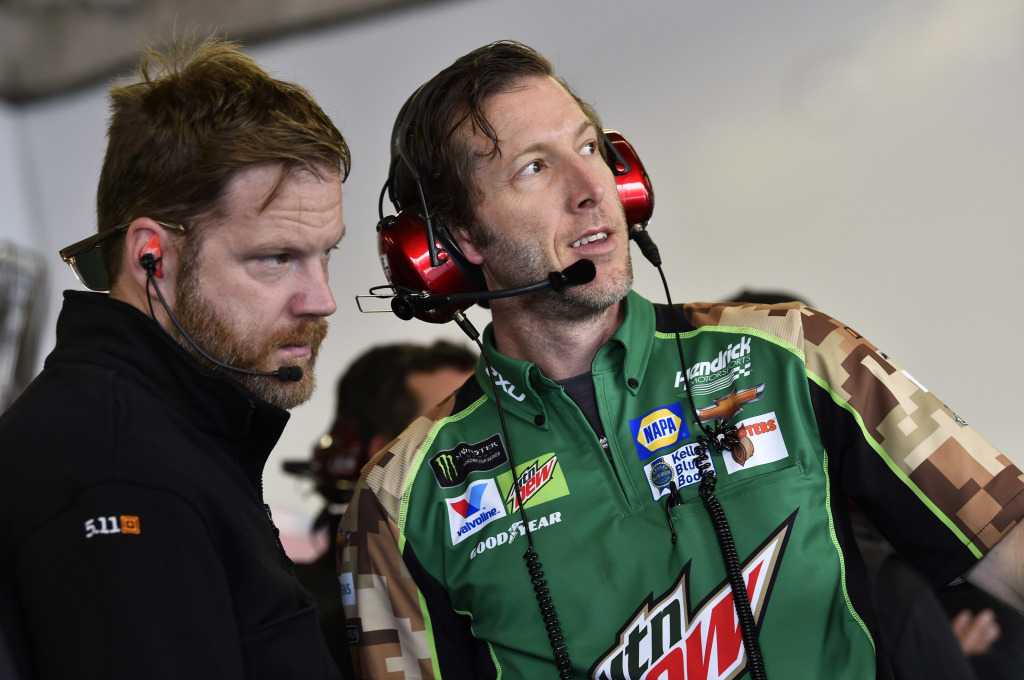
Alan Gustafson (Image by Nigel Kinrade/NKP/LAT)
“It’s an incredible piece of equipment,” said Gustafson. “The technology behind it is amazing, but there are some variances, and there are some things that aren’t just super-straightforward. If you build your car based on kind of a coordinate measuring system that we would use here, there are some views that cameras can’t get and there are some views that are slightly skewed, so there are some discrepancies between that.
“So, understanding in actuality and reality of where the part is and what the OSS interprets that to mean, there was some room there to work, for sure.”
HMS is one of the teams that has an OSS system at its shop. During a recent visit to its Concord, North Carolina campus, crew members revealed they use the system quite often while building their cars -- even before and after wrapping them -- to track how much the numbers might have changed as the car was continuously touched.
“It’s a unique system, and there is some drift in it, so you have to chase it throughout the season,” said Knaus. “And 'drift' just means as you break it down, reset it, break it down, reset it, things kind of change a little bit from location to location, so you've got to try to stay on top of that. Establishing those baselines early on and getting them put in place can be difficult.
“The other thing is as rules change, you’ve got to be able to adapt with the rules. Sometimes leniency drifts one way or another for a week or two, and then NASCAR gets on top of it, so then you've got to change to catch up all your fleet back to where they’re at.”
Mike Wheeler of Leavine Family Racing called the OSS a “game changer” and noted teams now have a tighter box in which to play. Todd Gordon of the reigning championship No. 22 group at Team Penske echoed those remarks and further explained how the tool has changed the way teams build cars.
For example, the old aluminum grid that would be placed over the cars was likely going to fit. Even if the cars weren’t purely like the grid NASCAR had, the car would adapt itself to it and teams spent years figuring out how far they could go with tolerances that would still fit the grid.
“That’s just racers,” Gordon said. “But now we came back to something that there’s a defined window of what you’ve got to work with and it’s a much smaller box. But within that window, there are things that you have to find that are sensitive … so what you need to focus on are different than what you had in the past.
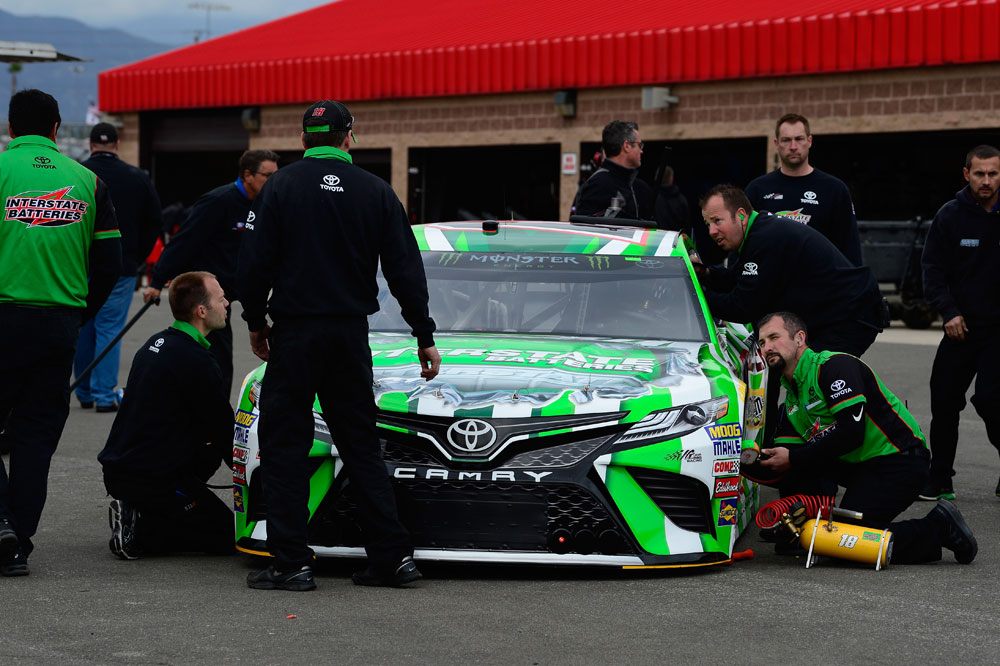
The crew for Kyle Busch's No. 18 attempt to pass inspection during qualifying at Fontana in 2018. (Image by Robert Laberge/Getty Images)
“It wasn’t purely rigid, so prior to the OSS we could move panels around, we could manipulate cars, we could put things in different places … we could get parts offset to where they would be aerodynamically better. When the OSS came into play, it really defined the box a little bit better as to what the gross moves of any of the major components of the car could be and changed what you had to work on. You weren’t trying to manipulate the (old) grid as much as now because the repeatability of the OSS system is really good. It sees things the same way.
“Some guys got ahead of us in how aggressive they could get with using that three-thousandths of an inch window that they had to work in and what things would look like working in that, but as a whole, it’s a very repeatable inspection scale. It does the same thing to a car multiple times; but understanding how to work with it, what it saw, what it didn’t see, I think was the biggest learning curve for all the teams.”
Said Pearn, “It’s a lot more time in the shop, I know that. It’s way more work getting a car ready to go to the racetrack than what it was before. It’s forced you to have more quality control from just a legality standpoint. It’s forced you to have more quality control from a performance standpoint, too. It’s made [things] a lot more tedious, a lot more work -- but if that makes competition closer, I don’t know. I still feel like it’s the same guys that are always rising to the top. Maybe it balances power between the manufacturers, but I don’t know. Either way, it’s just a lot more work, I’ll say that.”
Teams that wrapped their hands around the system early on or those who figured out how to use the OSS to their advantage saw success when the car went from the race shop to the track. The easiest way was by investing in the tool and having it at the shop instead of carving out time at the NASCAR R&D Center. Bigger teams bought their own OSS, but Wheeler noted a smaller group like LFR does not have one.
Gustafson said “oh, absolutely” there was the correlation between understanding the OSS and performance. At times there were experiments with different colored lights and different colored cars to see the effects.
“It was fun for me -- I don’t know what everybody else thought, but I enjoyed it,” said Gustafson. “It was a neat challenge, and it was cool to be able to learn and understand the different things that went on with it and then be able to take that information and implement it to a performance advantage. I know sometimes that is a bad word, performance advantage -- I don’t know why -- but I think it was there. I do think that will calm down some because it’s ran the course a little bit, but it’s still there.”
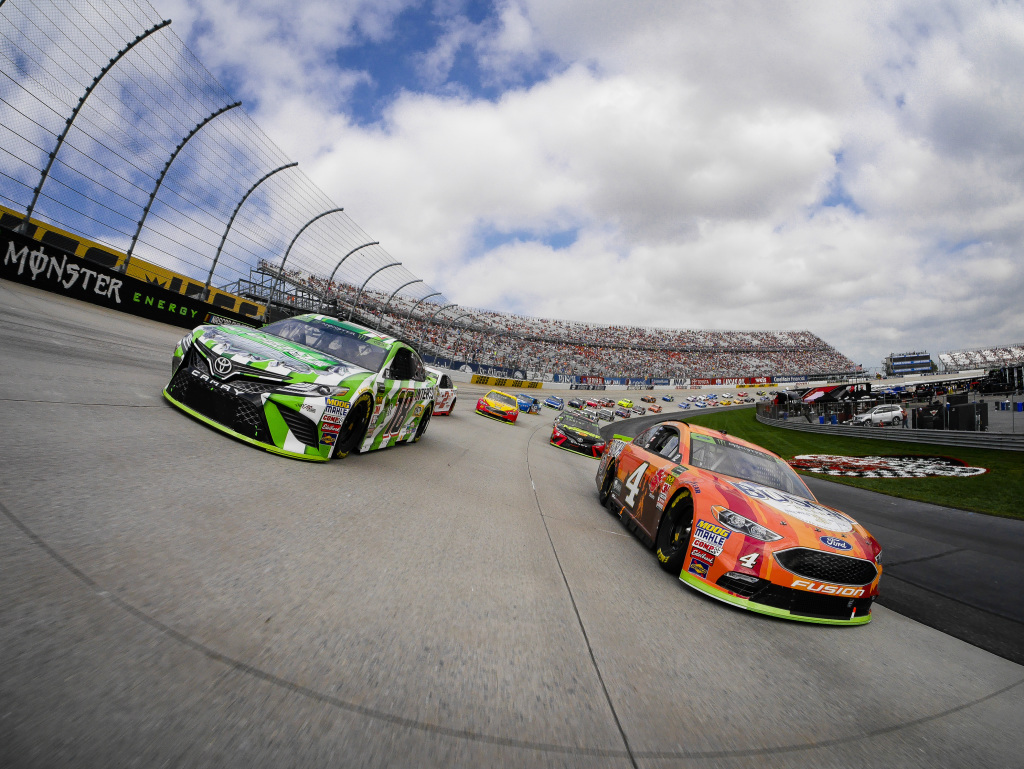
Did getting ahead on OSS play a significant part in Kevin Harvick's fast start to 2018? (Image by Barry Cantrell/LAT).
Gordon felt Stewart-Haas Racing did a “phenomenal job” adapting to the OSS, which showed with the strength of Kevin Harvick. But in the case of his team and Joey Logano, Gordon said they were not as strong in the beginning of the season because he anticipated that teams would all be in the same spot and be in a restrictive box.
“I didn’t look at that and say, ‘What can’t it see?’ I looked at it more of, 'It’s going to see everything.' And there were things that it couldn’t see, and NASCAR had to learn how to officiate those pieces, and teams got ahead because they could work in the boxes of places that the OSS was blind to start with.”
NASCAR has confirmed for this season it has moved three of its cameras in the OSS for a better view of the decklid.
Going into the second year with the OSS in play, Gustafson believes there will be more of the same in terms of how teams push the issue. While it is always their responsibility to adapt to how NASCAR inspects the cars, he said there is also going to be work to exploit the loopholes. Wheeler believes the OSS was the right way to go, and Knaus praised the tool for what it’s capable of.
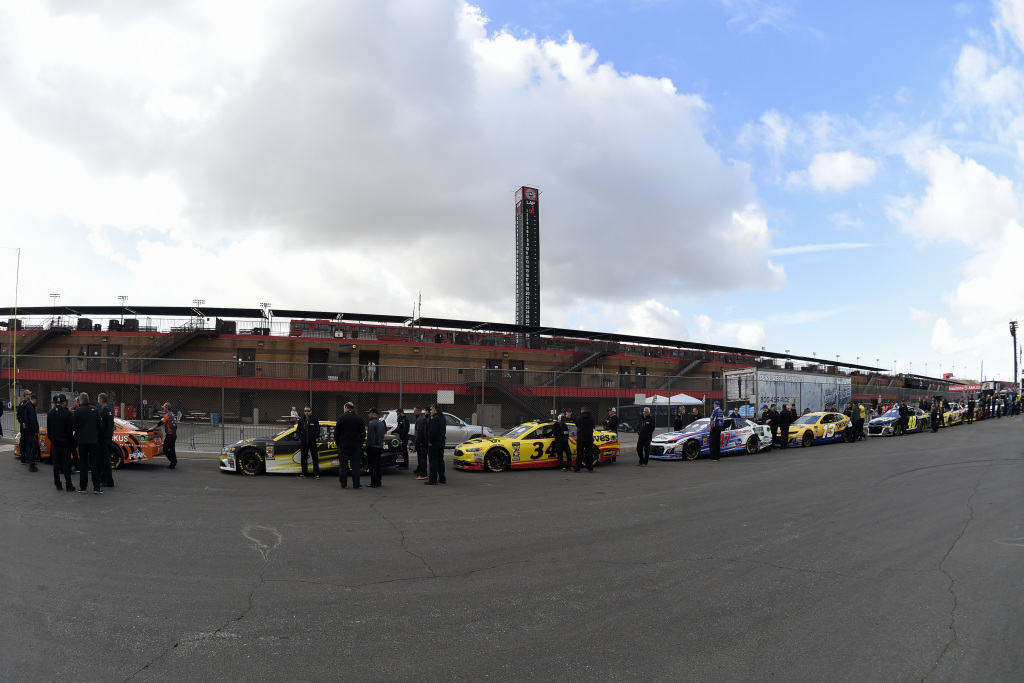
Cars line up for inspection. (Image by Logan Whitton/LAT)
“Oh, I hope there’s no story with inspection,” said Gordon of this season. “I think the question marks as you lead into a new season, we’ve had a change in several positions in the officiating area and how that impacts what we see and how we’ll send our cars through inspection and who looks at them and how they are scrutinized.
“It’s the same as last year, so I think we’re all understanding what it’s abilities are and how to make sure we stay within the abilities of what it has to make sure our cars are good for inspection but still find the places you can work on.”
NASCAR announced last week each of its three series would have officials dedicated to each garage. For the Cup Series, there will be 10. Jay Fabian has also been named the new series managing director.
Inspection...so much work and regard for such a simple word.
Kelly Crandall
Kelly has been on the NASCAR beat full-time since 2013, and joined RACER as chief NASCAR writer in 2017. Her work has also appeared in NASCAR.com, the NASCAR Illustrated magazine, and NBC Sports. A corporate communications graduate from Central Penn College, Crandall is a two-time George Cunningham Writer of the Year recipient from the National Motorsports Press Association.
Read Kelly Crandall's articles
Latest News
Comments
Comments are disabled until you accept Social Networking Cookies. Update cookie preferences
If the dialog doesn't appear, ad-blockers are often the cause; try disabling yours or see our Social Features Support.