No Mirage Here
Historically, global motorsports, and particularly Formula 1, had been a Eurocentric affair, albeit with outposts in Japan, South America, Australia and America. However in the late 1990s, bastions of motorsport like France, Italy and Germany were seeing declining crowds, aging tracks and increasing financial and municipal challenges to hosting major international races. Former F1 impresario Bernie Ecclestone saw a shifting landscape and moved to expand the sport's footprint around the world.
Malaysia's Sepang International Circuit was the first toehold in the plan to diversify F1's calendar, but international racing in this region of the world was hardly new. After all, Macau to the north had been hosting Formula 3 since 1983 and GT racing dating back to 1954.
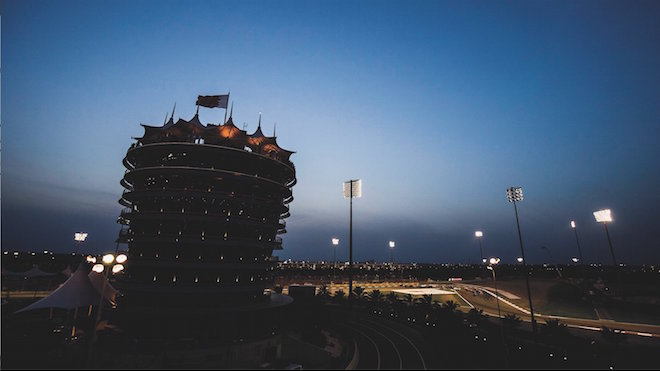
Then, a new, state-of-the-art track sprang up in a Middle Eastern desert within the Kingdom of Bahrain. In the 1930s and '50s, grands prix had been hosted in Libya and Morocco, but never before had this region of the world been thought of within the context of modern international motorsports – until the Bahrain International Circuit made its debut on the 2004 F1 calendar.
"When we first opened the Bahrain International Circuit (BIC) back in 2004, F1 was something brand new to the region. However, motorsport certainly wasn't," says BIC chairman Mr. Arif Rahimi. "Indeed, the Bahrain Motor Federation was formed back in 1952, so we do have something of a racing heritage in certain disciplines. But unlike drag racing, which was familiar to a core racing fan base, there was little knowledge of F1, let alone the teams and drivers involved at the time."
Skeptical voices from afar were muted as plans for BIC came together and were eventually realized. In creating those plans, the track's founders looked to their own roots for the path to success.
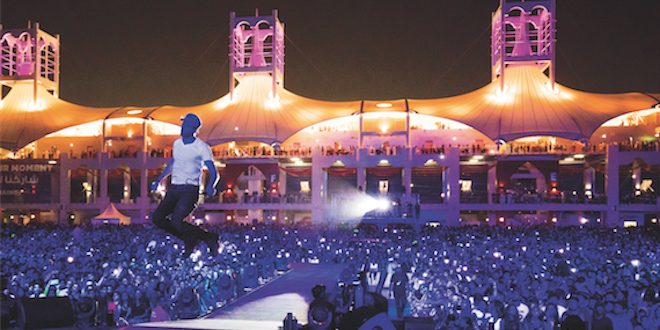
"You could quite easily assume therefore, that bringing F1 to a new region was a risk, but we didn't see it that way," continues chairman Rahimi. "The key from the beginning was to find our position in the sport. We have never tried to compete with the historic European races; rather, we took the core elements of our culture and reflected that in the way we host F1. Hopefully, 13 years on, fans who've been to Bahrain for F1 now recognize the traditional Bahraini hospitality, the family friendly nature of our event, and the broad spectrum of racing and entertainment."
Today, the excitement around the Formula 1 race can be felt across Bahrain.
"The circuit is a point of pride for Bahrain. You notice around the time of F1 especially that the whole country is taken in by F1 fever," adds Shaikh Salman Bin Isa Al Khalifa, BIC's chief executive. "I would reckon that, given our small population, we probably have the highest percentage of residents attending the race than any other country which hosts F1."
From that first grand prix in 2004, through to the track's tenth anniversary race in 2014 that saw an exciting switch to racing under the lights, BIC has gone from strength to strength. Indeed the '14 grand prix is often hailed as one of the most thrilling F1 races in recent memory, where Nico Rosberg and Lewis Hamilton went hammer and tongs for the full race distance.
"The tenth anniversary race was something special for us, especially as our first night race," says Shaikh Salman. "To have that marked with one of the best races I have ever witnessed was a true honor. Our primary role is to ensure the best experience for fans, and much of that is getting the right mix of on- and off-track experiences and entertainment."
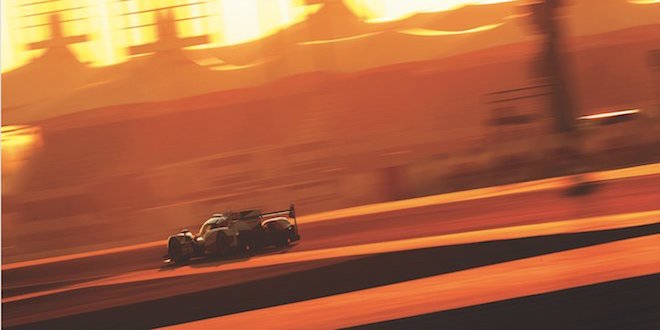
As a result in part of F1's success in Bahrain, BIC is far from a one-race venue. The FIA World Endurance Championship has scheduled its championship finale there every year since 2013, except for '14 when it hosted the penultimate round. And at a regional level, Bahrain International Circuit is the epicenter for a variety of motorsport series and activities on two wheels, four wheels and karting.
"A key element for us at BIC is to ensure that we operate as a sustainable long-term business, not solely reliant on F1. Yes, of course it is F1 that put us on the map, but the facilities we have built enable us to use the circuit all year round," says chairman Rahimi.
"Overall, we host in the region of 350 events per year, in addition to our setpiece international events. Economically, F1 is of course the most important, bringing in around $100m per year of direct economic impact to the circuit and local business. Outside of that, the impact of F1 on tourism to the Kingdom throughout the year is significant."
Among those 350 annual events is the longest-running circuit racing championship in the Middle East, known as the BIC 2000 Challenge and now in its 11th year. Catering to amateur and semi-professional drivers and teams, the BIC 2000 Challenge is for production-based sedans and GT cars under 2000cc engine displacement. It's created an opening into motorsport for many people in the region. In addition, the circuit also hosts the Porsche GT3 Cup Challenge Middle East, and on two wheels the Bahrain Superbike Championship, where all riders compete on identical Ducati 899 Panigale sport bikes.
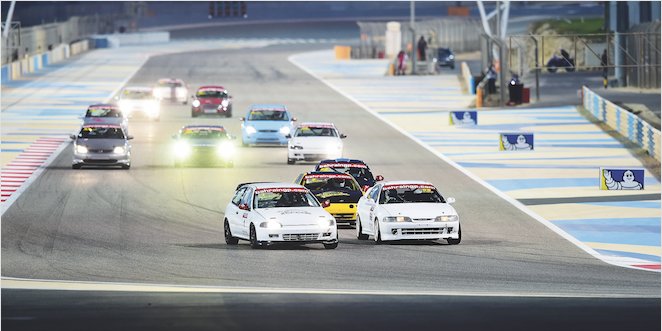
The facility is also home to an FIA-CIK karting track and an off-road course that is the site for a Land Rover Experience. BIC is also looking at newer horizons by embracing the worlds of drag racing and drifting.
"Now that we have become an established race, we have been fortunate enough to be able to travel around the world, supporting new promoters as they come into F1," says Shaikh Salman. "Baku has been the most recent example of this where we have provided extensive consulting services to them around marshaling, race control and logistics. We are proud that our team of home-grown experts are now an exported commodity around the world.
"Our plan is to continue to build patiently our global reach as the home of motorsport in the Middle East. Making use of our world-class facilities, growing interest in the sport and increasing our calendar of events will all contribute to that. You only have to look at the crowds and participation in events such as our drag racing to see how interest has grown."
Not only has the Bahrain International Circuit established a solid motorsports presence in the Middle East, it's also undoubtedly compelled the legacy circuits around the world to raise their game as well, and that is no illusion.
DESTINATION BAHRAIN
bahraingp.com
Presented by:


Latest News
Comments
Comments are disabled until you accept Social Networking Cookies. Update cookie preferences
If the dialog doesn't appear, ad-blockers are often the cause; try disabling yours or see our Social Features Support.