PRUETT: A chance, a hope and a future
There are no participation trophies on the Mazda Road To Indy. And you won't find the dead ends that have plagued so many other open-wheel training systems in the past.
Take it from Brazil's Victor Franzoni, the kid who just won the Pro Mazda championship, who summed up the MRTI's value in 18 eloquent words: "Mazda is not just giving the prize money in the Mazda Road to Indy, they are giving hope."
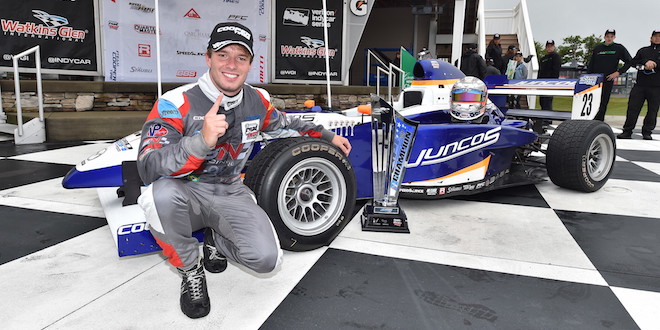
The 21-year-old Sao Paulo product is following in the footsteps of countryman Tony Kanaan, who chased similar opportunities with empty pockets before Franzoni was born. Working 60-70 hours a week as a race car mechanic, Franzoni's busy life outside his Juncos Racing Pro Mazda chassis was dedicated to earning the income required to pay for Cooper tires and entry fees to vie for the title.
With his father at his side, the two spent the season perfecting the art of finding the cheapest hotels, where they shared a single room, and ate at the least expensive restaurants. Unburdened by wealth, Franzoni channeled his inner Kanaan, who slept on shop floors and lived below the poverty line while trying to move up the open-wheel ladder, and was duly rewarded last weekend for demonstrating his immense natural talent.
The sacrifices, all made to pursue the big prize on offer – a free season of Indy Lights, paid for by Mazda – reserved for the Pro Mazda champion were worth it. Pitted against the highly-talented Aussie Anthony Martin, who won the 2016 USF2000 championship and the free Pro Mazda ride that came with it, Franzoni took seven wins from 12 races. He placed second at the other five.
"Victorious," as I like to call him, just spent an entire season on the podium and is headed to Indy Lights with a check for $800,000 to pay for 2018. Thanks to Cooper Tires and Andersen Promotions, Franzoni will also have a combined $91,000 in credit to cover tires and entry fees. Maybe he won't have to work as much and can spend his weekdays training like most of the other MRTI drivers.
The story of "Victorious" Franzoni is only possible because of Mazda, and he isn't alone. Oliver Askew won a shootout held by Mazda during the offseason where the Florida karting sensation, who was also chosen by Jeremy Shaw as one of his Team USA Scholarship winners, took to open-wheel racing like it was his life's calling.
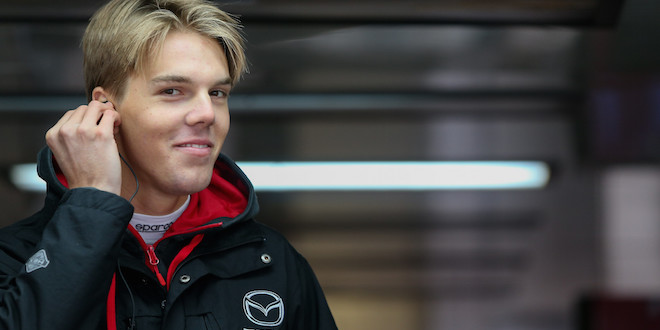
The 20-year-old phenom, who took his Mazda prize and turned it into a USF2000 championship in his first season out of karting, is on his way to a free season of Pro Mazda in the new PM18 chassis with the $325,000 check provided by Mazda. Like Franzoni, Askew has a healthy tire and entry fee credit of $44,000 to use when he signs with a Pro Mazda team.
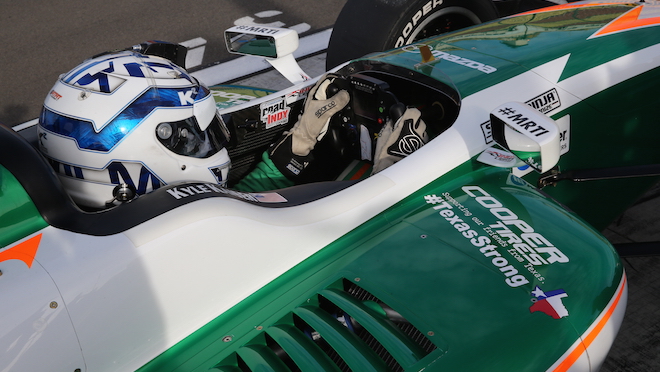
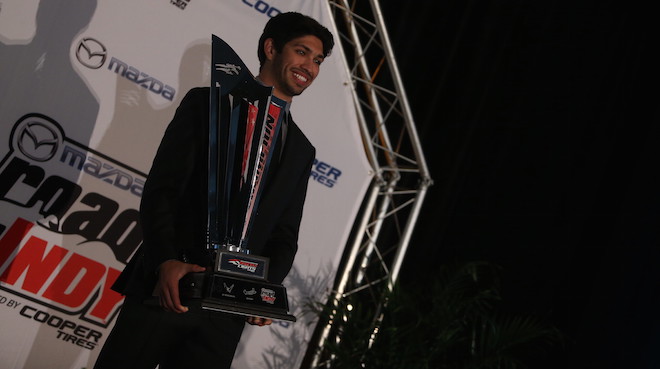
At the top of the ladder, Kyle Kaiser captured three wins and $1 million to graduate from Indy Lights to IndyCar. A steady season of performances, including three wins and eight podiums from 16 rounds, will catapult the Northern Californian to next year's Indy 500 and a few additional races, at minimum, to kickstart his IndyCar career. Kaiser took another $30,000 in cash prizes and will have a $25,000 parts credit with Dallara to use in IndyCar. He'll be 22 when he gets there – the same age as many of his friends who are graduating college.
Drivers who finished second to fifth in each series took home money from Mazda as well: Lights runner-up Santi Urrutia pocketed $75,000, which is more than double what an IndyCar driver earns in prize money for a win outside of the Indy 500.
Combine all of the hard cash Mazda has committed to its MRTI drivers in 2017, and $2.6 million was distributed to its champions and top contenders earlier this week. The extra incentives from Cooper, Andersen, Dallara, and a number of other companies only add to the value found on our ladder system.
As IndyCar heads into its season finale with points leader Josef Newgarden (2011 Indy Lights champion) being chased by Scott Dixon (2000 Lights champ), Helio Castroneves (1997 Lights runner-up), and Simon Pagenaud (2006 Atlantic champion), it's easy to appreciate how one system, the MRTI, gives the Askew's a chance, the Franzoni's hope, and the Kaiser's a future.
It also gives IndyCar its future stars and champions.

Latest News
Comments
Comments are disabled until you accept Social Networking Cookies. Update cookie preferences
If the dialog doesn't appear, ad-blockers are often the cause; try disabling yours or see our Social Features Support.