CRANDALL: How to train Michigan's dragon
There are a few questions that need answers after the FireKeepers Casino 400 at Michigan International Speedway.
A track raved about for its ability to produce three-wide action and multiple racing grooves was a skeleton of itself this past weekend. Sure, the 200 mph speeds were there, and clean air remained as important as ever, but it was tough sledding for those who weren't the leader.
To start, it was one groove. Passing – taking restarts out of the equation – was limited. Three-wide excitement? Nearly non-existent. How about drivers running up next to the wall? Unthinkable. This was not a Michigan we had seen before, and I can't help but wonder if it could have been avoided.
See, the Monster Energy NASCAR Cup Series could have rolled into town and gone about its business, and many might be talking about the great racing this week. Instead, the decision was made to run the tire dragon one lane off the bottom of the track.
Using the tire dragon is a double-edged sword because while it might have improved the grip in that groove, it also resulted in drivers being forced to run only there. Those who didn't or were forced out of line had to gather themselves back up while counting the positions lost.
"It was so hard to pass out there," Ryan Blaney said. "The fastest cars couldn't get to the front if they weren't already there."
Case in point was Martin Truex Jr. Truex dominated the early portions of the race by winning the first and second stages. He was one of the fastest cars all weekend and had things well in hand until late in the race when he lost the lead.
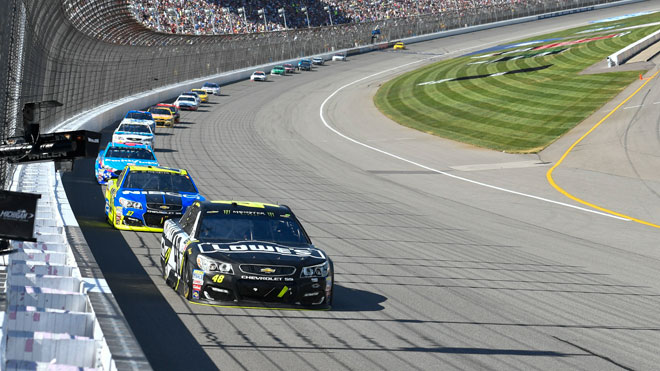
In dirty air, Truex (pictured, No. 78) went nowhere. And despite having one of the strongest, if not the best car in the field, Truex could do nothing lined up on the inside lane on restarts. It's here we must admit the only reason restarts were worth watching is because drivers on the inside were peddling hard to make it stick while those on the outside powered by, hoping they weren't taken out by anyone on the bottom getting loose.
"Without a shadow of a doubt our No. 78 Auto-Owners Insurance Toyota was the best car out there, but inside-lane restarts at the end just killed us," said Truex after finishing sixth. "Unlike the outside lane, we just couldn't get going each time we restarted in the inside lane. It stinks when you have to race that way."
Chase Elliott, who finished second, also mentioned how hard it was to pass in his post-race comments. His teammate Jimmie Johnson was one who pointed out how it was a one groove track.
So why was a good thing touched in the first place?
The tire dragon and VHT compound have been the recent go-to in hopes of improving the racing at certain tracks, yet it's head scratching why one thought Michigan needed it. What has been so bad about the track's past races? What was wrong with drivers having lane options and seeing the likes of Kyle Larson and Dale Earnhardt Jr. running inches off the wall?
In no way do I mean to say the racing was terrible, so don't misunderstand the disappointment here. Any effort made to improve the racing product is commendable, but the focus is usually on places where it's obvious it's needed. Michigan has never struck me as a place that immediately comes to mind.
When asked if the tire dragon had made a difference or not, third-place finisher Joey Logano admitted he didn't know it had been used. But he followed that up with, "I think they did it in the groove, so no. They did it in the wrong spot, in my opinion."
Let's start with hearing the reason behind doing it first and then discuss how the track could be improved for the August race.

Latest News

Comments
Comments are disabled until you accept Social Networking Cookies. Update cookie preferences
If the dialog doesn't appear, ad-blockers are often the cause; try disabling yours or see our Social Features Support.