Weighing the Triple Crown debate
Fernando Alonso's appearance at this year's Indianapolis 500 has been heralded as a step towards an attempt by the Spaniard to become the second driver ever to win racing's Triple Crown. But as this piece, first published in the July, 2017 issue of RACER (No.285), reminds us, the definition of what the Triple Crown actually consists of is far from clear ...
It took Graham Hill a decade to accomplish the achievement that sets him apart from any other racing driver in history. Or maybe just nine years... The racing world is united in recognizing the suave Brit as the only holder of racing's Triple Crown – but less so over what that actually entails.
Conventional wisdom holds that the honor belongs to a driver who can win the Monaco GP, the Indy 500 and Le Mans. Hill, famously, made Monaco his playground: he scored five wins in the Principality. But where things get tricky is that Hill himself defined the Triple Crown differently.
"It's the World Championship for drivers, the Indianapolis 500, and the Le Mans 24-Hour race," he told a British TV host in early 1975. He cemented his stance with the follow-up, when he was asked which of the three titles meant the most to him.
"Indianapolis (MAIN) produced more loot than the others," he said. "Le Mans was very nice to win after so many years of trying, and that's the one that meant that I did win the Triple Crown, but out of all of those, one has got to say the World Championship, because it's a whole series of races over a complete year."
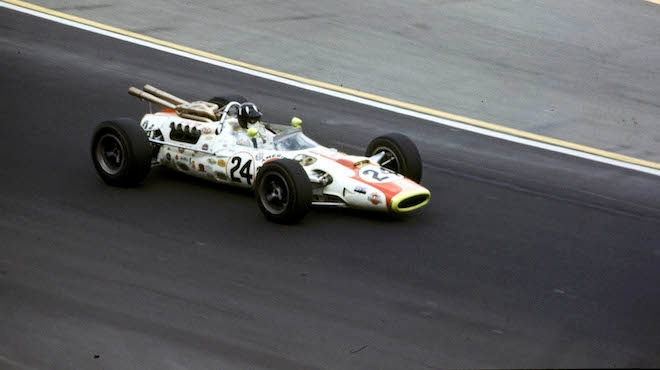
It's a purely academic point, because regardless of where you draw the Triple Crown line, Hill still qualifies for the honor. His two world championships came six years apart – the first in 1962, when he gave BRM its only title, and again in '68, this time as Lotus's rock and leader after teammate Jim Clark's death at Hockenheim in April. (He also won Monaco in 1968, RIGHT). Those titles bookended his Indy win, which he earned as a slightly embarrassed rookie in the 1966 race, when a third of the field was eliminated in a crash at the start.
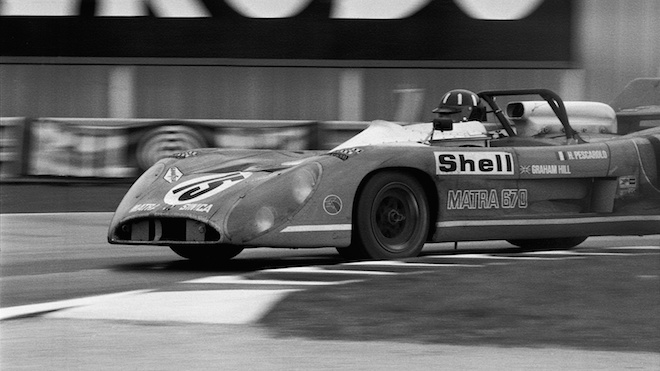
All were achieved by a driver in his prime – a description that was becoming increasingly difficult to associate with Hill by 1972. That year marked his 10th visit to La Sarthe (BELOW), and he made the trip amid increasing speculation over his future in F1, where the 43-year-old veteran was struggling miserably with Brabham.
But if Henri Pescarolo was worried about sharing his Matra MS670 with a driver in decline, he was in for a surprise. Hill may no longer have been able to dance on a knife-edge, but Le Mans back then demanded mechanical sensitivity at 95 percent effort, and that suited Hill just fine. He took the lead just after midnight, and later that afternoon, Hill's special place in racing history had been secured.

Latest News

Comments
Comments are disabled until you accept Social Networking Cookies. Update cookie preferences
If the dialog doesn't appear, ad-blockers are often the cause; try disabling yours or see our Social Features Support.