Rear View: Jovy Marcelo, 25 years on
Jovy Marcelo's soft features and permanent smile belied the fact that he was a championship-winning racecar driver on the rise in open-wheel racing. The Filipino driver, killed 25 years ago today in a crash during practice for the 1992 Indy 500, was largely anonymous – a new face in the CART IndyCar Series – at the time of his death. A quarter century later, he still remains a bit of a forgotten footnote in 500 history.
"He was real soft-spoken, but in the car, he was not afraid to race you hard, wheel-to-wheel," 1996 CART champion Jimmy Vasser said of his former rival. "I think of a young Paul Tracy – Jovy was the same way."
Born and raised in the Philippines before his family moved to the San Francisco Bay Area, the second-generation driver came to prominence in the Toyota Atlantic Championship, where he showed great potential in 1990.
After switching to the crack P1 Racing team the following year, Marcelo won the Atlantic title by four points over Vasser, his main rival. Long on talent but light on funding, the two young upstarts graduated to CART in 1992 with smaller teams that offered no chance to bother the big programs.
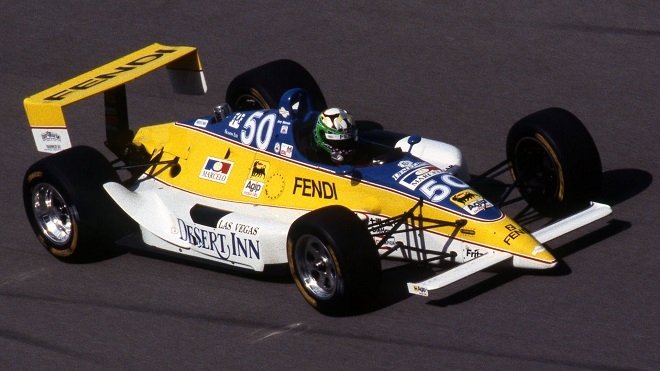
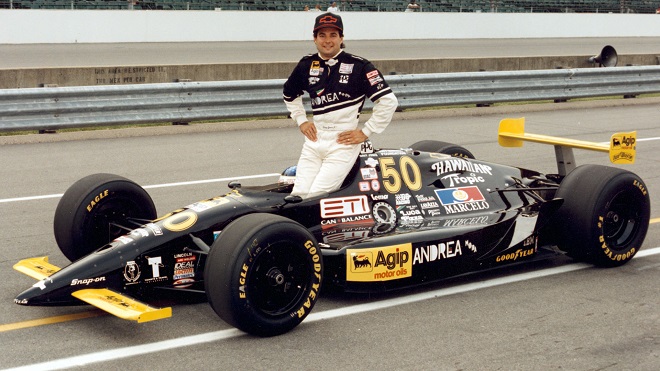
Their journey continued at the back of the CART grid, with Marcelo joining the tiny Euromotorsport outfit (pictured, TOP) and Vasser landing with the new Hayhoe Racing effort. Despite their humble starts, Vasser (pictured below with Marcelo in '91, Marshall Pruett photo) spoke fondly of fighting over mid-pack positions with his Atlantic nemesis.
"He was a great person," he said. "He came from a really tight-knit family. He was married with kids. He had a couple of small children. I knew his father real well – a real likable guy. He was the only pro driver I've ever seen from the Philippines, really. And he was a great competitor. He was a smooth driver, pretty quick.
"I think he was a great protagonist for me in the Atlantic Championship. I liked those years. And Jovy was a champion. That says it all right there. I was second in the championship. I had six poles and six or eight wins, but he pulled it out and beat me by four points. He was a well-deserved champion."
Veteran IndyCar team owner Derrick Walker gave Marcelo his first Indy car test. Like Vasser, he was stunned by the realization so many years had gone by since Marcelo's passing.
"He was just a nice, nice kid," Walker recalled. "Pleasant, a serious professional – very mature for his age. And his parents, his father, they were just good people to be around.
"We tested him and, like a lot of people that you meet along the way, you can't put a deal together because you didn't have the money to be able to make anything of it. But he tested in typical fashion for him – very diligent and not getting too distracted by the occasion; he took it in his stride. I liked him a lot for the little time I spent around him."
The CART community didn't have much time to get a feel for Marcelo's capabilities in the three races he contested with Euromotorsport prior to Indianapolis. Saddled with a year-old Lola chassis powered by an uncompetitive Cosworth engine, Marcelo was never going to impress against the Andrettis, Unsers, and other legends in the series. Through the first three rounds of the championship, Marcelo barely cracked the top 20 at Surfers Paradise, Phoenix or Long Beach, but was looking forward to his first appearance at Indy.
Driving the No. 50 entry, Marcelo made it through Rookie Orientation, but the old Lola wasn't performing up to expectations once official practice began on May 2. During an era where the entire month was used for practice and qualifying was completed over two weekends, the Euromotorsport team realized it had no hope of running for the pole and formed a plan to continue practicing and searching for speed while aiming to qualify during the second weekend.
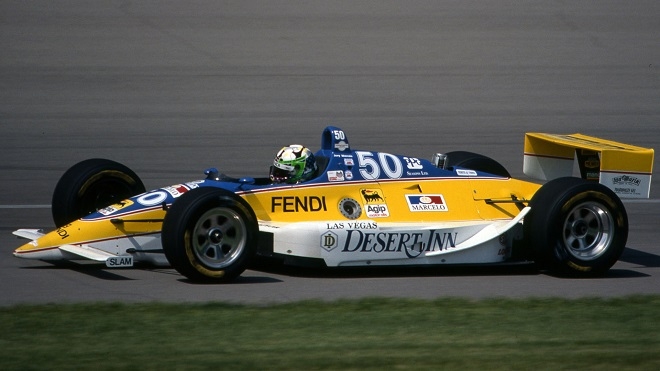
On Thursday the 14th, Marcelo would raise his speed to 216.8 mph, and with one day left before the final weekend of qualifying to reach an average of 220 mph – the minimum speed most felt would be needed to make the field of 33 – the pressure was on.
To give Marcelo his best chance of earning a spot on the grid, the Euromotorsport team installed a fresh engine to use for the weekend, but it also meant the car spent most of Friday the 15th in the garage. Marcelo and the team finally ventured out at 3:48 p.m. to test the engine and try some simulated qualifying runs. Nineteen minutes later, he was gone.
The IMS TV cameras only managed to catch the tail-end of Marcelo's crash entering Turn 1, but reports had him getting low into the corner, which caused the car to break free and rocket toward the wall. The No. 50 hit nose-first before ricocheting and continuing around toward Turn 2, where Marcelo came to a stop.
The crash was undoubtedly violent, but looked like countless others where drivers emerged alive and intact. Yet Marcelo was pronounced dead at Methodist Hospital at 4:35 p.m.
IMS Medical Director Dr. Henry Bock offered a succinct answer on the physical cause of Marcelo's death: "Blunt force head injury caused by the crash. There were no other injuries. After examining Marcelo's helmet and uniform, there are no marks or damage indicating Jovy was hit by a tire, suspension piece or any other member of his car."
Marcelo died five days short of his 27th birthday, leaving behind his pregnant wife Irene and five-year-old son Karsten. His death on May 15 also coincided with the 10-year anniversary of Gordon Smiley's horrific loss at the Speedway in 1982.
The exact root of the basal skull fracture that took Marcelo's life was never sufficiently proven. Although its widespread adoption would come a decade after his crash, the use of the HANS device would eventually and greatly reduce the number of basal skull-related racing deaths.
Marcelo's father, Edward, proved to be one of the more remarkable figures in the sport after losing his son. Rather than retreat and grieve in private, he was a visible figure afterward and continued to support Indy car racing by providing associate sponsorship for the Euromotorsport team through the mid-1990s (BELOW: Davy Jones in a Marcelo-backed Euromotorsport Lola at Indy in 1993).
Marcelo's death also affected the entire Vasser family – at the track and from afar.
"It was a very tough time for me, being a rookie and a young guy," said Vasser. "The one guy that I was kind of coming up with got killed at Indy... It was tough on my family as well. There was a point there where they really didn't want me to keep doing it after Jovy died. It was tough on my dad because there was some confusion when it happened. There was a news report in the Bay Area, and Jovy lived in Hillsborough (about 15 minutes south from Vasser's San Francisco home). My dad wasn't at Indy, but he heard on the radio, 'Local rookie killed at Indy' and he freaked out because he thought it was me. It was a real tough time for him.
"Then I went on to break my legs in the race, so there was a time there the rest of my family wasn't real happy about me being a driver. Not to mention all the crashes that happened in 1992. I broke my leg, Jovy got killed, and a lot of other guys got hurt – Jeff Andretti was in a terrible way, with his feet, (almost) finished his career. '92 was a really tough year in that way."
Marcelo didn't get the chance to mature as an Indy car driver, to sample better equipment, or to produce the results many believe he was capable of delivering.
"He won [Atlantic] races on the road courses and the ovals and he stepped it up," Vasser said. "How far he would've gotten in his career, I don't know. But he certainly was talented enough to have the opportunity to be in the position he was in. A lot of moving forward has to do with having the right type of package; there were a lot of guys who are talented that I'd see growing up in the lower formulas that didn't really get the chance to move on who probably deserved to be there. Jovy deserved to have a better chance at Indy car than he got."

Latest News
Comments
Comments are disabled until you accept Social Networking Cookies. Update cookie preferences
If the dialog doesn't appear, ad-blockers are often the cause; try disabling yours or see our Social Features Support.