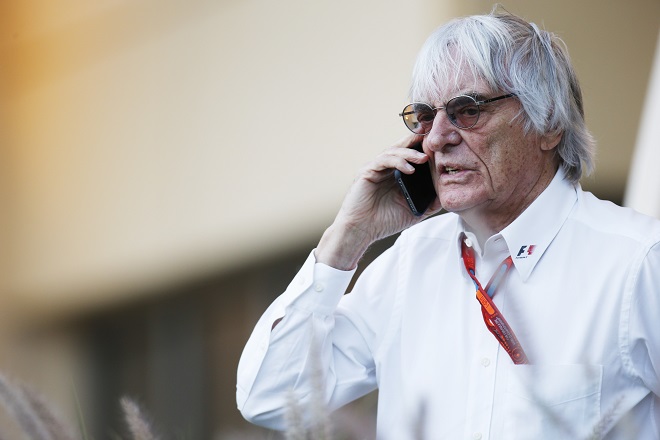
MILLER: The Great Dictator
He was arrogant, confident, observant, abrasive, passionate, clairvoyant, churlish, organized, petulant and persuasive. He was a gambler who didn't suffer fools and a ruthless negotiator who treated promoters and countries like ATMs.
But, above all else and most importantly for Formula 1, Bernie Ecclestone (above) was the smartest guy in the room for five decades.
And while he was finally shown the door a few days ago, don't ever kid yourself: Ecclestone didn't just run F1 – he rescued it and drove it to heights nobody could ever imagine 50 years ago.
"Formula 1 would have never got to the level it is without Bernie," said Derrick Walker, who began his racing career as a mechanic for Brabham when it was owned by Ecclestone in the early 1970s. "And not only did he love F1 – he saved it."
Derek Daly spent five years competing in F1 before heading for IndyCar but was around long enough to see and appreciate Bernie's blueprint.
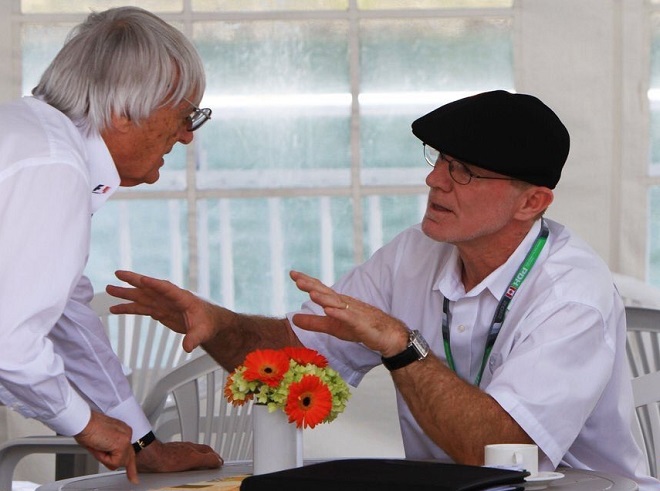
"He was a master deal maker with an amazing brain."
From selling and racing motorcycles to making savvy investments on property and used cars, the Suffolk, England native was hooked on F1 by the late '50s and wound up managing Jochen Rindt's career before he was killed at Monza in 1970. He purchased the Brabham team in 1972 for a reported steal of $120,000 and immediately began asking questions and making changes.
"Back in those days the teams did individual deals with the promoter, so if you had a star driver you got more money but everyone was paid poorly," recalled Nigel Roebuck, the dean of F1 writers whose career began at the same time as Bernie's foray into F1. "So Bernie said to the teams, 'Why don't I do a deal for everyone?' They agreed and his message to the promoters was if you pay, you get a race; if you don't, you won't. He organized everyone and unionized the teams."
It was the beginning of FOCA (Formula One Constructors Association) and Ecclestone was always good to the band of little guys like Tyrrell, Williams and Nunn as they fought to compete with Ferrari's budget.
"Bernie was extremely loyal and whatever deal I did with him he always kept his word and all we had was a handshake," said Nunn, who went from a successful Formula 3 driver to designing, building and operating his Ensign F1 team from 1972-'83 before engineering Alex Zanardi and Juan Montoya to three consecutive CART titles in the late '90s. "If we needed money or engines or whatever, he'd always have it for us to keep us on the grid."
By the time the FOCA-FISA war broke out in 1980, Bernie had sold Brabham so he could concentrate all his efforts on running the show. It was BE against Jean-Marie Balestre and FISA, the sporting arm of the FIA, and the eventual winner was Ecclestone, who gained the commercial rights to F1.
"At the time F1 was barely on television [internationally] and maybe only three or four times in Britain," said Roebuck. "So Bernie started doing TV deals with countries with the stipulation they had to show every race and the fees began to go up and up. He transformed television and started making the owners rich."
Ecclestone's famous quote about not needing any spectators because of his TV deal wasn't all bluster, because the contract was worth billions and divided among the teams based on performance. But it was a staggering sum of money and even the Minardis of the world received millions each season.
Of course he ruffled quite a few feathers along the way with his financial demands and it seemed like an annual threat that he was going to do away with the British Grand Prix.
"He was very good at manipulating the media and he'd say he was done with Silverstone or Brands Hatch and they would all print stories and throw everyone in a panic and of course he'd always get his way," said Daly with a laugh. "He could emotionally detach himself and make decisions but he was very street smart and knew which buttons to push."
One of Ecclestone's few defeats came at Long Beach. After F1 ran the streets from 1977-'83, Chris Pook informed "Bernard" that he was switching to CART in '84 because he could no longer afford an F1 race.
And it was CART that created some anxiety for him in the '90s – especially when world champion Nigel Mansell defected in 1993. "Bernie was very worried about CART back then," confirmed Roebuck.
But, unlike F1 or NASCAR, IndyCar never had a leader like Bernard or the Frances and both series skyrocketed past American open-wheel racing during its costly split from 1996-2007.
"It was always very clear who was boss and he was the right guy at the right time," said Walker, who spent more than four decades in IndyCar as a team manager, car owner and official. "He had a very simplistic view of racing and I compare him to R.P. (Roger Penske) in that they had a small, smart group of people and they always get things done.
"He won't have a successor and they'll do things differently now but he showed the way to make racing a business."
Adds Nunn: "Bernie made a fortune and he made a lot other people wealthy in the process but he truly cared about F1 and making it successful. He was brilliant."
A few days ago Roebuck asked Ecclestone if he was proud of what he'd accomplished. "He said, ' No I'm not proud, just satisfied.'"

Latest News
Comments
Comments are disabled until you accept Social Networking Cookies. Update cookie preferences
If the dialog doesn't appear, ad-blockers are often the cause; try disabling yours or see our Social Features Support.