PWC: The future of Touring Car
The Touring Car class in Pirelli World Challenge has come a long way from where it was just a few years ago. At the tail end of the 2013 season, the class seemed like it was on its deathbed, with nine cars entering the season finale that paired with the IndyCar Series race in Houston.
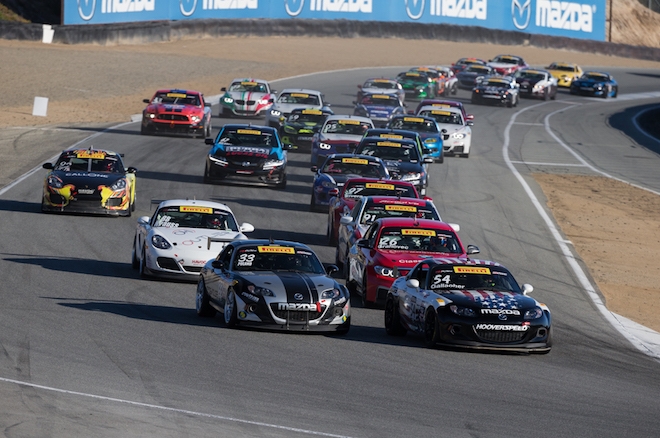
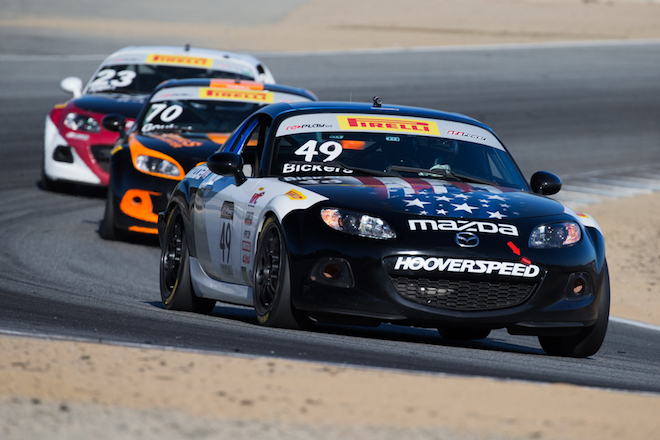
Contrast that to October's wrap-up of the 2016 season at Mazda Raceway Laguna Seca, where 20 Touring Cars were on hand, and the combined field of TC, TCA and TCB entries topped 40. Touring Car featured a healthy mix of BMW M235iRs, Mazda MX-5s, Nissan 370Zs, Honda Accords and even a Porsche Cayman.
Healthy field size aside, purists see one issue: With a couple of exceptions, those cars aren't touring cars. The MX-5s, the Nissan Z-car and the Cayman all lack the one defining characteristic that historically separates a touring car from a sports car: a back seat.
"Decisions were made based on, first and foremost, driving entries," explained Jim Jordan, who came on board with WC Vision in 2016 with the title of "manager of business development," but whose primary task of the moment is coming up with a direction for the Touring Car class. "The folks in charge made decisions that were right for the time. They made decisions to allow certain cars like MX-5s, which are extremely popular, but when you have MX-5s competing against BMW 235s, that doesn't fit the marketplace."
Jordan has a long history with World Challenge's Touring Car class, from the team owner side to viewing it form the manufacturers' perspective. So he approaches a plan for the class out of respect and love for what it has been and can be.
"When I looked at Touring Car, I saw some huge opportunities for the class, that I felt with a little bit of change in perspective and unifying vision could actually make Touring Car one of the premier classes in motorsports," he said. "Both in my career at Mazda, but also personally, I enjoyed Touring Car racing and have been involved. It started with the current configuration of World Challenge in '99 when my brother Joe, myself and Charles Espenlaub competed in the last few races of the season. Since them, I have had a team that competed in it and, at Mazda, supported the series and helped grow Touring Car, and within that context saw both the pitfalls and the opportunities.
"I've watched the series grow to great heights, have some challenges and now, in this era of rebirth, I saw huge potential and finally talked [series CEO] Greg Gill into hiring me. The first thing I did was an analysis of what was working and what I felt was holding back the series. I put together a 30-month vision of the class that I first shared with the competitors in August, what we're going to do for 2017 and 2018."
For 2017, not much will change from the class's current configuration. The cars that are eligible now will be eligible next season. But in 2018, there won't be a place in Touring Car for cars that don't fit the classical definition of a touring car. However, existing competitors and grassroots racers making the jump to the pro ranks will still have a place to race in TCA.
"We're sort of taking the touring car back to the Touring Car class at the upper end. The TCA class, we're making it kind of the entry level class, we're going to keep it less stringent where competitors could run popular cars in the marketplace," he said. That includes the NC MX-5 Cup car that swelled the TCA ranks in 2016 when the ND model became the basis for the one-make series, plus cars like Honda's new Civic Si body-in-white designed for racers to construct their own cars. Jordan also pointed out the Toyota GT86 car built by Toyota Germany that he thinks would be a good fit for TCA.
"The top class is definitely moving in that direction," Jordan explained. "The TCR formula, the specification that is used worldwide, is very equivalent, at least in spirit, to the GT3 or GT4 rules. In other words, the manufacturer, or the specified tuner for that manufacturer, builds a specification and they submit the car. [The governing body] does a Balance of Performance on the car so, in essence, every car has a relatively equal opportunity to win.
"In 2018 we're going to welcome TCR cars to Pirelli World Challenge. At this point our plan is for them to be a standalone class within Touring Car. The biggest change we've made is we want the cars to be commercially available in that body style in the U.S. If it's a SEAT or a Lada, it's really of no relevance to the U.S. marketplace, so we're not going to recognize those cars. There is enough interest from current manufacturers that I think we're going to have a good field of TCR cars."
Jordan had made a few references to interest from manufacturers, and while Touring Car is generally made up of privateers as opposed to many factory or quasi-factory teams that populate GT, he recognizes that manufacturer support is critical to teams. The parts, the expertise and contingency are all vital to making racing at this level possible for a privateer team. But manufacturers can bring other things to the table as well, including ready built cars. The BMW M235iR with which Toby Grahovec won the 2016 Touring Car championship is one example, and a new car from Audi expected to compete in 2017 is another.
"Audi introduced their new TCR car, the RS3 LMS, and asked if they can compete with that car here in the U.S.," he said. "Well, a TCR car is faster than our current TC level. So Marcus [Hasselgrove, PWC director of competition] and Dan [Goodman, Touring Car technical manager] from our side negotiated with Audi, and they're actually building a specific model that we will allow. It's a somewhat detuned TCR car; we felt it will be competitive, but not overly competitive, with current cars like the BMW M235. The part that makes me happy about that is it really recognizes Pirelli World Challenge as being an important series within worldwide motorsports when you have companies like Audi building a specification just to match our class."
"The other good thing about that program is that in 2018, it will be a very economical and easy upgrade to take that Audi and put it in a full TCR configuration. It shows both the importance of the series but also the flexibility of the series to accommodate both our teams and our OE partners to come up with good solutions to make the series even more interesting," he adds.
Finally, there is TCB for B-Spec category cars. The series issued a challenge when it announced its long-term vision that if the racers can get the numbers of cars back up to previous levels, it will continue.
With grids having swollen in recent years, it's entirely possible that with the realignment of the Touring Car classes and the introduction of TCR that Pirelli World Challenge could find itself facing another problem: too many cars. It's a problem they'd like to have, and have considered the possibilities of further dividing the races, where TCR and TC would comprise one group and TCA/TCB another, much like GTS was broken out from GT and GT Cup a few years ago.
The Touring car classes will look pretty much the same for 2017, but big changes are coming for the following season. More news about the category is expected from this week's Performance Racing Industry trade show in Indianapolis.

Latest News
Comments
Comments are disabled until you accept Social Networking Cookies. Update cookie preferences
If the dialog doesn't appear, ad-blockers are often the cause; try disabling yours or see our Social Features Support.