IMSA: Andy Blackmore's Mazda DPi styling review
Vehicle stylist and racecar livery specialist Andy Blackmore offers his insights on the styling cues involved with Mazda's brand-new RT24-P Daytona Prototype international. His thoughts on Cadillac's DPi-V.R will follow on Thursday -Ed.
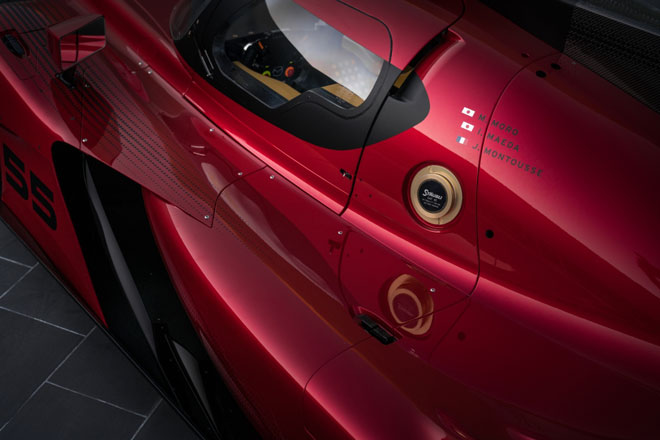
Mazda's version of the new Daytona Prototype international, which was the first to be revealed among IMSA's new DPi manufacturer entries, is quite striking. Enhanced by its flowing lines, the Riley/Multimatic-built P2 car uses a development of the Soul Red metallic paint which the previous Prototype racer and all recent Mazda concepts have carried.
Styling studio input on racecars is normally a touchy subject within car companies. Every designer wants to do a racecar, but the engineers and the data from the wind tunnel will dictate a different story, which often results in reduced road-car styling overtures. The usual end result is token OEM graphics such as the stick-on headlamps as seen in other series.
Mazda, counter to those reduced expectations, really should be applauded for what it has achieved. Time will tell if aero has been compromised for the Mazda design language, known as KODO.
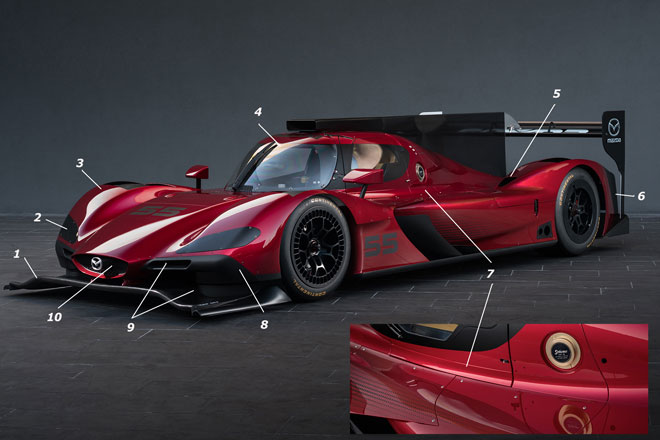
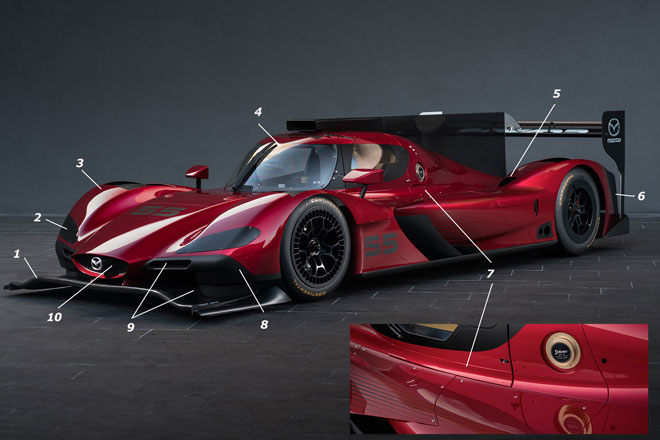
So, what are the points of the RT24-P design that stand out most of all? I've made an annotated list with the provided image above and below:
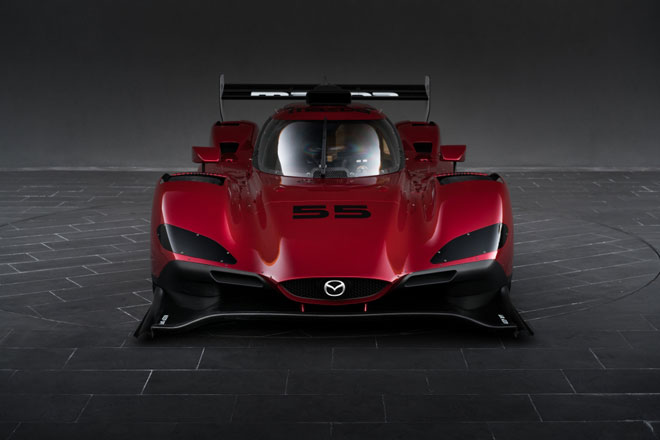
2 - While these lights shown here are generic covers, it will be awesome if Mazda can retain their shape for racing. The narrow, slightly angled light shape is one of the strongest elements of the KODO design language. While most Mazdas have the lamps visually connecting the main grille, this still works very well.
Cadillac
. Its soft, rounded shape is in marked contrast to the "fashionable" upright look seen with the other designs. Looks better for it, but will this be an aerodynamic compromise?4 - Underneath all the Mazda styling is a Riley Mk.30 P2 chassis, developed by Riley Technologies and Multimatic. The Canadian Multimatic company also developed the previous Lola-based prototypes by Mazda and was also instrumental in the development and build of the road and race versions of Ford's new GT. Mazda Design North America have done an impressive job "disguising" the Riley. Unlike the Cadillac, expect the RT24-P to retain most of its launch coloration for the race season which will help hold onto that Mazda look.
5 - As with the front fenders, the rear fenders buck the current trend of blocky, upright form for a very elegant classic shape which extends out of the rounded sidepod. This look is enhanced by the Soul Red paint.
6 - The rear of the body tucks inside of the rear wing end plate, in contrast to the Cadillac and many WEC prototypes.
8 - Expect dive planes come race time – a necessity in prototype racing.
9 - The front of the car really is Mazda's calling card and there are some nice details here. Small air intakes in the matte black area (which itself, helps the look of the front end) aid brake cooling while a full length air channel underneath has interesting form where the recessed lower body wraps around the front wheel well immediately above the splitter.
10 - Center to the design is the Mazda signature grille. In a sea of tall Black boxes, the Mazda grille is distinctive and its fitting it adorns the front of the car. In my opinion, it could have been wider, but aero is probably at play here. The subtle ridges immediately above the grille sweep up over the nose box and around the cockpit. Very elegant.
Mazda wins in the looks department. Crucially come the Rolex 24, the car is expected to carry over what you see here. Sure, it will have the official number panel, series branding and some sponsor logos, but the core look, design and paint will be as the launch car and will fit perfectly into the Mazda family.

Latest News
Comments
Comments are disabled until you accept Social Networking Cookies. Update cookie preferences
If the dialog doesn't appear, ad-blockers are often the cause; try disabling yours or see our Social Features Support.