In RACER Magazine: Indy's Quantum Leap
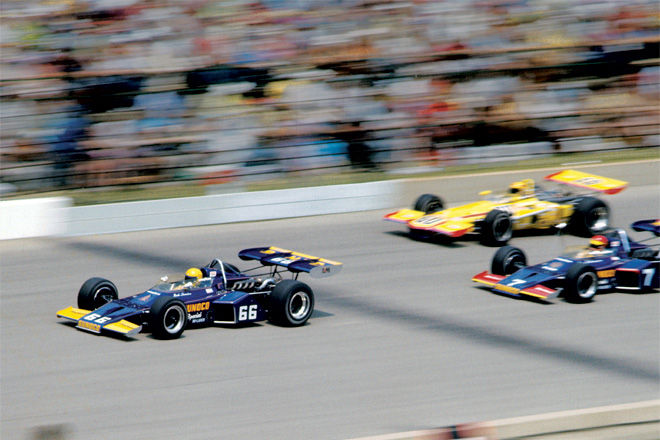
The Indianapolis 500 had never seen a leap in speed quite like it – and it never would again. Huge wings and massive boosts made the 1972 race a journey into the unknown.
Peter Revson captured the pole position for the 1971 Indianapolis 500 at a record 178.696 miles per hour. Just one year later, Wally Dallenbach qualified at 178.421mph – and missed the show!
In what went down as the most jaw-dropping Month of May in Indianapolis Motor Speedway history, horsepower ran amok, speeds jumped into uncharted territory, and stopwatches were almost rendered obsolete.
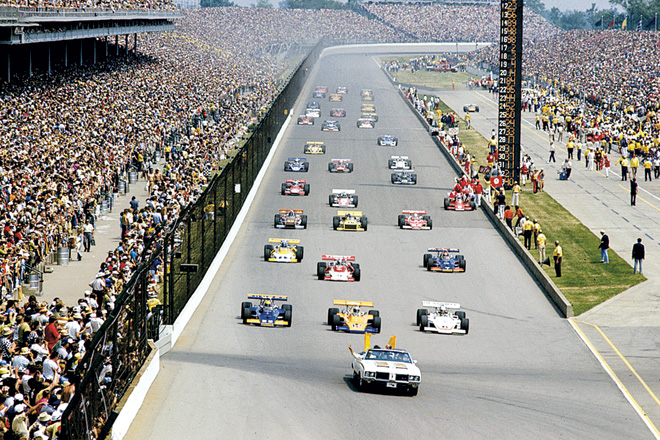
"Man, that was a fascinating time, because there was so much to learn and ideas were flying around just like the cars," says Mario Andretti, who was part of the Vel's/Parnelli Jones Superteam that year, along with Al Unser and Joe Leonard. "We had huge rear wings, new profiles and the horsepower was huge!"
McLaren had rocked the IMS establishment a year earlier with a new, sleek design by Gordon Coppuck that would qualify first and second with Revson and Mark Donohue, as well as alter the look of an Indy car and send the opposition scurrying for the drawing board.
Even though neither McLaren M16-A had finished in '71 and Al Unser had soldiered past the new wave of English innovation to score his second straight victory in a two-year-old Colt chassis, the Brits had put a scare into Gasoline Alley for the second time in a decade.
So when Indy opened for business in the May of '72, there were four new McLaren M16-Bs – factory entries for Revson and Denny Hulme, who would soon be replaced by Gordon Johncock after suffering burns in practice, and the Penske Racing-run machines of Donohue and Gary Bettenhausen.
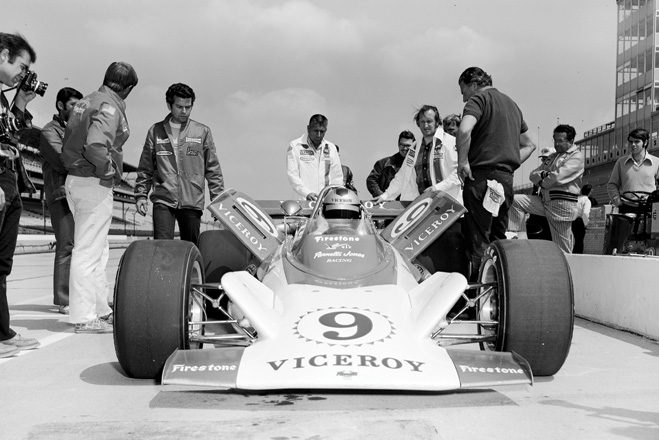
A disparate entry list that also included chassis called Antares, Brabham, Scorpion, Lola, Kingfish, Gerhardt and Colt did have one common denominator: a massive rear wing that stretched to the outside of both rear tires.
"We tested in late 1971 at Phoenix without a wing and then we put one on and it was like night and day," recalls Roger Penske, who was, of course, an original McLaren owner in '71 with Donohue. "It was the beginning of a new era and a new word: downforce."
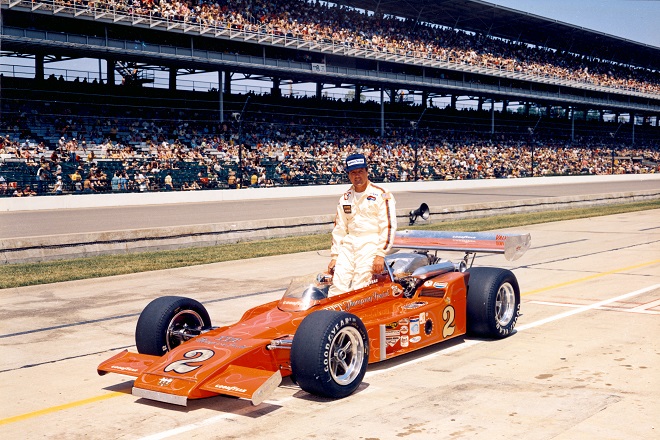
"It was those giant rear wings and horsepower," says Foyt (pictured below with his '72 Coyote), whose modified Ford/Foyt V8 was massaged by engine guru Howard Gilbert. "But it was mostly horsepower – and I know that we had 1,200 horsepower that month." Sonny Meyer, son of three-time Indy king Louie and one of Indy car racing's most respected motor men for decades, still smiles when he thinks of 1972.
"Oh man, that was a lot of fun because we had unlimited boost (manifold pressure). And it was crazy because the driver also had a boost adjustment in the car, so he could crank it even more after someone like George (Bignotti) turned it up," says Meyer, who was an invaluable part of Pat Patrick's team's Indy wins in 1973 and '82. "We made more than 1,000 horsepower and that's staggering with a four-cylinder engine."
Adds Foyt: "You had to have an educated foot back then, because you could spin the wheels coming off the corner. We had that much power. It was great."
The Speed Issue of RACER magazine
, on sale now.Click here
to take a video tour of the issue.click here
, or to buy The Speed Issue online, click here.RACER is also available digitally for Apple, Android and Kindle Fire devices. RACER Digital has the complete content of the magazine's print edition formatted for mobile viewing. With RACER Digital, you'll have access to your RACER content all the time, wherever you are.
The RACER app can be found by searching for "RACER Magazine" in the Apple, Android or Amazon App stores. The app is free and includes issue previews and the RACER.com newsfeed. Individual issues can be purchased for $1.99 and an 8-issue annual subscription is $9.99. Back issues are also available.

Latest News
Comments
Comments are disabled until you accept Social Networking Cookies. Update cookie preferences
If the dialog doesn't appear, ad-blockers are often the cause; try disabling yours or see our Social Features Support.