IMSA: Taylor brothers to become human science experiments at Petit Le Mans
The coolest technology in action at Road Atlanta during Saturday's 10-hour season finale will ride along inside – and on – Ricky and Jordan Taylor. The brothers will swallow pellet-size capsules that contain multiple sensors, and will also apply transdermal patches to their forearms before they strap into the No. 10 Wayne Taylor Racing Corvette DP as part of an intriguing human data acquisition experiment conducted throughout the Petit Le Mans race.
The exercise, which comes courtesy of an Ohio professor, and a former NFL strength and conditioning coach, will use the thermal intensity inside the Corvette to monitor the brothers' primary internal functions and analyze the contents of the sweat that comes from IMSA's first driver-based data generators.
"This is the examination and quantification of the driver's physiological response to the environment in the cockpit," Dr. Ed Potkanowicz, the associate professor of exercise physiology at Ohio Northern University, told RACER. "They're subjected to G-loading, repeated muscular contraction, thermal stress, and all they have to cope with it is maybe a liter of fluid in the car for the duration of their stint.
"It's an area of focus and research I call Driver Science. Like Runner Science or Boxer Science, why shouldn't there be Driver Science? With that data, we can develop training interventions to make the driver more competitive."
With the data recording (and transmitting) capsule in the Taylors' digestive system during the race, real-time information on the brothers' core temperatures and heart rate will be transmitted to a receiver in the cockpit. Dr. Potkanowicz cites the increased accuracy of the capsule as a primary advantage over other acquisition methods, and with the information in hand, the team and the doctor can align the data with the lap times produced by the Taylors and look for any intersections of heat-related performance changes.
"The company that developed the capsule technology, HQ Inc., has seen them used by NASA for astronauts, the military for fighter pilots, and it's been used in traditional sports like football and baseball, and also opened it up to the racing community, which is where I picked it up.
"[WTR engineer] Brian Pillar and I have been talking for about a year because he is very interested in incorporating driver performance data into how he engineers the car and into his strategy decisions. Teams have been using traditional heart-rate monitors worn by the drivers for years, and that data is shown in real-time on the telemetry screens in the pit box so the engineers can monitor throughout the race. They also see the temperature inside the cockpit in real-time.
"The capsule method is much more accurate. It transmits the driver's heart rate and core body temperature to a small data recorder inside the car, about the size of a small radio. The data will allow the doctors and engineers to analyze the relationship between elevated core temperature and heart rate, and their effect on lap times and driver performance, in particular, during each driving stint.
"It will also make it possible to pinpoint exactly when performance begins dropping off and then will allow the team to make the decisions based on data as to when a driver needs to continue or to get out of the car. And it will allow development of customized training programs to help drivers be able to arrive much later at that point where their performance begins dropping off."
The doctor's last note is of particular interest. Jordan Taylor makes regular use of a highly advanced racing simulator (above) provided by Simcraft that accurately replicates the experience of driving the WTR Corvette DP. With the core temperature data taken from the capsule, Dr. Potkanowicz can make use of a computer-controlled thermal suit – akin to a driver's cool suit – that pumps heated fluid to elevate Taylor's core temperatures to match the DP's fiery cockpit.
Drivers routinely conduct cardio training in high heat to prepare for spending hours in a hot race car. By training on the simulator for long periods with the suit recreating the fluctuations in core temperature, Taylor – or any driver that makes use of a simulator – would have a more exacting training regimen experience to follow.
Having previously tested the capsule and internal data logging system before Petit Le Mans, Jordan Taylor believes it will help drivers to explore new ways to improve their craft.
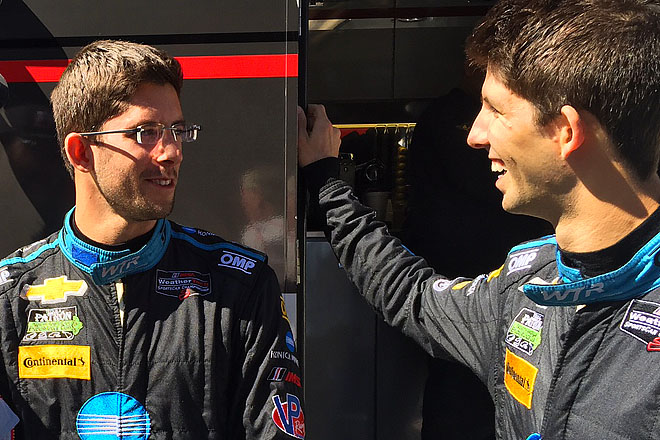
"It was weird the first time we did it because it was an unknown," he said (pictured, left, with Ricky). "We did it at a test at Watkins Glen and it was just a little odd, the science of it. But all of us drivers are interested in knowing what we go through in the car. Everyone obviously says it's difficult, but it would be nice to have something behind that. Just at our test, we only used it for a couple of hours, but it was already surprising what we found out. In race conditions this weekend, it'll be more extreme. It'll be hotter and we'll be collecting data longer.
"Over the course of a 10-hour race, it'll be really interesting to compare core temperature with our body surface temperature with how much we sweat and heart rate, and compare that with lap times and race pace and how we feel in the car. It's the first time I've been involved in a science project like this and I'm curious to see the results for myself.
"Probably the most surprising thing we learned at the test was how high our core temperature got while we were driving. In two hours, my core temperature was enough to be admitted to the ER with a fever. The doctor said I would have immediately been sent to the hospital. It's hard to believe because when I really feel sick, I feel like I'm going to die, but when I'm in the racecar and reach that core temperature, I feel perfectly fine. I'm not sure how it correlates, but it was amazing how surprised the doctor was at how high our temperature rose."
Dr. Potkanowicz is also looking for new technologies that will eventually replace the swallowing of a capsule.
"You can't make a recommendation or suggest an intervention if you don't know what you're trying to adjust, so the first step is to quantify it, and that's where we are right now, to quantify what the driver is experiencing," he said. "Once we get that message across, the goal is to develop technology that will allow us to monitor the driver continuously but not as invasively as the pill. Incorporating the data-gathering technology into a platform like the radio ear buds would not be invasive or disruptive, and it's among the options being investigated."
Complementing the capsule, the Taylors will also work with ex-Washington Redskins trainer Scott Ackerman, the founder and CEO of CoreSyte, to feed data into a patch they'll wear during the race that uses six fluid receptors and a microprocessor to analyze the chemical makeup of their sweat.
By understanding the amount of specific chemicals and minerals expelled through their sweat while driving, Ackerman will be able to use the information and prepare drink bottles with more or less of whatever nutrients are needed to maintain a healthy and properly hydrated form during the next stint.
From Ackerman's process to Dr. Potkanowicz's Driver Science project, it's clear the days of solely relying on vehicle-based data acquisition system to improve performance are limited. And it won't take long for teams to ask their drivers to plug into the ever-increasing pool of data while searching for new areas to optimize performance.
"There are hundreds of different parts of a car that we know everything about," he said. "But, there's one very important part of the car that we don't know anything about, and that is the driver. When he or she gets into that car, we trust they are fully trained and prepared physically, but we have no way of knowing or measuring that or knowing when that performance is going to drop off. These data capturing and analysis methods bring the driver into the process."
The final part of the experiment, which happens to be somewhat humorous, means the Taylor brothers will have one more pass to make long after Petit Le Mans has ended...
"It will be ingested by the drivers at 7 p.m. Friday and will remain in their system until they pass it 36 to 48 hours later," the doctor said with a smile.

Latest News

Comments
Comments are disabled until you accept Social Networking Cookies. Update cookie preferences
If the dialog doesn't appear, ad-blockers are often the cause; try disabling yours or see our Social Features Support.