MILLER: Here for a good time, not a long time
Almost every Friday I eat lunch at The Pit Stop in Brownsburg with some tough hombres from days gone by. Lee Kunzman dodged the Grim Reaper twice in three years in the early '70s, Pancho Carter survived a deadly crash at Phoenix, Merle Bettenhausen had his right arm torn off in his IndyCar debut a decade after his dad died at Indianapolis and Bill Vukovich lost his father and then his only son in racing accidents 35 years apart.
They've been burned, broken, mangled, crippled and devastated, but never harbored a bitter word about the sport – and quitting wasn't in their vocabulary. They viewed death as one of the hazards of their job, just nothing they planned on experiencing.
They feel bad that Bryan Clauson lost his life a week ago. But they have such a different perspective than most people.
"I look at Bryan like my dad because he was so alive," said Bettenhausen, speaking of the two-time national driving champion who was killed while testing a friend's car in 1961 at the Speedway. "Dad was full of imagination and adventure about what was next and what he was going to do.
"Bryan was racing all the time and winning in different cars at different tracks all over the country, and what he was doing was so fulfilling. He had that feeling of accomplishment that he was the best, and it's something not very many people experience.
"The night I passed Billy Engelhart on the last corner of the last lap and won with one arm was the night I became my dad and my brother Gary. Until then I didn't understand it, and Bryan had that feeling constantly."
Kunzman was all the rage in the late '60s as he breezed into USAC and started kicking ass in midgets and sprinters – on pavement and dirt. In 1970, just as IndyCar owners were starting to pay attention to this kid from Guttenburg, Iowa, he suffered a broken neck, broken arm and third-degree burns to his face and upper body when a stuck throttle sent him over the wall at Odessa, Missouri.
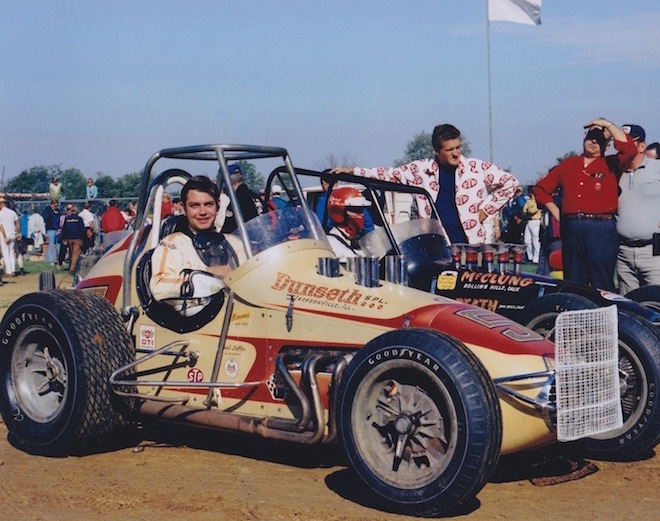
Above: Kunzman in 1969 at Terre Haute. Photo courtesy John Mahoney.
A year later he won his comeback race and then, after finally getting that big break of a good IndyCar ride, he was critically injured while testing in October of 1973 at Ontario, Canada, and spent two years re-learning how to walk, talk and function. But he was in the 1975 Indy 500 starting lineup.
"I wanted to come back when I was still in intensive care because racing was the total motivation of my life, and you knew it was risky but you just didn't dwell on it," said Kunzman, who scored 30 USAC victories (midgets and sprints) in less than four full seasons and was inducted into the Sprint Car Hall of Fame in 2006. "The feeling you get driving a racecar and winning you can't get anywhere else in life. And Bryan had won over 100 races in just the last few years so I know he felt it a lot. "
Carter, a four-time USAC champion who excelled on the high banks of Salem and Winchester, suffered shattering injuries to his pelvis, hip and leg when something broke during IndyCar testing in 1977 at PIR. He was back in a sprinter at IRP four months later, using his right hand to push down the throttle on his damaged leg – and he won the feature.
He scoffs at the theory Clauson was tempting fate by going for 200 starts in 2016.
"I would have loved to have tried to tackle 200 starts when I was a kid," said the 17-time Indy 500 starter, who recently had surgery and is walking without pain or the pronounced limp for the first time in three decades. "There's no doubt Bryan left way too early, but I almost got killed when I was 27 and racing is an addiction, especially if you're successful.
"He was racing five nights a week and on top of his game but, unfortunately, accidents are part of the deal."
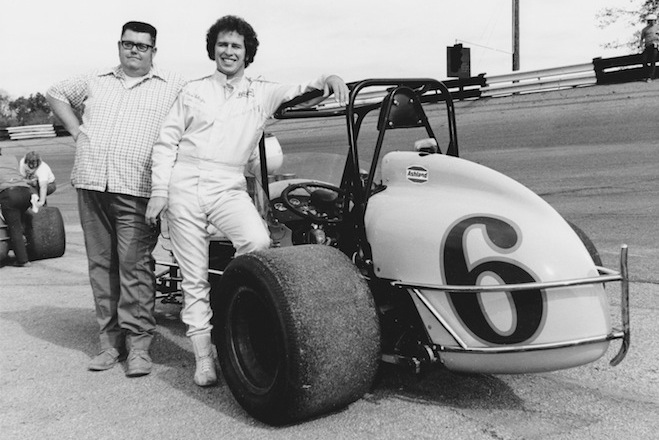
Above: Pancho Carter with car owner Steve Stapp in 1974. Photo courtesy John Mahoney.
Fatalities and danger went arm-in-arm in the '60s and '70s, and that's why open-wheel racing held such a captive audience. Racing is so much safer today, but it's faster and still capable of cruel reality.
"In my dad's era and certainly the '60s and '70s before roll cages it felt like you cheated death and you conquered it," said Bettenhausen, whose injuries at Michigan in 1972 helped start the removal of Armco guardrails on ovals. "Drivers had to be so exact back then because an inch either way could be the difference between whether you made it or you didn't.
"Don Branson, Jud Larson, Red Riegel, Ron Lux and Dick Atkins all got killed in the same season. Nowadays there are so many crashes that drivers walk away from and death is a rarity so when something bad happens, it's a shock."
A year removed from the accident at Pocono that killed Justin Wilson when he was struck by a piece of debris, the open-wheel world is grieving again. But it appears that Clauson's parents Tim and Di, sister Taylor and fiancée Lauren Stewart are celebrating B.C.'s life as much as they are mourning his death.
The little boy who died of cancer here at Riley Hospital over the weekend puts it all into perspective for most racers. That poor kid never got to experience life, let alone feel the euphoria of running the cushion at Eldora, hearing the fans roar after winning the Chili Bowl or the goose bumps of starting the Indianapolis 500.
"Look at all the people who get killed on ATVs without wearing helmets or in car accidents going 40mph or simply falling in their bathtub or down the stairs," Carter reasoned. "When I got in a racecar I wanted to get to the edge to see how far I could go, and I think Bryan was the same."
Bettenhausen (pictured at IRP in 1973, making his comeback with one arm) didn't know Clauson, but he liked what he saw. "He was a helluva driver and he had that feeling of beating the best, over and over again. I'm sure he was aware of the danger and it wasn't like he didn't know it was there, but he had supreme confidence in his ability."
B.C.'s life could be summed up in the Huey Lewis and the News song title "We're not here for a long time, we're here for a good time," because that's exactly what he had for much of his 27 years.
And the geezers at Friday lunch know they're lucky to still be on the right side of the grass. But they were fully prepared to accept their fate.
"I wanted to be known as a racer's racer, and I think Bryan certainly was," said Kunzman, who has also survived a heart attack, stroke and Type 1 diabetes since retiring in 1980. "If I had to risk my physical being to make that happen, it was worth it.
"You know the risks, but you're more than willing to take them."

Latest News

Comments
Comments are disabled until you accept Social Networking Cookies. Update cookie preferences
If the dialog doesn't appear, ad-blockers are often the cause; try disabling yours or see our Social Features Support.