BUXTON: Ghosts in the machines
I've lost count of the number of questions I've asked drivers in my career. Since becoming a TV pit reporter, the quantity and frequency has exceeded every expectation, the rat-a-tat machine gun of inquisition that exists within the Broadcast Pen leaving little time for thought or reflection. Three questions, three answers; bang, bang, bang... Next! New driver, new questions; bang, bang, bang... Next! Hello, where did you finish again? Gotcha. Bang, bang, bang... Next!
But every now and again you receive a response so raw and so real that it stops you in your tracks. It leaves you scrabbling around and shuffling your feet, trying to keep eye contact but feeling as though you should look away lest your emotions bubble to the service and all semblance of professionalism be lost. You want to dig deeper, partially out of a journalistic desire to get to the root of the issues affecting the sportsman you are employed to interview, partially because you genuinely care about what is so affecting the human being into whose eyes you're looking, and of whom you enquire so frequently that it is impossible to not feel a very real connection.
Of course, by delving deeper you immediately fall into the trap of appearing from the outside to be overstepping a line. By trying to be sensitive to the emotions of your subject, but doing so in front of the camera lens, is considered by some to be going too far. Were you not to ask the questions that required asking, however, you let down your employer, you let down yourself, and you let down the individual pouring themselves out to you.
At that point, you have only to consider the fact that, in front of a television camera, it is always the interviewee who is in control. If they don't want to talk, they don't have to. If they talk it is because they want to. Sometimes because they need to. Saturday in Germany was one of those rare moments. And a painful one.
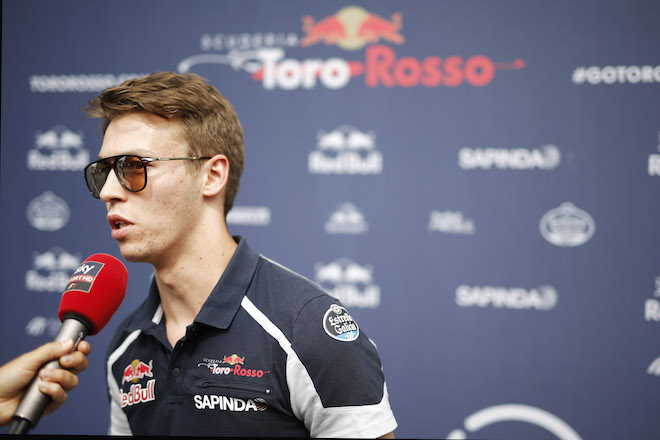
Dany Kvyat's fall from grace could not have been more extreme. After outscoring the highly regarded Daniel Ricciardo in 2015, he started 2016 brilliantly, roaring to the podium in China (LEFT). At the next race in Russia he was pilloried for a first lap blunder, and by the time we arrived in Spain, his car had been handed to a teenager ... who won the race. In so doing, he cemented his own place at the team, firmly relegating the Russian not just to the B-team, but to a life of ignominy.
He'd been in free-fall ever since, being out-driven and out-raced by his new (yet ironically also his junior career) team-mate Carlos Sainz. After stumbling at the first hurdle in German qualifying, that which stood in front of me in the Broadcast Pen one week ago was a shadow of the man who had taken that Chinese Podium.
I'd first met Dany Kvyat in his Formula Renault days as he prepared for life in GP3. I've thus known him a good few years, and in that time have watched a skinny, gangly, ungainly kid grow into a man. The spotty child who sucked his teeth when he breathed in mid-interview to calm his nerves while he visibly shook in front of the camera had evolved. His face had broadened, his shoulders widened. Age, confidence, maturity and assuredness oozed from him as a joyous smile stretched across his clean-skinned face.
The figure before me in Germany was a ghost. The child I previously believed had been banished stood in the shell of an adult. Skin broken and blemished, hair greasy and dank, hands shaking, teeth sucked with a quick inhalation between sentences. Here was a bag of nerves who admitted he had no idea what he was doing, where he was going, or what was happening in his head.
I am not a psychologist, but was a man seemingly on the brink of depression, an illness still so desperately misunderstood, under-reported and under-diagnosed in global sport. Its realities are staggering, its impact devastating, its onset often sudden and unheralded. Did he, does he, have the support network to deal with the stresses of his position? Is the Red Bull factory of shattered dreams really so cold and callous that it would stand by and watch one of its own unravel so spectacularly and so publically? Does it care? Should it?
The questions were raised and raised loud. Not out of some tabloid baying for a story, nor out of some sick desire to pick at the bones of a man falling apart. Formula 1 is a travelling circus, the members of the paddock one big globetrotting family. There was genuine concern for Dany on Saturday night. It exists still.
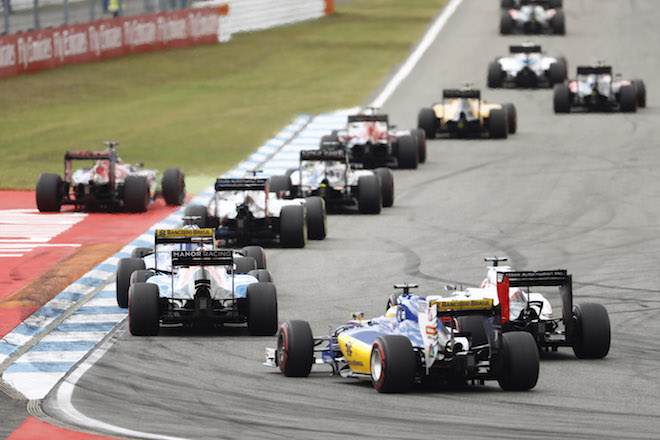
As the Max Verstappen flags waved at Hockenheim, I allowed myself a thought on Sunday afternoon for the shift in fortune which had placed him in a car capable of podiums, and had thrust the man who once sat in that same steed to the lower reaches of the Top 20.
For the drivers who start a Grand Prix outside the top 10, their sole target for the race weekend is to score a single point. Position 11 on Sunday was Esteban Gutierrez, a multiple race winner and champion in junior formulae. At the back of the grid in P22 was Marcus Ericsson, himself also a junior-level champion and race winner.
Amongst their number was Jenson Button and Fernando Alonso, whose combined Grand Prix victory tally hits almost half a century, and who have three world championships between them. Take them out of the mix, and between P11 and P22 on the 2016 German Grand Prix grid, the drivers had amassed 23 championships and 229 race victories to even make it to Formula 1. These drivers are not idiots. Every one of them has proven something unique and special to get the chance to race in the world's premiere racing series.
Imagine what it must take to then have to adjust a competitive instinct which has forever been focussed on victory, to one which, at best, is hoping to bring home just one solitary point. Imagine having to come to terms with that. Sure the house in Monaco, ridiculous car and little black book filled with Victoria's Secret models' phone numbers can ease the pain, but these guys exist to win. Having to learn to live without that most addictive of drugs, to have to go cold turkey while you watch those around you soak up the taste of success, must be galling.
We focus on the top ten. We stellify the race winners and podium finishers. We glorify the battle for points and the fight for the world championship. But every once in a while, we should take the time to focus on those with by far the hardest jobs in the sport. Those to whom a single point is relished as magnificently as a race win.
We expect so much, and are quick and brutal in our assessment when expectations are not met.
But for the adulation and hero worship, we perhaps would do well to read the words that adorn Dany Kvyat's Instagram page, changed just recently in the wake of a season of soul-crushing disappointments.
In the space left for personal explanation and reflection, he wrote three simple words:
"Just a human."
RACER's Formula 1 coverage is presented by Grand Prix Tours. Feel the power and the glory of Grand Prix racing now via Grand Prix Tours' Pick 8 competition.
Presented by:


Latest News

Comments
Comments are disabled until you accept Social Networking Cookies. Update cookie preferences
If the dialog doesn't appear, ad-blockers are often the cause; try disabling yours or see our Social Features Support.