INDYCAR: Hildebrand, Kanaan test aero options
for its next aero kit
, and according to the series, the exercise was a success."We've had two cars out there testing, tried running without the rear wheel guards, we've tried running with more downforce on the bottom, tried taking overall downforce off, and we're just looking at different solutions," IndyCar competition president Jay Frye told RACER. "It's all about exploring and everything you learn is valuable."
Decision time nearing over aero kits
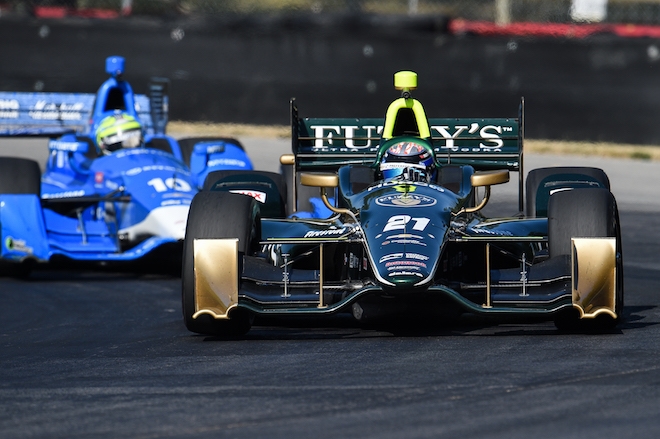
Kanaan drove his No. 10 Chip Ganassi Racing Chevy and Hildebrand stepped in to drive the No. 21 Ed Carpenter Racing Chevy in place of Josef Newgarden, who was originally scheduled to assist with the test. IndyCar asked CGR and ECR to bring additional cars to the paddock-wide test to evaluate multiple aero configurations and how those settings affected both cars while running in close proximity.
The aero kit test, which was the first of many, saw Kanaan and Hildebrand turn 120 laps in tandem as IndyCar sought feedback on whether the aero changes made it easier or harder for passing to take place. Once the aero test outings are completed later in the year, IndyCar is expected to take its findings and commission a brand-new aero kit to be used by all teams in 2018.
"It's the same kind of testing we did at the Speedway with dome skids; we had more than one team involved, had a full test matrix, and at the end of the day, we had a lot of computer data, but more importantly, we had track data and driver input to base our decisions on," Frye added. "Track data is what really matters. And with that data, it gives us a direction and you learn some things; even if something didn't work, you can cross it off the list. The direction [on aero kits] is becoming clearer."
From Kanaan's viewpoint, spending the day chasing or trailing Hildebrand to determine how IndyCar racing could be improved was a welcome opportunity.
"I wanted be part of the test," the 2013 Indy 500 winner told RACER. "This is the car we have for the next however many years, so how can we make it better? This is a step forward in what IndyCar is doing because it's helpful for us, and it's most important for the fans. We're trying to figure out the best configuration to use with the downforce when we race, and it's all about making it a better show for our fans."
For a science- and engineering-minded driver like Hildebrand, being asked to help the series with a set of aero experiments was greatly rewarding.
"I've been looking into all of it and researching what they were wanting to do, so it's cool to come here and try it," he said. "I sat with [IndyCar's] Tino Belli and Bill Pappas at Iowa and discussed their test plan, and it was very straightforward in what they wanted to learn. It's about understanding raceability.
"The other piece is about figuring out what gets people excited about racing. In essence, we were testing different downforce levels, different efficiency levels with downforce and drag, trying that from more downforce on the topside, then from the bottom side ... It was all to create an understanding of which package allows you to race closer to the car in front of you, and if it makes passing harder or easier."
Hildebrand says Belli and Pappas conducted the test like a series of short races, and then sought individual feedback before bringing both drivers together.
"Tony and I were trying to replicate race conditions: full fuel, new tires, then racing with one car in front of the other to generate an understanding with the aero options on the car," he said. "It was all so they could get our thoughts on directions to take for further tests down the line.
Related Stories
"Tony and I basically agreed on everything. Bill and Tino were collecting our feedback in isolation before we got together as a group and it all lined up. All of us realize, down to the engineers on the race teams, that you can only understand so much about these theories by doing simulations. You ultimately have to stick the packages on the car and go run it with other cars and see what happens on the racetrack."
Hildebrand also praised the series for its curiosity and willingness to find ways to improve its racing though big departures in how it currently uses downforce. It would be easier to introduce a drag reduction system, a Hanford device or some other gimmick to increase the number of passes, but Hildebrand likes the idea of finding a downforce package that reduces some of the challenges drivers face.
"There's a lot to learn here," he continued. "And there's not a specific agenda behind understanding the different elements of what makes for good racing. They want to test and figure out what's best, and they want improve the racing without adding a bunch of artificiality. It's more of a purist's approach to things.
"With all the downforce Indy cars have, it's pretty hard to get close and follow a car to make a pass at a lot of tracks, which we all know. Figuring out the best way to minimize that disturbance is important, and finding the answer isn't as easy as some might think. But that's what IndyCar is looking for, and that's why we're here testing. It's great to see they're going after complex answers instead of quick fixes."

Latest News
Comments
Comments are disabled until you accept Social Networking Cookies. Update cookie preferences
If the dialog doesn't appear, ad-blockers are often the cause; try disabling yours or see our Social Features Support.