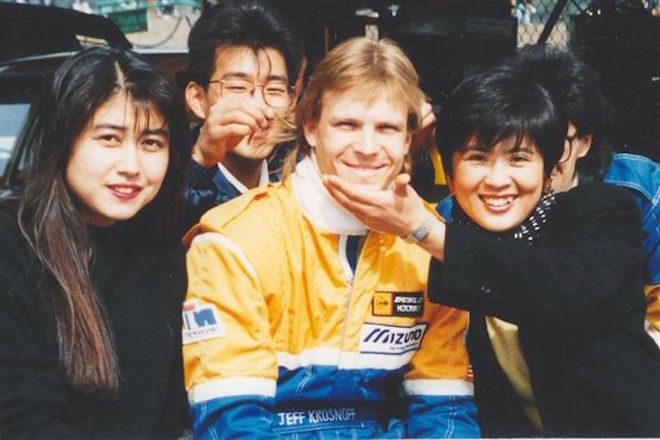
Krosnoff: Postcards from Japan
On this date 20 years ago, the racing community lost Jeff Krosnoff in an accident during the final laps of the CART race at Toronto; a crash that also claimed the life of volunteer track worker Gary Avrin.
Although 1996 was Krosnoff's rookie season, he'd already established himself as an immensely popular member of the CART paddock. But he was also a long-time member of RACER's extended family: as well as being a close friend of RACER founder and CEO Paul Pfanner, Krosnoff was a regular columnist in California Sports Car magazine (the official magazine of the SCCA's Cal Club region at the time, and the first publication produced by Pfanner Communications).
Krosnoff was as sprightly with a pen as he was with a steering wheel, and in addition to the standard driver column fare of race recounts and future hopes, his missives were filled with wry observations that capture an extraordinary period for Japanese motorsport (in one entry, he notes that the F3000 field was doing qualifying laps at Suzuka that matched the race pace of the F1 cars during the Japanese GP a few weeks earlier), as well as offering a candid glimpse into the life of an expat racer in the early 1990s.
That said, many of his stories were relatable to drivers of any era. Take, for example, his account of suffering a brake failure in his Group A car on the way into Fuji's hairpin:
"...there you are. You have totally committed yourself to the corner. You have entered the turn easily 50mph faster than the previous lap. You have gone well over a mile past the 100-meter board which marks your braking point. And now (as you pump the brake pedal with feverish pitch) you realize that your unconditional faith in those eight little asbestos prophets has been violated. The track grows narrower, the corner approaches faster, the sky falls into darkness and the final credits begin to roll. Fortunately, before I ever reached this scenario - the stage where one begins to hear the faint bellow of the fat lady's voice off in the distance - I was able to get the car slowed down enough to survive unscathed."
In celebration of his life and career, we've decided to republish a small selection of the columns that he wrote in 1990, the second year of the long period that he spent racing in Japan. During that season he was dividing his time between Japanese F3000 and Group A touring cars.
JAPAN: THE RAW TRUTH
January, 1990
One day, not too long after my arrival in Japan, I had been training especially hard. The goal was to acclimate myself to Japan's humidity as quickly as possible. Anyway, I was feeling quite exhausted by the end and apparently I must have looked worn as well. My manager's wife (I was staying at their home) misread my condition as the symptoms of an illness. She immediately produced a thermometer, while I insisted I felt fine. She would have none of this. (Mothers are the same throughout the world). So, there was never really any alternative but to relent to her maternal pressure and let her take my temperature. Maybe I would put her at ease.
I hadn't had the electronic apparatus in my mouth for three seconds before she turned the most peculiar shade of blue! For the life of me I could not figure out why. The thermometer read normal – that is, once I placed the thing under my arm where it was designed to be used!
Although this episode left a slightly displeasing taste in my mouth, the other experiences I have had during my rookie year in the Japanese Formula 3000 championship have been more palatable. Speaking of the gustatory sense, I do quite well with the cuisine of Japan. In fact, I rather prefer their dishes to all of the other ethnic foods. A typical meal would start off with miso soup, progress to small portions of raw vegetables, raw fish, raw tofu, raw seaweed ... ahhh, let's face it, nothing is cooked! Garnished, of course, with loads of steamed rice.
One finger-food I particularly enjoy and feel compelled to mention is takoyaki. A small dumpling filled with boiled octopus, this tasty treat substitutes for hot dogs in Japanese baseball parks and is sold on almost every street corner. Getting hungry? Wait, there's more! Never mind – descriptions of these culinary delights may be too graphic for these pages.
For me, digesting the language poses much more of a problem than stomaching the food. It cannot be too difficult, I suppose; all the children speak it! In fact, that is where I am receiving the majority of my tutelage – from my manager's eight, six and two-year-old children. The only problem is that I am learning words like ;crazy', 'elephant' and 'more rice, please', which obviously limits my ability to hold a meaningful conversation. The kids seem to understand me well enough, though – especially the two-year-old.
So as I prepare for my second year of life and racing in Japan, all of the necessary contingencies are covered. I have my own rice bowl, my own chopsticks, and my own slippers! In a more serious vein, I feel that I am better acquainted with Japan from both the perspective of daily living and motorsport etiquette. I have driven the circuits, gone wheel-to-wheel with the drivers, and have become more comfortable with the performance envelope of a Formula 3000 machine.
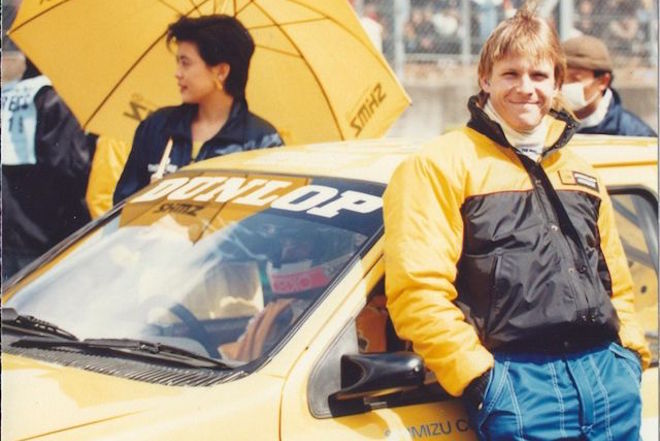
This season, I am scheduled to campaign the Formula 3000 with a Mugen-engined Lola T-9050 and Group A Championship with a Ford Sierra RS500 with the Sundai Racing Team. This is a slight change from last year when I drove for the Speed Star Racing team in Formula 3000. And, although I have changed teams, I will again enjoy the full support of the Speed Star Wheel organization. This is in addition to a major effort from Dunlop.
I am looking forward to working with the new team, Last year I tested and raced with them in Group A so I am already familiar with their personnel. Their Formula 3000 program has progressed in recent years and I feel confident in their potential to win races. Testing begins in early February, hence my next article will be from overseas. Until then, sayonara!
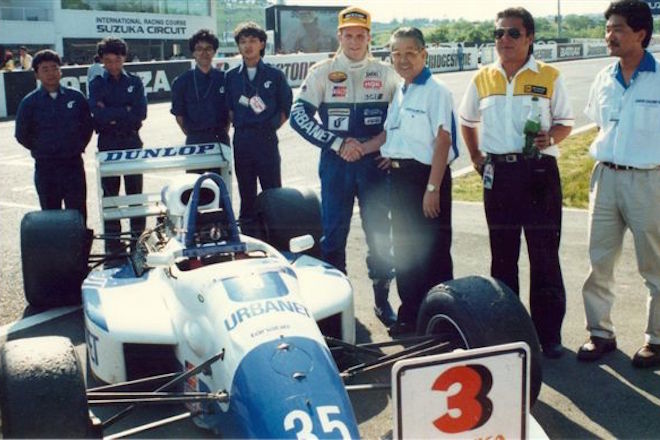
February 4, 1990
I'm presently aboard the Shinkansen (bullet train) heading for Ogiri and the Nishi Nihon Circuit. Tomorrow, I'm scheduled to test the Group A car alongside my teammate, Mauro Martini.
As I sit here, peering through the rain-streaked window, I suddenly feel taken back by the myriad slashes, lines and curves that collectively represent the Japanese written language. It seems funny how long it's been since I last noticed them. Then, they appeared to be so alien, so distant from my own 26-letter alphabet. Now, these complex characters are familiar, albeit still undecipherable. I suppose this is a sign that my homologation into Japanese society is growing more complete.
February 5, 1990
Once again I find myself on the Shinkansen, this time bound for Osaka. I am returning after a brief test in the Group A car – a Shimizu-sponsored, Ford Sierra-Cosworth. It is the same car in which I drove the final race of the championship last year.
Today was not meant to be a long test, just two hours in the morning and another two in the afternoon, split between Mauro and myself. The fact that it would be our only test prior to the first race in March is what made time scant.
Mauro began the morning session and then handed the car over to me. Once behind the wheel, I immediately began to feel comfortable and got down to competitive times. It was as if I had not spent the past two and a half months in America. Toward the end of the first session, I could feel the power go off slightly, the result of a slightly blown head gasket. Fortunately, only a small portion of the day was lost and the crew, working through lunch, saw that the car would be ready for the afternoon. In this session, we would be focusing our attention on the handling of the car. It was set up by Nagasaka, last year's driver, who prefers a good deal of body roll. It is drivable, but neither Mauro nor I particularly like the way it wallows all about the road.
In any case, something will have to be done. The new factory Nissans were on hand today and lapping one second quicker than us. I think we can perhaps make up the difference, but we weren't able to find it today. The second motor let go just after Mauro went out. I hate ending a day this way.
February 7, 1990
Today was my first day back in a Formula 3000 car, and oh, is it great to drive very, very fast again! It was also the initial run with my new team. I already know most everyone as they are essentially the same personnel as on the Group A team – both cars are part of the Sundai Spirit Racing Team. Thus, there were no new faces or new names. There was, however, a new energy and many promising ideas.
Lola is behind in its production and as a result, we do not have either of our new chassis. So today, Mauro Martini (my new teammate) ran his '89 car while I took over the T-car, a Lola T-88/50. This car is known to have been temperamental. Despite its reputation and with a little work, I was soon lapping at record times for any '88 car. It may have been a little slow down the chute, but it was actually pretty good through the corners.
Nevertheless, it is no match for its 1990 successor, which is an unbelievable two seconds faster. The new T-90/50 is beautiful, taking on the appearance of a Lotus F1 car with Benetton sidepods. The monocoque is very narrow, high in front and cut low around the driver's shoulders. It very much dictates that the pilot adopt a reclined sitting position. It is absolutely tailor-made for me. I cannot wait to get into it!
February 8, 1990
Our two-day tire test is now computer data. The teams are back at their shops preparing for the test next week and for the upcoming season. One thing is clear to everyone: 1990 is going to be a cut-throat year in Japanese Formula 3000. In fact, many are saying that it will bear more resemblance to a small F1 championship than to F3000. This year's campaign includes four car constructors, three tire manufacturers, five engine builders and heavy corporate involvement. In addition, the fields will be upward of 37 cars, making pre-qualifying the norm. The grids then, will be swelling with international talent such as: Johnny Herbet, Christian Danner, Ross Cheever, Martini, Thomas Danielson, Volker Weidler, Kazuyoshi Hoshino, Masahiro Hasemi and Hitoshi Ogawa (reigning Japanese F3000 champion) to name a few. These factors have many critics acknowledging Japanese Formula 3000 as an excellent avenue to Formula 1.
THE SEARCH FOR THE ALCHEMIST'S STONE
October, 1990
Back in medieval times – in the days of swords and sorcery – it was believed that a relatively worthless material such as lead could be transformed into gold. By concocting a special potion and citing a few bewitching phrases, alchemists eagerly sought to meet this transformation with success. However, as one might imagine, success was more than a little difficult to achieve, for no matter what solution these primitive chemists mixed, the piece of lead remained a mere piece of lead. Henceforth began a desperate search for the alchemist's stone, that one elusive ingredient missing from an otherwise magical recipe.
Despite the centuries that have elapsed since these mystical days, lately I have been pondering the actual existence of these omnipotent stones and whether or not one holds the answers to my racing woes. In Group A, my teammate Mauro Martini and I have been comfortably in the top three on two occasions when some minor glitch has cost us a finish. First it was a turbo-pressure valve which broke and next it was a malfunctioning differential. In Formula 3000, it has been the development of my new 1990 Lola chassis that has given me trouble. Undoubtedly, one of the main problems is that I have had no proper testing in the car. All of the sorting out has been done within the time restraints of the race meetings. Not that the balance of the car is that terrible, but to win races it needs to be a bit more refined.
During the first race with the car, I experience numerous moments while trying to tame the car's wildly oversteering tendencies. The next race at Fuji was better to a degree. Now, the car suffered from turn-in understeer, a condition much easier on the heart but not quite so amicable for the radial tires. While awaiting the green, the skies opened up with a torrential downpour and thus officials declared it to be a wet race. As it turned out, this was to be my first wet race in a formula car (remember, I'm a California native). The start was absolutely unbelievable. The spray was so dense that I could not see 10 feet in front, and making matters worse, many of the drivers failed to switch on the red taillights. Anyway, I was up to third before I made my pit stop for dry tires – at this point the track was beginning to dry. I rejoined the hunt in ninth and was confident about moving upward. Unfortunately, several laps later my engine developed a misfire that eventually became terminal, ergo, I would have to wait a couple of weeks before having another run at the points.
In the interim, I was able to maintain quite a busy schedule. First there was a charity auction attended by many drivers to help raise money for the UNICEF foundation. Then, I spent several days in Shizuoka at the 1990 Motor Sports Expo where I was an on-stage guest for a live talk show. While in Shizuoka I made an extra effort to visit the Tamiya Plastic Model Company. Now I have been an avid modeler for years – mainly GP cars – and for me, Tamiya models have always been the best. Naturally then, I had to have a look. As good fortune had it, one of the managers happened to recognize me and from there gave me the VIP tour of the entire facility. It was absolutely fantastic. After this came a week trip to England where I was able to spectate the Birmingham round of the FIA Formula 3000 championship, visit several F1 factories, and generally get an overview of the European racing community. All in all, it was very enlightening. Finally, it was on the plane for another 20-hour flight back to Japan for the seventh round of the Japanese Formula 3000 championship.
With attendance figures estimated at a conservative 50,000 people, this event was again held at the Fuji International Speedway. Unlike the previous race, however, this event was run under hot and humid skies which my Mugen/Honda engine did not fully appreciate. It was just not able to pull sufficiently down the straight, even though I was carrying less wing than virtually anyone else. And because Fuji has a mile-long straight, this translated into a serious handicap. Unfortunately, I did not become aware of this situation until I began to mix it up with other cars in the race. By then it was too late.
From seventh on the grid, I narrowly became part of a five-car accident, escaping only with a slight thump on my right rear tire. After that, I spent the next several laps watching as cars easily drafted past me down the straight. However the handling of the car was quite good through the back part of the circuit and this roughly offset my shortage of power.
As the race progressed, I was able to fight my way past several cars ahead (including Ross Cheever and Johnny Herbert) and into the points. When the checkered flag fell I was in fourth place and applying pressure to the man in third. This result was the best finish for a Dunlop-shod driver on the day and moved me into seventh in the drivers' championship with three races remaining.
I wonder if my engine builder has found his magic stone.

Latest News

Comments
Comments are disabled until you accept Social Networking Cookies. Update cookie preferences
If the dialog doesn't appear, ad-blockers are often the cause; try disabling yours or see our Social Features Support.