LM24: Ford GT40 Stories - Dan Gurney
RACER looks back at the legendary Ford GT40 program that dominated the 24 Hours of Le Mans with four consecutive wins from 1966-1969 in a series of new interviews with the iconic drivers who represented the Blue Oval.
Dan Gurney made his first start at Le Mans in 1958, and by the time he joined the Ford GT40 program, the great American had grown accustomed to packing up and leaving the circuit long before the race was over. Prior to Ford, seven out of Gurney's eight trips to Le Mans ended prematurely, and he and co-driver Jerry Grant weren't immune from reliability issues on their GT40 debut in 1966. By 1967, and with a new approach in mind, Gurney and fellow great A.J. Foyt took their Ford to victory – the second consecutive win for the brand at Le Mans - and thanks to Dan's cheeky sense of humor, the tradition of spraying champagne from the podium was born that day.
On taking lessons from Le Mans driver/entrant Briggs Cunningham to Ford: "Well, I will tell you, after eight or nine times, I realized that I could drive pretty fast, and it was faster than Briggs Cunningham could drive, but Cunningham used to finish ahead of me every single time. And I thought to myself, dang bust it, that is trying to tell me something. At that time, it was much more of an endurance race than a race. Briggs could do a very good job of not beating up on the car. I had adopted the Briggs Cunningham method of running at Le Mans. In the end, you have to decide whether you a driver that wants to beat your teammate by going fast, or collaborate and try and win the race. I was in a transitional stage at that time."
On applying those lessons en route to victory in 1967: "Really, the thing that I got from Cunningham was the fact that I spoke to my good friend AJ Foyt for '67 in that story, and he was receptive enough that we both ended up driving the car carefully like that. We ended up upping the average speed for the whole race, we had a trouble-free race, and Briggs would have been happy."
On setting a careful tone of saving the car with Foyt from the moment practice began: "I never ran the car within four seconds of what it would have done if you wanted to go for it. I spent a lot of time with AJ, who was at the peak of his international fame at the time, really; I don't think he really believed me at first, of me talking about how Cunningham ran.
"Bravery doesn't enter into it but skill and lap time does. If you do go for it and all of the sudden it is hard for the teammate to match it or equal it, or whatever it would be, all of the sudden he's going to start breaking the rules that we were trying to live by to try and go faster. And that is just normal with many drivers or teammates."
On the internecine rivalry between the two camps running GT40s for Ford: "Well, when you drive for Ford Motor Company and there are competing factions – some of the cars are entered by Carroll Shelby, or Shelby American, the others are from Holman Moody – and there are lots of different combination of IndyCar drivers and other drivers, some of which don't have a whole lot of road race experience, not to mention endurance racing, that was a politically volatile situation to be in."
On Ford's expectation for the Foyt/Gurney GT40, and their differing (and ultimately successful) agenda: "I think AJ and I were expected to be the rabbits in this fight. I got the car dialed in a little bit before AJ came and I wanted to get it where it had the right balance too, aerodynamically. Once I did, why, he was happy with it. But when we went to qualify, I think we qualified seventh or eighth. He came in, said "What's going on? What is wrong with the car?" That kind of stuff. I said, "The car's great. Don't worry about it." [Ford] just didn't want to hear that. To them it was a 24-hour race. And to us it was finally emulating [Briggs] Cunningham, and this was my 10th attempt, so I wasn't going to let that [call to be the rabbit] cloud the vision.
"You wouldn't expect something to go haywire if you were not abusing the car. You try to say, well, wait a minute, [after] 10 years, you ought to [learn and] apply something.
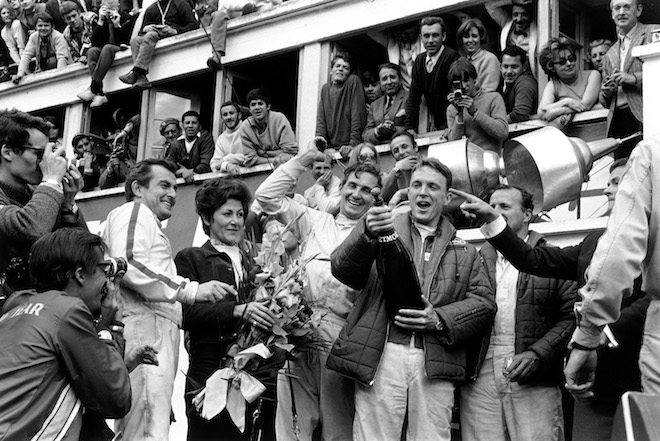
Above: Gurney and Foyt celebrate a first-place finish; Ludovico Scarfiotti and Mike Parks (Ferrari 330 P4 Coupe) finish second. This was the first time champagne was sprayed in celebration on a podium at Le Mans.
On beating Ferrari while setting speed and efficiency records: "A win of a world-famous event where you are up against pretty doggone good competition[like] Ferrari was, in many ways, even better because AJ and I both set new records, the highest average speed and we won what the little French cars used to win all the time, the index performance. That was with the 427 [cubic inch V8 engine]. Normally, that would not have happened."
On the reaction of Henry Ford II to the brand's all-American win in 1967: "Hank the Deuce – or Henry Ford the second – liked the fact that that particular car was made in the States and had two American drivers. That was something extra to him. So all of that, these little pieces ends up in a pretty good pile of wonderfulness. So it was, and still is, an achievement that meant a great deal to us. I know it did to AJ. It did to me."
On Ford's return to Le Mans in 2016 with the new GT model: "When I first saw some artist concept of the car I thought,'that is zoomy looking, [but] I wonder if it is any good'. And I recently read a good article about it and it had been to all the right places and had the right people going, so it could be a terrific performer. And I'm glad to see that.
"I was worried that they might have gone [to Le Mans] with the PR department running things. But I don't think that is the case. They've got some wise old birds, old geezers, they know what it is going to take. They are being pretty thorough and there's a lot of wisdom that was gained over a long period of time among the people that were in charge. So that should be very good. So I feel a lot of confidence that everybody's going to be proud of them."
On missing Ford's Le Mans return and encouraging the new generation of GT drivers: "They did invite us, [wife] Evi and I were invited over there, but I'm not going to make it because of my heart condition. I am going to be at Pebble Beach where they're going to have [the GT] there. That will be very nice to see.
"You know, it was only recently, maybe a month ago, [Ford] sent me some little cards, one for each of the drivers. And they wanted me to put something on it. I just said something like, 'good luck and remember it is an endurance contest.'"
On a magical stretch in 1967 where he qualified second for the Indy 500 on May 13, won the 24 Hours of Le Mans with Ford on June 11, and won the Spa Formula 1 race in his All American Racers Eagle-Weslake chassis on June 18: "Spa [was] more of a Lone Ranger kind of personal thing. It's not quite so much of a team [like Le Mans] ... although there was a lot of teamwork. That [was] a storybook outcome."
And what about Gurney's winning co-driver, A.J. Foyt? What does he have to say about his triumph in France? The wily Texan declines most requests to discuss Le Mans these days, and when he does speak, romanticism is nowhere to be found: "I never did like going over there to race. I didn't really like the food or the people. It was so much faster then than it is now. You'd have a kink you'd run through at over 200 [miles per hour]. The think I didn't like about it was you had all those little s***boxes drafting and you're running a hundred mile-an-hour faster and that's what caused a lot of wrecks over there. And then in the middle of the night, if they see an American car, [the fans] might walk across [the track] and make you have a wreck because they didn't have it fenced off."

Latest News
Comments
Comments are disabled until you accept Social Networking Cookies. Update cookie preferences
If the dialog doesn't appear, ad-blockers are often the cause; try disabling yours or see our Social Features Support.