In RACER's Great Teams III Issue: Impero Rosso
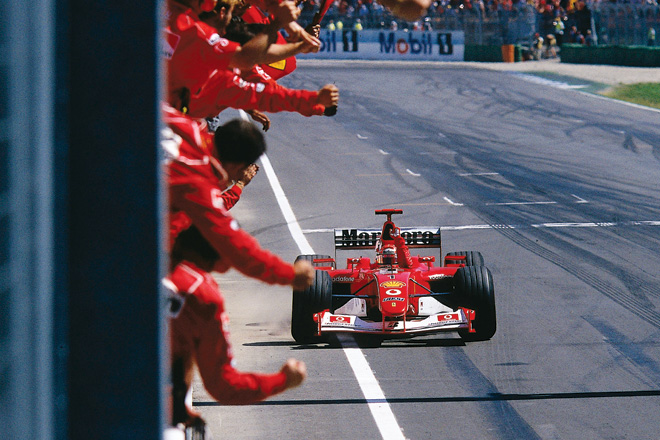
For five glorious seasons, Scuderia Ferrari and Michael Schumacher were imperious in their domination of Formula 1. But like all empires, rise is inevitably followed by decline....
Within a few hours of arriving at Maranello in 1973, Niki Lauda was asking himself why the hell Ferrari didn’t win every grand prix, so superior were its facilities and resources. Four years later, his question more than answered, he got the hell out immediately after securing his second world title.
Michael Schumacher, in contrast, was ushered out of Ferrari against his will at the end of the 2006 season – despite seeming to win every race.
Or perhaps because...
Luca di Montezemolo is the link. As a languid young man with Enzo Ferrari’s ear, but a mind of his own, for two seasons he insulated Lauda against poisonous politics. Although that bubble didn’t burst when he was reassigned within the controlling Fiat Group in 1976 – it deflated.
The Scuderia was a spent force upon his return as its suave CEO in 1991. Maranello had stagnated while its cars were designed in leafy Surrey, in jolly old England, and was no longer fit for purpose when outsourced designer Barnard switched to Benetton for 1990.
Although di Montezemolo realized that expertise would have to be brought in – he even turned to Barnard for help – he determined to breathe life back into Maranello. This bubble would be stronger.
So strong that eventually he felt compelled to stick a knife into it.
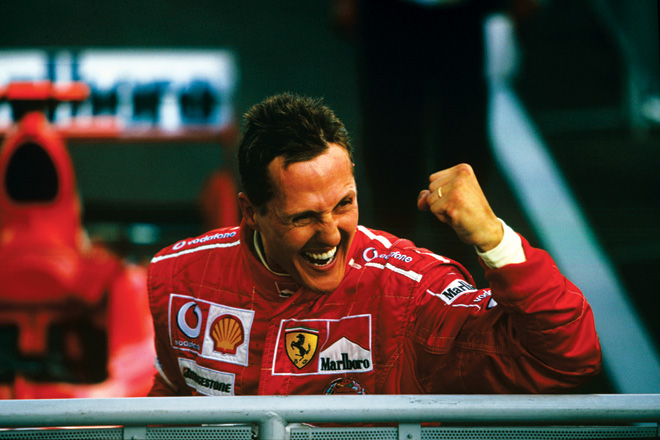
But then, Schumacher’s Ferrari had always been strictly business. He imbued it with a need to overachieve. His struggles upon joining the Prancing Horse in 1996, title near misses in ’97 and ’98, and broken leg in ’99 only made him stronger. And in 2000 he wore down McLaren’s Mika Hakkinen, the only rival he respected, to earn Ferrari’s first drivers’ title in 21 years.
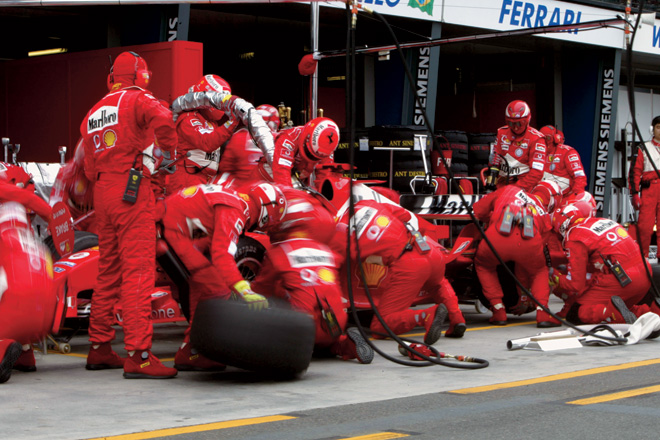
Byrne, Brawn and Stepney – a South African and two Englishman – had been with Schumacher at controversial, tight-knit Benetton. Yet, as Ferrari, the world’s favorite Formula 1 team, became increasingly multinational, the more it retreated to within Maranello. Divisive isolation had become unifying integration. Being able to design and build one’s own engine and gearbox had always been beneficial. The difference now was that Ferrari was sufficiently stable for long enough to capitalize on this.
The empty vessel that had made so much noise was now brimful of all it needed.
Get the complete version of this story in the Great Teams III Issue of RACER, on sale now. Click here to take a video tour of the issue.
click here
, or to buy The Great Teams III Issue online, click here. To learn where to buy RACER in your area,click here
.RACER is also available digitally for Apple, Android and Kindle Fire devices. RACER Digital has the complete content of the magazine's print edition formatted for mobile viewing. With RACER Digital, you'll have access to your RACER content all the time, wherever you are.The RACER app can be found by searching for "RACER Magazine" in the Apple, Android or Amazon App stores. The app is free and includes issue previews and the RACER.com newsfeed. Individual issues can be purchased for $1.99 and an 8-issue annual subscription is $9.99. Back issues are also available.

Latest News
Comments
Comments are disabled until you accept Social Networking Cookies. Update cookie preferences
If the dialog doesn't appear, ad-blockers are often the cause; try disabling yours or see our Social Features Support.