WEAVER: Squaring the Triangle
Pocono presented a big test for NASCAR's new competition direction and it passed with aplomb.
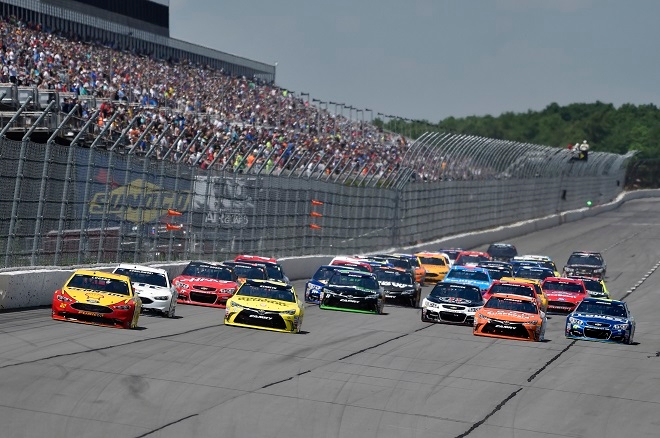
The "Tricky Triangle" has long been derided by fans for its lackluster racing product, prompting NASCAR and track officials to shorten the pair of events at the track from 500 to 400 miles back in 2011. Further, an increase in debris cautions over the past decade offset the track's best quality – producing road course-like fuel mileage affairs.
But no such caution flew in the final laps of the Axalta We Paint Winners 400 and the lower downforce package shined by Pocono standards. Fans were treated to their own version of the Indianapolis 500 finish, with the leaders in a race against the odds to preserve their fuel to the end.
Unlike the Greatest Spectacle in Racing, the fuel lasted for each of the leaders and Kurt Busch scored his first victory of the season.
Part of the excitement on Monday can be owed to the inherent flukiness of racing. The lack of practice over the weekend meant teams were still trying to get a handle on their setups come Monday. And one ill-timed caution would have disrupted the various strategy plays and turned the race into a contest of speed and track position.
But even then, Pocono produced more passing than usual, no doubt thanks to the reduction of downforce at the start of the season.
It took the better part of a decade, but NASCAR officials are finally listening to the garage and the results appear optimistic. That brings us to the approaching weekend at Michigan International Speedway and the next step of the plan, an additional reduction of downforce on an experimental basis.
NASCAR has ordered a decrease in spoiler height from 3.5 inches to 2.5 inches, a splitter reduction of two inches and a resizing of the rear deck fin to compliment the spoiler change. So what does that mean for the Sprint Cup Series?
During a Goodyear tire test last month at the two-mile superspeedway, drivers were entering the corners up to three mph faster but were actually 10mph slower through the center. The key to good speedway racing has always been forcing drivers to lift in the turns and it appears that NASCAR has achieved that goal with the upcoming package.
The rules are only set to be used twice this season; this weekend at Michigan and next month at the newly repaved Kentucky Speedway. NASCAR has indicated that this could become the standard configuration in 2017 but have shown a verbal unwillingness thus far to use it again in the second half of the season. Of course, that could just be a smokescreen to prevent teams from working on two different packages at the same time.
If this proves successful, NASCAR has to consider implementing it for the rest of the year. The sanctioning body first tested the current package last season at Kentucky and Darlington Speedway to rave reviews. But, despite a fan push to use the package during the Chase, NASCAR opted to hold onto it until the start of this season and that was unfortunate. The playoffs featured sub-par racing on mostly intermediate speedways and the only drama was born from the elimination races and the Kenseth/Logano feud.
If NASCAR can make the racing product better through a mid-season rules change, that's a chance it must take. It's no secret that teams are rediscovering the lost downforce as the season continues. They're building a notebook on these cars and at these tracks in advance of the playoffs. So let's throw the best teams in the industry a curve ball.
Owners have expressed a willingness to make changes in the name of improving the sport and drivers have been near unanimous in their desire to continue decreasing the reliance of aerodynamic grip.
Sure, the Coca-Cola 600 was a bit of a dud, but that can be credited to night racing and Furniture Row Racing applying a once in a decade butt-kicking of massive proportions. By in large, NASCAR is producing good racing right now but everyone seems to agree that additional steps can be made immediately.
Pocono was excellent, so now we await the results of Michigan and what may come next.

Latest News
Comments
Comments are disabled until you accept Social Networking Cookies. Update cookie preferences
If the dialog doesn't appear, ad-blockers are often the cause; try disabling yours or see our Social Features Support.