MILLER: Indy's weird, wild, wonderful 1966
The 1966 Indianapolis 500 is remembered for the first-lap crash that eliminated 11 drivers and the controversial finish that saw two Formula 1 champions trying to pull into Victory Lane. But, 50 years later and now saddled with spec cars at the IMS, it's refreshing to reflect back on one of the most diverse month of Mays ever and how the spirit of innovation saturated 16th & Georgetown.
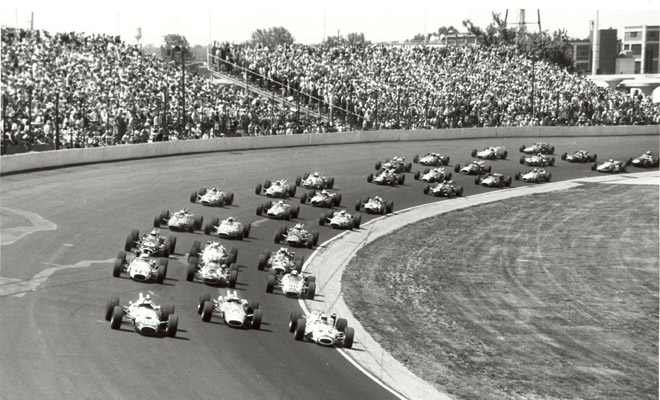
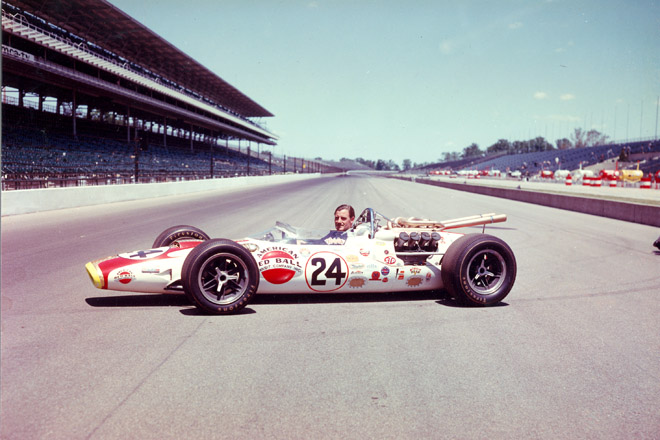
In '66, there were 15 different makes in the starting lineup and a few more that failed to qualify. The rear-engine revolution had engulfed the Speedway by then so everybody tried to improve on Colin Chapman's Lotus (like Jim Clark's, left) with various designs or copies.
Of the 79 entries, there were physically 70 cars in or around Gasoline Alley with 57 drivers either assigned to them or destined to try one of them out.
"If someone had an idea they weren't afraid to try it," said Bobby Unser, who would qualify a Huffaker/Offy for his fourth Indy start. "They weren't all good ideas, understand, but it was an exciting time because people were experimenting and using their heads."
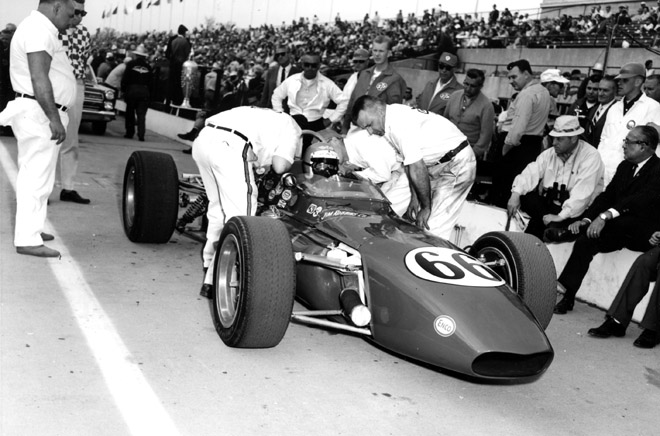
And there was no shortage of car builders, designers and dreamers. Dan Gurney, Fred Gerhardt, Eric Broadley, Joe Huffaker, Rolla Vollstedt and Chapman had multiple cars in the race while Jerry Eisert (right), Ted Halibrand, Clint Brawner and Dick Cecil all had single entries qualify. There was an A.J. Watson rear-engine design along with a Watson roadster.
It also was the debut of what would become one of Indy's most successful and eye-pleasing cars ever – the Eagle.
"Goodyear didn't have any cars in the '64 race so that ticked them off and they wanted some cars built that could make the show," said Gurney, whose All-American Racers also debuted an Eagle in Formula 1 in 1966. "They asked (Carroll) Shelby and he said no because he was too smart, so of course I volunteered."
AAR cranked out five cars for Indy – one for Gurney and teammates Joe Leonard (right, with Gurney) and Lloyd Ruby, then sold one to Lindsey Hopkins for Roger McCluskey and another to John Klug for Jerry Grant.
"It was a slippery little car," said The Big Eagle after all five of AAR's creations qualified.
Six Gerhardt cars made the field, led by Gordon Johncock, while Jim Clark and A.J. Foyt headed the Lotus contingent of four starters. Newcomer John Mecom fielded Lolas for Rodger Ward, Jackie Stewart and Graham Hill while a trio of Huffaker chassis qualified and along with two Vollstedt's creations.
Bobby Grim qualified the lone roadster (Watson) and there was also a Watson rear-engine design in the show plus one-offs
But some of the cars that didn't make the race were just as fascinating.
Veteran Bill Cheesbourg jumped back and forth between the Stein Special, which featured a pair of twin-engine Porsche flat-6 engines in a Huffaker chassis (left, Marshall Pruett archive), and Quin Epperly's old laydown roadster with a turbine engine owned by Norm Demler. Neither proved quick enough.
Ford had begun to squeeze the vaunted Offenhauser out of the picture so superchargers and turbochargers were added by some teams, but 10 of the first 11 spots on the grid (including the front row) sported Ford power.
The rookie class was just as impressive as some of the innovations as Stewart and Hill were joined by NASCAR star Cale Yarborough (below), Carl Williams, Gary Congdon and future USAC heroes Larry Dickson and Mel Kenyon.
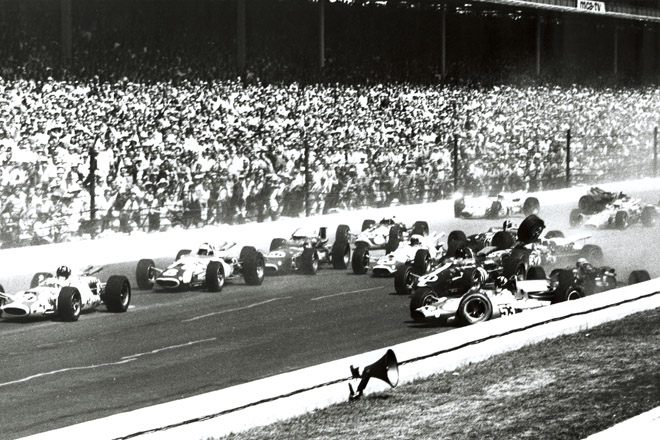
"Why 33 of the world's top racing drivers find it impossible to drive down a straight piece of track without running into each other sure beats the hell out of me," said Gurney, who got KO'd along with Foyt.
Following the second red flag in two years, the race resumed and it was between Clark and Ruby for most of the first 150 laps. After leading 68 laps, 'ol Rube's Eagle/Ford lost power and Clark had a pair of uncharacteristic spins but didn't hit anything and on lap 151 it was fellow Scot Stewart in the top spot.
The future world champion held it for the next 40 circuits and owned a comfortable advantage with 10 laps left when his Lola/Ford lost oil pressure. Hill, who had started 15th in his first-ever oval and admitted he was very uncomfortable with the high speeds and walls, suddenly found himself atop the scoreboard in his Lola/Ford (bottom).
Already an F1 champion (1962), Hill became only the fifth rookie winner – much to the dismay of Clark, who tried to pull into Victory Lane only to find his British buddy already occupying it. Chapman (right, with Clark) claimed USAC scoring was in error but opted not to file a protest.
"Nobody is more surprised than I am," chirped Hill in Victory Lane along with rookie owner Mecom.
Johncock – who had to start the race in the pits to have his damaged nose cone replaced – managed to run the 500 miles in the fastest elapsed time but finished fourth, behind Hill, Clark and Jim McElreath.
There was always a rumor that Tony Hulman had paid Johncock the winner's share as "hush money" because USAC had privately admitted he was the true winner.
"I might have won but I sure didn't get paid for it," said Johncock, who would go on to become a two-time Indy champ.


Latest News
Comments
Comments are disabled until you accept Social Networking Cookies. Update cookie preferences
If the dialog doesn't appear, ad-blockers are often the cause; try disabling yours or see our Social Features Support.