INDYCAR: Power would have missed St. Pete regardless of medical evaluation
Will Power was going to miss last weekend's IndyCar season opener at St Petersburg regardless of whether he failed a concussion test, Team Penske has confirmed.
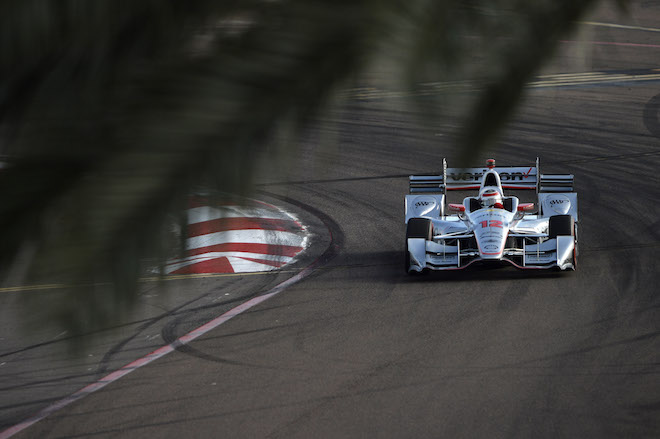
The Australian was sidelined for the weekend with concussion-like symptoms shortly after placing his No.12 Chevy-powered entry on pole on Saturday; symptoms that were thought to have been linked to a practice crash a day earlier.
IndyCar has since confirmed that the concussion diagnosis was incorrect and that the 2014 champion was suffering the effects of an inner-ear infection, but Penske team president Tim Cindric said on Wednesday that his driver would not have particpated in Sunday's race even if he'd been medically cleared to do so.
"If you're asking if he ever said he wanted to race the race, aside from the obvious, the answer is no," he said.
"I think the only discussion on Sunday morning was whether or not he should do one or two laps just to see how he feels in the car versus having a real run. It's fair to say that with or without the diagnosis or whatever or any of the doctors' orders on Sunday, he wasn't going to drive."
Power, who was replaced for the race by Oriol Servia, admitted that he felt so unwell that he almost didn't participate in qualifying.
"Before qualifying I wasn't feeling very good, and I wasn't sure whether I should do it or not," he said.
"I was kind of keeping it to myself, and yeah, I just thought, 'I'll just go out, see how it is,' and kind of did one lap on black tires, and then went from there and just kept it short. I just really was just doing one more lap and a lap and then pitting. But yeah, I wasn't feeling good at that point.
"[Afterward] I don't think I said much to anyone. Once you get in the car and you do what you do, it just comes naturally."
IndyCar safety consultant said that Power's impact on Friday was relatively low impact, and the 56G of force that was measured on the chassis coupled with the average of 30G detected in Power's ear accelerometer data fell below the normal threshold where concussions might be expected. However IndyCar protocol is to presume that any such symptoms experienced in the aftermath of an accident are related to that crash, which is why it proceeded with its concussion tests.
"If you have an inner ear infection with fluid in the inner ear like Will did, that by itself can cause you to have a sense of balance disturbance, vertigo, can cause you then to be nauseated," said Trammell.
"It can produce a headache. Anybody that's had a sinus or inner ear infection knows this, and if you have a headache and you're nauseated, you don't concentrate very well. Add to that fact that as Saturday went on, Will's neck stiffness and soreness seemed to respond badly to loads under braking, and that causes increasing muscle tension, which also causes a headache.
"So now you have a driver that's nauseated, has a balance disturbance, vertigo, headache, can't concentrate very well, and you have him take the SCAT test, which he'll now fail. It's part of our concussion protocol to say that if you fail a concussion assessment test, that you have to be evaluated by a more definitive diagnostic test such as the impact test before you can return to competition. We take the possibility of concussion very seriously and want to err on the side of caution rather than the other way around."
Dr. Steve Olvey, one of the pioneers of the CART safety team and a neurocritical care physician, helped administer eight hours worth of tests to Power on Monday in Miami.
"We have a whole battery of tests that can be done. In fact, it's quite extensive, involves three different departments, the Department of Neurology, Radiology, and Ear, Nose and Throat, and it was quite a feat," he said.
"We looked at every conceivable area of detecting concussion and occult concussion. What was really important was that his impact test on Monday was actually a bit better than his baseline test that he had back in January of 2015."
Power passed the balance and coordination stages, along with a sophisticated MRI.
"The long and short of it is that we were unable to detect any evidence for acute concussion, and in fact, his DTI [diffusion tensor imaging] was perfectly normal, indicating that there was no residual effects from any past concussions that showed up on that," continued Olvey.
"We'd like him to sit out this week, but it's related to the cervical muscle tension problem, not a concussion."
Power is scheduled to return to the cockpit for a test day at Barber next Tuesday to make up for missing yesterday's full-field test at the venue, and will go into the upcoming race at Phoenix looking to claw back some of teammate Juan Pablo Montoya's 49 point lead.
"The double points races are going to be big for us, so I'm real happy that they have them this year," he said. "As much as I would have been complaining about it otherwise."
Presented by:

Latest News
Comments
Comments are disabled until you accept Social Networking Cookies. Update cookie preferences
If the dialog doesn't appear, ad-blockers are often the cause; try disabling yours or see our Social Features Support.