PRUETT: Rolex 24 At Daytona Rewind
The Rolex 24 At Daytona has been responsible for some amazingly unforgettable sequences in recent years. Whether it was 1996 and Max Papis defying physics while pursuing Wayne Taylor to the finish, Tony Stewart coming close to winning in 2004 before a mechanical failure ruined his day, or Juan Montoya scorching the track whenever he was the closing driver, America's big sports car season-opener has authored some incredible snapshots of action and drama.
Knowing the Rolex 24's trend of producing an amazing 10 minutes of racing here, or 30 minutes there, processing and contextualizing last weekend's unrelenting 24-hour assault is a serious challenge: What happens when almost every class, throughout the entire race, produces impossibly good racing? Forget trying to find a single snapshot; it's easier to subtract the handful of hours that were boring than to try and digest the supreme awesomeness that took place during green-flag running.
Other than the 21 cautions that absorbed five hours, 10 minutes, and 29 seconds, the other 18 hours, 50 minutes, and 11 seconds made for some of the best competition I can recall in almost 30 years of watching or attending Rolex 24s. 2016 tops them all.
watch and enjoy the insane battles that made the 54th Rolex 24 the new standard
for endurance racing enjoyment.BUT IF THERE WAS A 2016 SNAPSHOT...
It would be the Corvette Racing teammates ragging the living %$#@!* out of their C7.Rs on the way to a memorable 1-2 finish. How nasty and unyielding was the battle between Oliver Gavin in the No. 4 and Antonio Garcia in the No. 3? Both drivers set fastest laps for each car in the final 20 laps of the race.
After approximately 23 hours and 30 minutes of racing, courtesies were forgotten between Corvette teammates, and but for a few millimeters on either side of their C7.Rs, the torrid pace being waged meant a frighteningly small margin of error was at play. One slight miscue by either driver in a braking zone or while side by side could have ended Corvette's day in disaster and handed the win to Porsche.
The record-setting margin of victory - just 0.034 seconds - is what made the headlines, but I'd rate the driving performances by Gavin and Garcia on the way to the start/finish line as the most impressive feat as their battle raged.
"Those last 10 laps I was driving around thinking 'I have to pull this off somehow, and I've got to keep Antonio behind for the next 10 laps and do it fairly and cleanly,'" Gavin told RACER. "It was some of the hardest 10 laps I've driven. In a strange way, I was very calm about it. I wasn't anxious or thinking 'I can't screw this up.' I was trying to let it flow. And it worked for most of it... There were some points that boiled over. It was like that [finish] line kept going away from me, and all I wanted was for it to come closer."
Precision driving can be elusive after limited sleep. Gavin was able to unleash a final surge of adrenalin before taking over the No. 4 C7.R for the run to the checkered flag when Corvette Racing program manager Dough Fehan and General Motors vice president Mark Reuss offered words of encouragement.
"In the motorhome, I was tired and all the things you are at the end of a 24-hour race, and we'd just got the penalty with [No. 4 co-driver] Marcel [Fassler] so our side of the garage was done, and Fehan came and gave us a pep talk," Gavin added. "He said 'We can do this. A lot of the other guys are worn down, we've had the pace throughout the day, and we can do this. This is something we can really achieve.'
"Then Mark Reuss was sitting next to me and gave me a slap on the back and said 'We can do this,' and all the lethargy, all of the tiredness, it was all gone. You get into the car, you think about how Daytona is one of the biggest races in the world and, also, you think 'this is what I do. This is what I'm paid to do by the team, and it's my time to deliver.' And I did."
The Corvette 1-2 in GTLM with Gavin, Fassler, and Tommy Milner leading Garcia, Jan Magnussen, and Mike Rockenfeller follows the team's class win at Daytona in 2015, and adds to the 1-2 earned 15 years earlier at the 2001 Rolex 24.
FASTEST LAPS
How did the fastest race laps from 2016 compare to those set in 2015?
Of note, the fastest P2 car from 2015 used a larger Honda engine in 2016 (2.8L to 3.5L), PC was allowed to use a lower rear wing angle to increase top speed, the fastest GTLM car from both years was the same (although the 2016 class updates added more downforce), and in GTD, faster GT3 specifications were brand-new this year.
2015 Fastest Race Laps:
Prototype: Ligier JS P2-Honda, 1:39.576
PC: ORECA FLM09-Chevy, 1:43.248
GTLM: Corvette C7.R, 1:43.942
GTD: Ferrari 458 Italia, 1:46.994
2016 Fastest Race Laps:
Prototype: Ligier JS P2-Honda, 1:39.192 (-0.384)
PC: ORECA FLM09-Chevy, 1:42.850 (-0.398)
GTLM: Corvette C7.R, 1:44.012 (+0.07)
GTD: Lamborghini Huracán GT3, 1:45.873 (-1.121)
PULLING THE BULLS
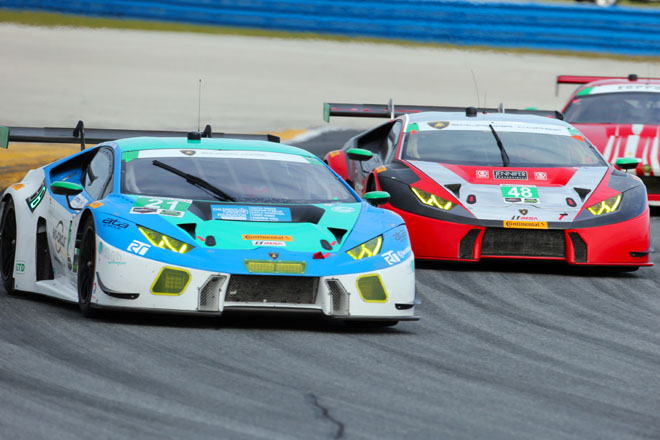
The only thing missing from the five Lamborghini Huracán GT3s throughout the Rolex 24 were dragster-style parachutes at the back of the V10-powered bulls, and after the race was over, the only thing missing from the five bulls were their engines, courtesy of IMSA's technical department.
I'd heard from GT drivers in practice and qualifying about the ridiculous straightline speed advantage the Huracán's held, and those points of input came from inside GTD and GTLM programs. Looking at the timing and scoring data, the wedge-shaped Huracáns did indeed have a sizeable advantage, which stood out as rather odd due to its shared chassis and drivetrain platform with the Audi R8 LMS GT3.
Beneath the skin, Audi's new R8 LMS GT3 and the Huracán GT3 are almost identical, and from an outward standpoint, the two rakish coupes bear an immense similarity to each other. Built from the same platform, using the same V10 engine, and featuring comparable shapes that meet the wind, it would be odd to see either the Audi hold a distinct performance advantage over its twin, or vice versa, but that's precisely what happened at Daytona.
Of the 75 fastest GTD top speeds recorded in the race, 72 belonged to Huracán GT3s.
Draw your own conclusions, but it doesn't take much detective work to figure out IMSA's call to pull five Lamborghini V10s, and the V10 from Magnus Racing's race-winning Audi, looks like one engine is being used as the baseline (Audi) to measure the discrepancies with the rest.
If you're curious where the Magnus Audi's best top speed ranks from all the laps turned by GTD cars in the race, that one's easy.
Inside the top-100? Maybe the top-150? Try No. 1472.
PROTOTYPE ACCORDING TO PLAN...ALMOST
As expected, most of the P2 cars fell out, and for quite some time, DPs held total command of the 54th Rolex 24...also as expected. It was a Corvette DP 1-2-3-4 at one point, which fit the anticipated outcome after all the P2 hardships. The part that defied prediction was how the last P2 standing had the sheer pace and ability to overcome penalties as the final hours unfolded.
The high volume of cautions undoubtedly helped keep the No. 2 Tequila Patron ESM Ligier JS P2-Honda in the fight by mitigating a serious disparity with the time it spent on pit lane compared to the second-place finishers. Including pit stops and penalties, the No. 2 was on pit lane for 47min27sec, while the No. 10 Wayne Taylor Racing Corvette DP was stationary a full 5min35sec less (41min52sec total), which is approximately three laps at full speed.
Of the 13 entries in Prototype, five were P2s, seven were DPs, and the DeltaWing completed the grid. From the first six cars to retire from the race, three were P2s and the DeltaWing was taken out in a crash. Both Mazda P2s were out with engine-related issues, and then the Honda in Michael Shank Racing's Ligier JS P2 ventilated itself before we reached the halfway point.
It left the troubled SMP Racing BR01-Nissan, which fell back at the green flag, and ESM, to face the DPs. Even Action Express Racing, the kings of reliability, encountered a bizarre driveshaft issue that took the No. 5 Corvette DP out of contention.
The No. 31 AXR Corvette DP was fast, but rarely fast enough to trouble the leaders, and although the No. 90 Visit Florida Racing Corvette DP did manage to spend some time at the head of the class, ESM and WTR turned the race into a two-team contest as the finish grew closer.
11 hours in, the Prototype class had lost four of its fastest cars, and over the next 13 hours, just one P2 had a shot at winning. There's plenty of evidence to suggest P2s held the upper hand from the Roar Before The 24 through the Rolex 24, but if I look at the advantage held by DPs in 2014 and 2015, I'm not overly troubled by P2s finally having their day in the sun at Daytona. Stepping out of 2016, and looking at the three-year sample of DPs vs P2s at IMSA's biggest race, the record still falls 2-1 in favor of the tubeframe prototypes.
Someone's always unhappy in a series using Balance of Performance table to equalize its cars, and this time, it was the DP team owners with the deficit fell on their side.
RATINGS
TV ratings were more than solid for IMSA's WeatherTech Championship season opener. According to SportsTVRatings.com, the final two hours on FOX Sports 1 had 430,000 viewers, which isn't that far from what IndyCar recorded on NBCSN last year. The opening two hours on FS1 had 376,000 viewers, which is also encouraging. Figures from Saturday from 4-10 p.m. on FS2 (143,000), Sunday from 7:30-10 a.m. on FS1 (155,000), and 10:30 a.m.-1 p.m. on FS2 (168,000) were also listed.
THE PIPO SHOW
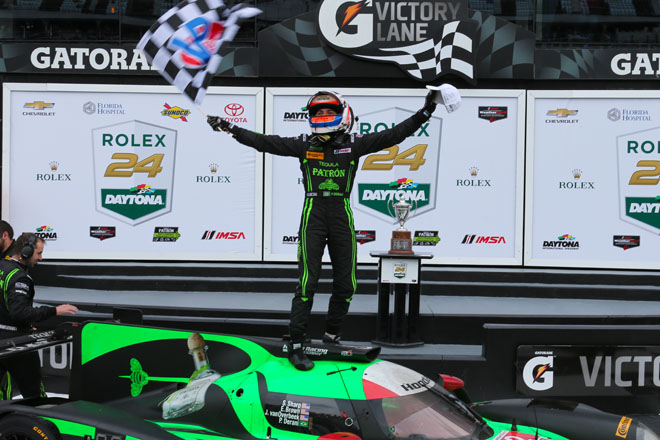
Pipo Derani's stirring drive to seal the victory for Tequila Patron ESM did little to help the Brazilian's profile immediately following the biggest win of his career. Leave it to the media - the group tasked with knowing about the players involved - to make the pint-sized 22-year-old feel even smaller during the post-race press conference.
Coming off a full-season campaign in the FIA WEC P2 category where Derani was the breakout star, earning one win and seven podiums, a reporter asked "Pipo, you had never been in a sports car race and you've never been in the United States; is that correct?"
Derani, visibly puzzled by the reporter's first question, responded "No, I did the whole WEC last year," before adding "but this is my first sports car racing here in America, and my first Rolex 24." It was a gracious reply in a moment where a harsh reaction would have been excused. I doubt Pipo will have the same problem next year.
At the other end of the spectrum, it's possible a few too many credited Derani for singlehandedly winning the race. He was certainly the deciding factor, but team co-owner Scott Sharp and Johannes van Overbeek shared in the heavy lifting and helped put Derani in a position to shine. No Sharp and van Overbeek, no win.
Taking nothing away from Derani, or his monster effort to close the race for ESM, it was clear he had the fastest car left in the field, and if the MSR Ligier-Honda held together, it's entirely possible Ligier-Hondas would have been celebrating a 1-2 on Sunday. Thinking back to all the IMSA races where DPs toyed with P2s, this was the first race since the new-look series launched in 2014 where DPs clearly had no answer.
Wayne Taylor's team put up a valiant fight, but they had issues of their own to deal with. It's doubtful Jordan Taylor, who was ill and complaining of a vibration over the radio in his final stint, was at 100 percent. Making matters worse, Angelelli, who took over from Jordan and brought the car to the finish, fought carbon dioxide poisoning from a broken exhaust header that required an immediate trip to the hospital after the race. They gave everything they had, but in normal circumstances, I'm sure they would have been able to sustain their charge with greater ease.
Granted, there's no way the two could have derailed Derani - even if they were at 100 percent - but I do believe it would have been less of a runaway result in the end.
There were 26.166 seconds between Derani and the ailing Angelelli when the checkered flag waved on Lap 736. Max lost 8.5 seconds in the last five laps, surrendering 5.3 seconds alone on the final tour as exhaust fumes filled the cabin.
From Lap 485 on, the lead was held almost exclusively by ESM or WTR, and with Derani chasing down Ricky Taylor to claim P1 on Lap 675, only a final pit stop exchange would temporarily unseat the Ligier-Honda from its dominant position.
"I know from my last stint, they were double-stinting tires and we could hang with them on that second stint," Taylor told RACER. "I got in and pulled out a 15 second lead on [Johannes] van Overbeek on older tires. Then Derani got in on fresh tires and pulled away by 10 seconds. When they went to new tires, they gave up five seconds on the opening lap, but made it up in spades the rest of the stint. I don't think it really mattered who was in the car. Derani's good, but I don't think he would have pulled away in a DP."
ESM's heavy reliance on Derani was a tactical masterstroke. The team's fastest driver in the field's fastest chassis/engine combination was lethal, and with the frenetic pace being set by the leading Prototype cars, team co-owner/driver Ed Brown only made a brief appearance in the driver rotation.
Per IMSA's timing and scoring data from the race, ESM complied with the letter of the driver ratings law by placing Brown in the car to satisfy the minimum requirement. Brown turned four laps (two run under yellow, two under green, from Lap 369-372) for a total of 13 minutes and 50.5 seconds, and left the rest of the race to the trio of Sharp, Derani, and JvO.
"That was not necessarily our intent," Sharp said. "It was a cutthroat part of the race. At that point, things were very aggressive, and coming out of the night into a heated restart, Ed decided it would be more advantageous to put him in later at a more relaxed point, and it just never happened. It was total dogfight to the finish."
I'll admit I didn't expect a P2 car to survive long enough to win the race, and the only other P2 running at the finish, the BR01, was 119 laps down and sank like a rock from the moment the race began. Chased home by five DPs, ESM, Ligier, and Honda deserve a lot of credit for breaking the DP Rolex 24 win streak at 12.
If we're lucky, we'll get to watch Derani, the Taylor brothers, the AXR drivers, and other assassins throw down in more equal equipment 12 months from now.
THE LAUGH FACTORY
At times, it felt like IMSA headlined three days at the Daytona Comedy Club. Starting Friday in the Continental Tire Series where the race-winning ST dealt with a door that fell off during a pit stop, the laughs continued on Saturday during the Rolex 24 when Scuderia Corsa's No .63 Ferrari 488 got in on the act, too, as its left-side door came unhinged during a pit stop.
And not to be outdone, Patrick Lindsey completed the longest lap in Rolex 24 history on Sunday when he took the infield back to the garage (which took forever) and had the media center in stitches as he shared the experience soon after arriving at his destination. It's not as if the weekend was lacking in fun, but these three instances of unintentional comedy made the 2016 even better.
MAZDA MADE GOOD
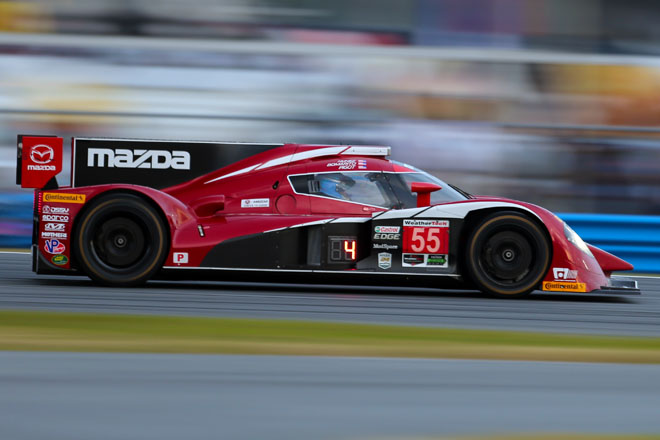
Finding shortcuts to achieve full reliability with a new engine is rarely an option at the Rolex 24, and as gut-wrenching as it might have been for the SpeedSource team - and Mazda executives - to see both of its P2s parked before sunrise, promise was shown.
Mazda's speedy new gas-powered engine did not disappoint when it came to posting impressive lap times, and even with two engine-related problems ending its day, the brand has become a legitimate concern for the rest of the Prototype class.
It might take a few more races before Mazda's full might is realized, but if Daytona confirmed anything, it was the Soul Red P2s now belong at the front of the field. Compared to the last two seasons, that's a refreshing change of reality.
DATA DIVE
The race is over an all we're left with is numbers to crunch in search of how each team or car model performed.
By averaging the 10 fastest race laps from the following cars and classes, we get a window into the relative pace each had to offer. Knowing the end results after 24 hours, it could also help to answer why some entries thrived and others struggled.
Prototype (Team or car # in brackets):
Ligier-Honda P2: 1:39.657 (ESM), 1:39.705 (MSR)
DeltaWing: 1:40.113
Ford DP: 1:40.280 (02), 1:40.332 (01)
Corvette DP: 1:40.556 (WTR), 1:40.612 (AXR 31), 1:40.659 (AXR 5), 1:40.971 (VFR)
Mazda P2: 1:40.677 (55), 1:43.107 (70)
BR01-Nissan P2: 1:41.275
GTLM:
Corvette C7.R: 1:44.267 (3), 1:44.705 (4)
Ferrari F488 GTE: 1:44.807 (72), 1:44.819 (68), 1:45.245 (62)
Porsche 911 RSR: 1:44.829 (912), 1:44.889 (911)
Ford GT: 1:44.908 (67), 1:45.134 (66)
BMW M6 GTLM: 1:44.918 (100), 1:44.957 (25)
GTD:
Lamborghini Huracán GT3: 1:46.224 (11), 1:46.358 (16), 1:46.617 (48), 1:47.012 (28), 1:49.054 (21)
Porsche 911 GT3 R: 1:47.456 (30), 1:47.561 (22), 1:47.599 (540), 1:47.612 (73), 1:47.642 (23)
Audi R8 LMS GT3: 1:47.617 (44), 1:48.012 (6), 1:48.708 (9)
Aston Martin Vantage GT3: 1:47.621 (98), 1:48.122 (007)
Audi R8 LMS: 1:47.664
Ferrari F458 Italia: 1:47.911 (51), 1:48.032 (63)
Dodge Viper GT3-R: 1:48.062 (93), 1:48.086 (33)
BMW M6 GT3: 1:48.222 (97), 1:48.398 (96)
PROBLEM CARS
What a dumpster fire. Winning the Rolex 24 often requires out-lasting the opposition, which is precisely what John Church and his JDC/Miller Motorsports team and driving roster achieved. They were the best of the eight ORECA FLM09-Chevys in attendance, and survived an overnight crash to claim the team's first IMSA win on the series' biggest stage.
It's how the rest of the PC cars and drivers fared that made the class a thorough disappointment for most of the 24 hours. Starting with the bizarre blown engine that meant five-time PC champs CORE autosport were the first out of the game, one of the Starworks PCs and the Performance Tech PC joined them in early retirement, leaving five cars to represent the class.
Problems (or crashes) struck every PC team at some point, giving JDC/Miller a four-lap advantage over second-place and nine or more laps to the rest of the competition with plenty of time left on the clock. Three of the four classes went down to the wire on Sunday; only PC failed to impress.
Attrition made PC a snoozer, but that doesn't mean the class lacked interesting themes. Along with JDC/Miller drivers Stephen Simpson and Chris Miller, IMSA saw two of its Prototype Lites champions combine to score wins (Kenton Koch and Misha Goikhberg), and as Koch explained after the race, the win was dedicated to his mother who underwent a heart transplant before last year's Rolex 24.
"It did feel very special to put a win on top of this one year anniversary," he said. "For those of you who didn't know, my mom was recently a recipient of a heart transplant a little over a year ago, and last year's Rolex there was a bunch of support out there that wanted to show their love and their support because it's a pretty big procedure, and now she's here and she's actually out walking our dog, whereas before she was struggling a little bit. Everything is going good now. It's really awesome to have her here and be a part of this win with this amazing team."
Each winning driver at the Rolex 24 receives a watch from the manufacturer. Asked if he'd give the Rolex timepiece to his mother, the young Californian had a surprising answer.
"Oh, man, now you make me feel bad for saying, no, I won't give her my watch," Koch said with a laugh.
SNOOKERED BY STRATEGY
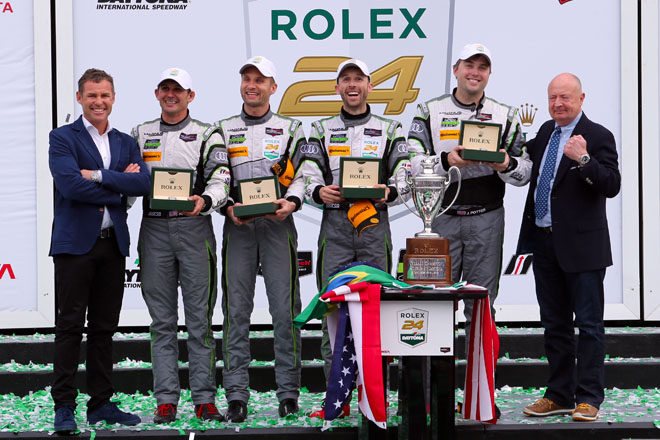
Fans of the Audi and Lamborghini brands went for a ride on an emotional rollercoaster in the final minutes of the race. It took a brilliant piece of strategy set in motion by Magnus Racing to triumph over Konrad Motorsport, and of all the classes in the race, GT Daytona was the one where the chess pieces being moved on pit lane had the greatest impact on the final outcome.
Speaking with Audi Sport Customer Racing North America's Brad Kettler, the veteran engineer says he was impressed by all involved at Magnus to move its Audi R8 LMS GT3 ahead of Konrad's Lamborghini Huracán GT3, and singled out Magnus driver Rene Rast and team strategist Lars Giersing.
"Rast's efforts to save fuel over the final stints allowed the team to survive, and it was the call made by Lars that doomed the Konrad Lambo long before the tank rand dry," he said.
"Going off the last stop, they cars were within one lap of each other, Rast had a 35 second cushion to surrender, the Lambo chased, burned fuel, Rast was slowed to save fuel knowing the Lambo would likely burn extra, the Lambo coughed, and Rene had just enough to make it.
"Rene was going so slow, but it was part of the strategy. He did just enough to stretch his tank and the Konrad guys did everything we'd hoped; they took the bait and went after Rene. That kid held his composure and didn't panic when the Lambo blew by, but then they choked. What a great result."
Rast, team owner John Potter, Andy Lally, and Marco Seefried took the win as the No. 540 Black Swan Porsche 911 GT3 R came within 3.048 seconds of stealing the victory, and according to Kettler, it's a minor miracle the Magnus R8 didn't finish second.
"It only had a liter of fuel left!" he exclaimed. "Rene had the low-fuel alarm before the last lap, and by that point, you're hoping you'll make it to pit lane. He got another lap out of it, which is incredible."
THAT CRASH
The crash that claimed the DeltaWing DWC13 (and added significant damage to the stationary No. 8 Starworks Motorsport PC piloted by Chris Cumming) should serve as the inspiration for Daytona International Speedway to add an early warning system for cars rounding the corner into the blind braking zone for Turn 1.
With Cumming's sitting in the middle of the track - out of sight for cars coming into the braking zone to after reaching speeds of 170-195 mph - drivers must rely on radio transmissions from their teams and yellow flags waving from corner workers to prepare for whatever's ahead.
Radio interference kept DeltaWing driver Andy Meyrick from hearing the warnings shared by his team, and while there was at least one yellow flag waving around the bend on Meyrick's left, I can't help but think an overhead early warning light - prior to the blind bend - would all but guarantee drivers have plenty of notice.
Sonoma Raceway went to a similar early-warning system with its blind Turn 3-3A section to try and prevent more crashes like the one Will Power suffered when he crested the hill and found another IndyCar sitting sideways in his direct path. The damage to the Australian's back in the impact sidelined him for the rest of the season. We're fortunate Meyrick and Cumming were uninjured.
FORGETTABLE FOR FCGR
Watching both Ford GTs fall victim to a variety of problems was far from unexpected for a new racecar. It was only natural to root for a Corvette vs Ford scrap throughout the GTLM race, but it would have taken a miracle for the GTs to stand up to the battle tested C7.Rs throughout their racing debut.
Knowing Ford, Chip Ganassi Racing, Multimatic, and Roush Yates Engines, the badass little coupes will be back for a better demonstration of their capabilities at Sebring.
What was a bit of shock on the Ford Chip Ganassi Racing front were the maladies and driving errors that took its pair of EcoBoost DPs out of contention. Outright speed wasn't the only attribute to elude the defending race winners; durability was also absent which caused numerous trips to the garage. Engine overheating, gearbox issues, and a lack of rear brakes were among the problems to sideline the FCGR DPs, and to make matters worse, Kyle Larson flattened the front of his car late in the race when brake issues resurfaced.
With such lofty expectations across all four FCGR cars in GTLM and Prototype, the No. 01 DP (P5) was the top finisher from Ganassi-land, despite being 11 laps behind the overall winner. Along with the No. 02 DP (P13, -28 laps), No. 66 (P7 in GTLM, -32 laps to the GTLM winner), and No. 67 (P9, -162 laps), the 54th Rolex 24 must have left the team with little satisfaction.
Given CGR's great history and number of overall wins since entering its first Rolex 24 in 2004, will Chip be satisfied to leave the top class on a low note and concentrate solely on GTLM in 2017?
MISCELLANEOUS
• How much fun was it to see Katherine Legge drop the hammer in the DeltaWing and lead with authority?
• 2014 24 Hours of Le Mans P2 class winner (and former Nissan P1 factory driver) Harry Tincknell held a few meetings with Prototype teams at Daytona. The young Briton would add some electricity to a class that's already packed with talent.
• What a great story with Andy Pilgrim and Black Swan Racing team owner Tim Pappas. Pappas was the first owner to show interest in Pilgrim after he was dropped by the Cadillac Pirelli World Challenge team, the two spoke, quickly came to terms, and nearly won GTD on their first outing. Also, wasn't the livery on the No. 540 BSR Porsche simply stunning?
• A full contingent of visiting dignitaries from the ACO, WEC, and PWC were present at Daytona.
• Adding to the list of attendees from other series, IndyCar had six people onsite to cover its open-wheel stars participating in the Rolex 24.
• Finally...my favorite random piece of news to come from last weekend? Stevenson Motorsports driver Dion von Molke wants to give Global Rallycross a go. Considering how well Audi LMP1 and Action Express DP driver Filipe Albuquerque did when he gave GRC a try, DvM could find a new calling...

Latest News
Comments
Comments are disabled until you accept Social Networking Cookies. Update cookie preferences
If the dialog doesn't appear, ad-blockers are often the cause; try disabling yours or see our Social Features Support.