PRUETT: Inside IndyCar's safety upgrades
announced last week
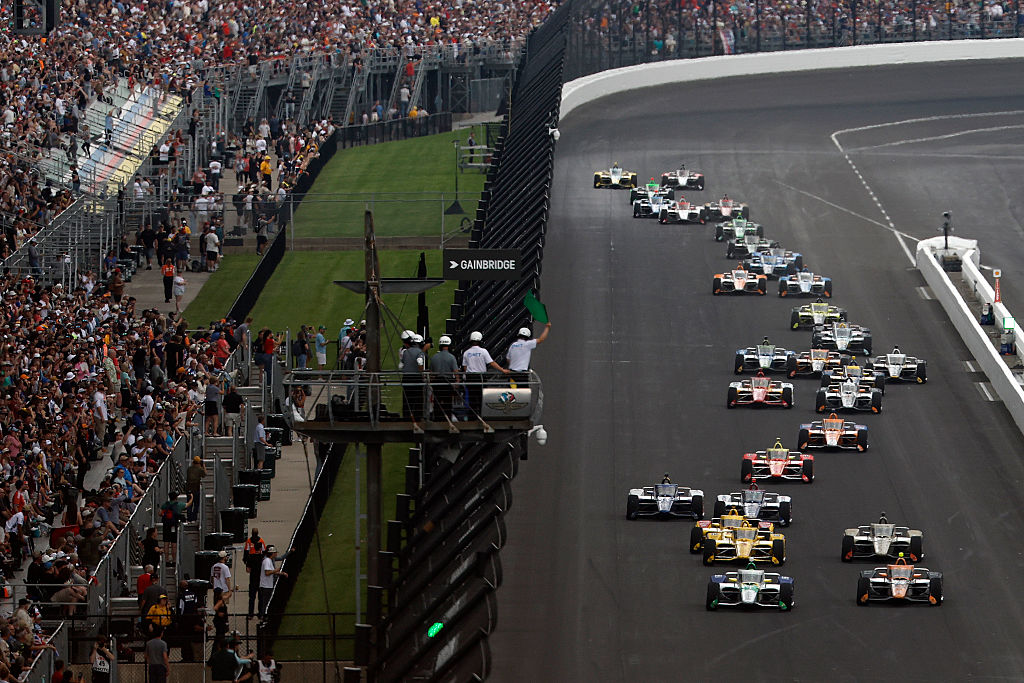
.Whether the series could have, or should have foreseen those issues and prevented them from happening prior to Indy and Pocono is an altogether different topic. The first wave of responses to the problems involve the implementation of a domed skid plate beneath the car, a NASCAR-style flap system that deploys at the back of the Dallara DW12 chassis (BELOW, right), and the increased use of tethers to keep large bodywork attached in an impact.
Timing aside, these are three smart decisions that were made possible by the brainpower and commitment of R&D resources by Chevrolet, Honda, Dallara, and IndyCar's technical team led by technology VP Will Phillips, aerodynamic development director Tino Belli, and others. Jay Frye, IndyCar's new president of competition, now presides over the group and will steer the next wave of safety developments.
IndyCar's announcement focused more on the upcoming safety advancements more than explaining the finer aspects of the parts and pieces, or how some of them will work once installed, and the series also declined a request to provide renderings of the items, so I asked Belli to break down the changes, starting with the dome-shaped skid plate that mounts beneath the DW12's floor.
"The dome skids make the teams raise the ride heights, which doesn't help them much [in terms of performance], but it does help the car when spinning by speeding air up under the car and creates a lot of downforce in a situation where it's not designed to have a lot of downforce," he said.
"The target is to help when the car is spinning, and the driver is all locked up, and the car isn't slowing down enough, so if we can generate significant downforce while spinning, it will slow the car down more before it hits the wall.
"It does reduce the car's chances of flipping over at 90 degrees, but that's not its primary purpose. The domed skid is meant to produce downforce while the car is turning through the 45, 90, and 135-degree phases of a spin and make the cars slow down quicker."
The domed skid, which runs down the center of the car, was used on the previous Dallara IndyCar chassis on Speedways through the 2011 season (BELOW), and was made from phenolic material. With the old chassis, teams would routinely run cars low to grind down the domes and increase underbody downforce...and accept the post-race fines imposed by IndyCar. The new skid will also be used exclusively on Speedways (Indianapolis, Texas, and Pocono), and will include metal strips to keep teams from repeating the practice this time around.
"The dome skid will require an increase of 9 mm in ride height," Belli said. "The skid is currently 3 mm, and the dome will add 9 mm. The dome has a significant titanium skid, and we don't want race engineers wearing them away – it defeats the purpose of having the dome – so there's three centerline large skids that teams will need to put on at the start of qualifying, and then the same skids will be required to use for the start of the race.
"Raising the ride height 9 mm higher is not massive for a change on a speedway; not as much if it were on a road course. We anticipate that manufacturers will effectively cancel out [the performance losses from the increased ride height] with the gains they make through their updated bodywork next season using the three volume boxes they can upgrade."
IndyCar will use the beam wing mounted at the back of the DW12 to deploy hinged flaps upward if a car faces backwards in a spin. With curved surfaces on the engine cover and sidepods for air to lift while a car is travelling backwards at a high rate of speed, the beam wing flaps are designed to disrupt that air from easily traveling onto the rear bodywork. The flaps are triggered by air speed, and use locking hinges to prevent them from being bent backwards beyond vertical.
"The beam wing flip is there to help the 135-180 degree part of a spin like the incidents we had at Indy this year," Belli said. "It's roughly the length and width of the beam wing section it sits on top of, and there's a scissor-style hinge like on the hood of a car that stops it from going more than 90 degrees."
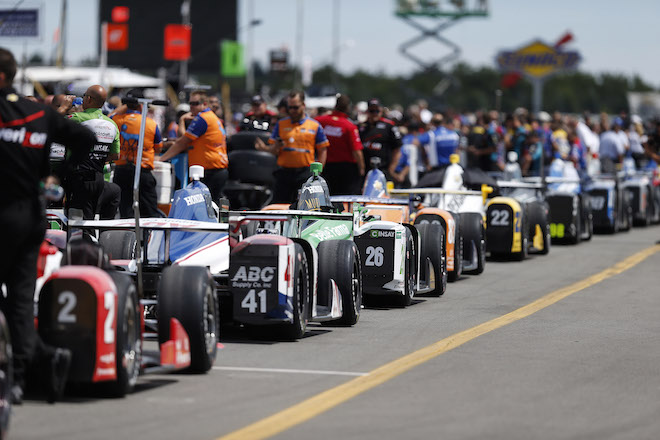
IndyCar capped the ends of the rear wheel pods to increase the rearward takeoff speed in the event of a spin on a Speedway, and according to Belli, the beam wing flaps push the takeoff threshold much higher than they were in 2015.
"Let's ignore the dynamics of hitting the wall for the moment," he said. "When a car's going 180 degrees backward before hitting the wall, we're looking to raise that [takeoff] speed far, far higher than would be possible. This year [after Indy] we introduced the blanking plates on the rear wheel guards which were a significant improvement in pushing that speed higher, and these flaps, push the speed somewhere in the range of a 20 mph higher before the car will want to flip on its own when it goes 180 degrees backwards.
"We're trying to push that speed so high that even when it hits the wall, and gets that lift from hitting the wall, that it won't turn it over."
The series has yet to finalize the beam flap design, but Belli says the pieces will extend approximately one inch behind the beam, and that those one-inch tabs are designed to be hit by rearward air and flip the panels up into their locked positions. The panels will not completely block air from passing between the beam and the bottom of the rear wing (ABOVE).
"It's all aerodynamic; imagine a hinge towards the leading edge of the beam wing, and a plate that follows the contour of the top surface of the beam, and it sticks about one inch at the back with a curvature," he said. "So when air starts coming at the beam wing from behind, it catches that lip and pushes it up to actuate it and pushes it up at 90 degrees. It's restrained from going further than 90 degrees by hinges. They're in two streamlined power bulges that deploy the flaps.
"And we actually had two prototypes of the beam wing flips at Indy that we were contemplating trying on Carb Day, but we chose not too because the manufacturer was rushed to produce them. We needed to not make matters worse at that point by acting on haste."
IndyCar also experimented with having the flaps deploy downward, beneath the beam wing, to block the exits of the underwing, but found the topside deployment to be a much better solution (top and bottom options BELOW), and will only use the top option.
"There were actually quite a few surprising results while we were doing this study, and blocking the underwing was one of them," Belli said. "Blocking the tunnel created more problems downstream. The other problem with trying to deploy something down into the tunnels is that it would have to be powered.
"The nice thing on the beam flip is, it's automatically deployed. If the car goes backwards at any rate of speed, they'll deploy. We don't need software and controllers and electric motors. The latency with those devices, because spins happen so fast, means they might not deploy in time to have the desired effect."
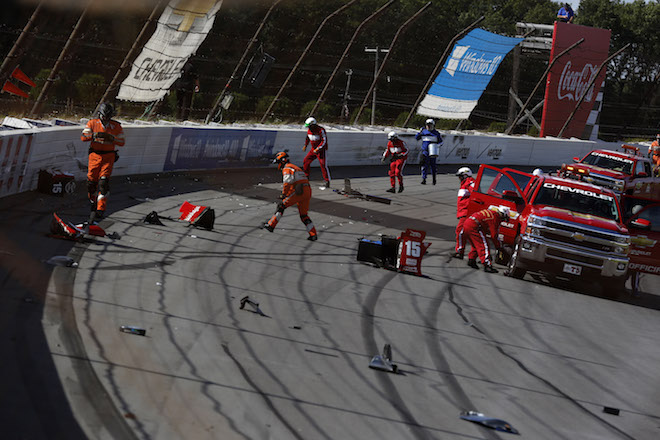
Wilson was killed by the heavy, dense nosecone from a crashed car at Pocono, and that piece, along with other bodywork ahead and behind the wheels, will have new steel tethers to hold them in place next season. Tethers have been in place for more than a decade on heavy suspension items, and with the addition of the bodywork extremities that are routinely knocked off in impacts with other cars or wall, greater safety for IndyCar drivers – and fans – should follow.
“We’ve obviously targeted the larger, heavier objects that would do the most damage,” Belli said. “What we didn’t say [in the press release] is we are requiring aero kit manufacturers to use more materials that would add toughness to the rear wheel guards if they’re re-made after October 31.
"When the manufacturers first made those items, they used stronger materials that were also more brittle, and that had an unintended consequence. They used better fibers, but they ended up tearing off more easily. Any updated wheel guards must have tougher materials to reduce this issue.
“The beam wing tether and the rear wheel guard tethers will be implemented for the first race. The nose tether and front mainplane tether is currently going to be speedway-only, so that will debut for the Indy open test in April. The dome skid will also be on for the Indy test, and the beam wing flips are also debuting for the Indy test. The flips and dome skids are speedway-only.”
Due to the rampant increase in winglets and flicks and other aero kit pieces, smaller items can also break off in an impact and pose airborne threats. Belli says installing new tethers will be limited to the bigger, aforementioned items, but he expects to see fewer small pieces on the updated 2016 bodywork from Chevy and Honda to break away.
“The front wing volume box regulations have been altered so we cannot have the Honda-type of front wing (LEFT) and we can't have the Chevy front stalks,” he continued. “Both manufacturers agreed to change that volume box shape so that’s gone as an option, so that should reduce more little bits from flying off. And under Rule 9.3, Honda will be making all-new sidepods and engine covers, and they are going to have far fewer pieces, so there will be fewer chances of pieces coming off.”
The work done by IndyCar, Chevy, Honda, and Dallara on these three safety items need to be tested in the real world, and physical confirmation of their individual and collective effectiveness will take spins and crashes at Indy, Texas, or Pocono to determine whether the two biggest problems from 2015 have been solved. And the series’ work isn’t done on the topic.
Improved cockpit safety in some form: a shield, a half-dome, canopy, or some other device to prevent helmet strikes has yet to appear, and Frye confirms cockpit safety advancements continue to be explored by the series and its partners.
“Yes, it’s an ongoing effort and it is evolving,” he said. “There’s a good combination of learning from what happened, and learning new things that came out of what’s happened. We certainly aren’t done; this is a good step with what we just released, but there’s more to come.
"We’re learning a lot from the tests we’re doing, and even from the ones where you don’t end up with an answer. We’re going to keep looking at our options; this was Step One, and we’re going to be doing a lot more over the next year. Nothing is off the table.”

Latest News
Comments
Comments are disabled until you accept Social Networking Cookies. Update cookie preferences
If the dialog doesn't appear, ad-blockers are often the cause; try disabling yours or see our Social Features Support.