IMSA: Ford's new GT loaded with open-wheel DNA
Peer beneath the Ford GT's bodywork and one thing becomes instantly clear: The Blue Oval has moved the goalposts beyond sight. The two-seat, mid-engine coupe fits the general template established by its grandfather, Ford's Le Mans-winning GT40, but the similarities start and stop right there.
Compared to many of the cars in IMSA's GT Le Mans class, or the FIA WEC's GTE-Pro category, Ford's new-for-2016 GT is a misfit. From a technical standpoint, it's a hypercar masked as a supercar, and deserves an exceptional amount of praise for re-writing the GT standard.
Among the steel and aluminum offerings from Aston Martin, BMW, Corvette, and Porsche, Ford's GT is a hand-laid carbon-fiber marvel that boasts compound curves, wind-cheating airflow channels, and shrink-wrapped packaging that won't be found on regular GT racecars.
Where Ford's twin-turbo V6 EcoBoost-powered GT ventures into a realm of its own is in the suspension department, and the innovative use of miniature rear sidepods built into the fenders to handle intercooling.
With the Ford GT built by Multimatic – the Canadian firm also responsible for cutting-edge racing dampers, suspension, and suspension testing – the GT utilizes a front suspension layout (ABOVE RIGHT) that is easily mistaken for something found on an open-wheel racecar.
Featuring a pushrod design with torsion bars and rocker arms, the left-front and right-front are connected by a traditional anti-roll bar.
Zoomed in on the front suspension alone, the racing pedigree is clear, and with normal GT racing items like shocks and dampers removed from the airstream, not to mention the benefit that comes with removing outboard weight, Ford's GT is takes advantage of a clean and tidy front suspension assembly.
In another break from GT traditions, the GT makes use of quick-change shims between the suspension control arms and the uprights that allow mechanics to alter camber and other alignment specifications on pit lane. It's yet another advanced system borrowed from open-wheelers and sportscar prototypes.
At the back of the car, the GT has the same pushrod suspension configuration that delivers the same result of optimizing airflow and centralized weight.
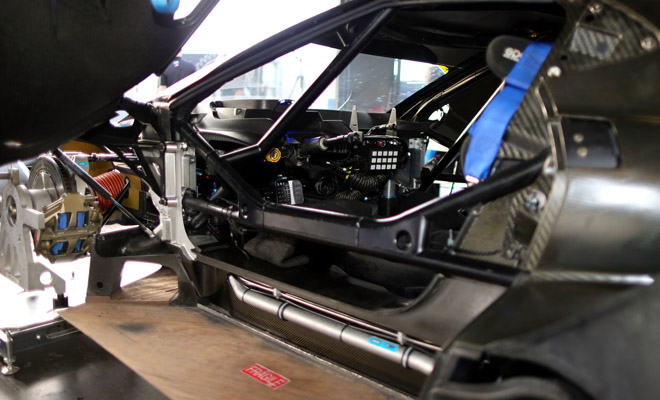
Through the torsion bar and rocker arm system (ABOVE LEFT), the GT's rear dampers sit vertically within the engine bay alongside the bellhousing where the flywheel and clutch reside.
Again, compared to most GT cars where traditional coilover shocks sit outboard, create turbulence, and add weight, Multimatic's approach to those problems with the Ford are both elegant and performance-friendly solutions.
Staying at the back of the Ford GT, Multimatic's expertise in weight distribution, center of gravity, and polar moment of inertia is evident in simple things like the location of the turbocharging system (RIGHT).
Swept forward towards the rear firewall, and resting incredibly low on either side of the EcoBoost's V6 block, the turbochargers are fed from the overhead air intake and fit within a short loop that feeds the sidepod-mounted intercoolers, which connect to the motor's intake plenums through thin ducting that runs within the narrow bodywork that connects the sidepods to the GT's roof.
That ducting then drops into the engine bay where it forces compressed air into each bank of cylinders (BELOW LEFT).
The circular forced-induction routing is, like so many aspects of the Ford GT, worthy of appreciation by those who are interested in the engineering side of motor racing.
There are dozens of other fascinating details we'll save to explore in the weeks ahead as Chip Ganassi Racing prepares two GTs for Ford's return to international sports car competition in January at the Rolex 24 at Daytona.
Click on the thumbnails to view larger images:
{igallery id=2367|cid=426|pid=9|type=category|children=0|addlinks=0|tags=|limit=0}


Latest News
Comments
Comments are disabled until you accept Social Networking Cookies. Update cookie preferences
If the dialog doesn't appear, ad-blockers are often the cause; try disabling yours or see our Social Features Support.