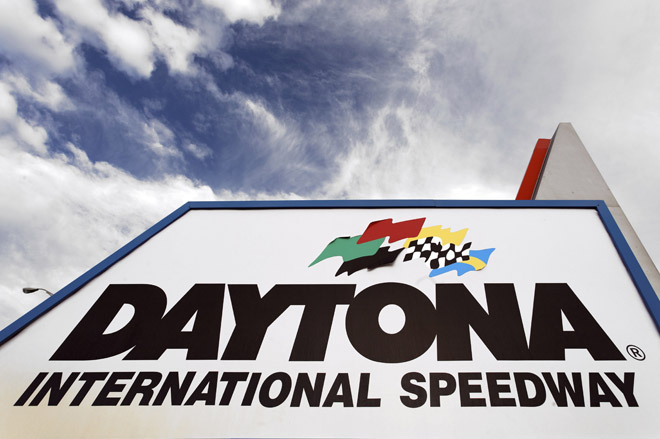
SCCA Runoffs at Daytona: In it to win it
As the SCCA Runoffs hits Daytona International Speedway, drivers are set to face a series of unique car setup challenges.
This article, presented by AiM Sports, originally appeared in the October issue of SportsCar magazine, the official publication of the SCCA. If you're attending this year's SCCA Runoffs and need assistance with your AiM Sports data system, contact AiM at the event by calling (951) 905-1144 and they'll gladly lend a helping hand.
If you've raced on a roval before, you likely made several small adjustments to your racecar in search of those last few tenths of a second – but this year's SCCA National Championship Runoffs at Daytona International Speedway (held Sept. 21-27, 2015) is like no roval you've ever run. Consequently, there are a number of tips you'll need if you want to win.
Daytona is different. As a point of reference, Auto Club Speedway in California has a modest banking of 14 degrees on the oval, while Michigan International Speedway sees 18 degrees. Daytona, on the other hand, has a neck-straining 31-degrees of banking. And, even as you cross the start/finish line after one of the two longest straightaways you've ever raced down, you'll be sitting on 18-degrees of banking. What does this mean for your car's setup? Read on and we'll tell you...
Aero advantage
Those long straightaways make horsepower and aerodynamics king at Daytona. Chances are, if you've been to the Runoffs before you are already packing as much power as you can produce given your class specifications, but there are tricks to cleaning up your aero in many classes.
"As a rule, you want the body to fit good, and you want to hide all the sharp edges that are facing forward," says Trans Am racer and team owner Tony Ave, who is also hoping to contend for the GT2 title at this year's Runoffs. "If I were racing an Atlantic car for example – one that was not subject to any type of spec rules – I would want to trick the ride height and the angle of attack to get rid of some of the drag that the tunnels make, or raise the skirt height. In a spec car, where you are not allowed to alter the body, then you try to run the back of the car as low as you can to get the wing out of the air. There are advantages to bodies that fit really good in places, and there are advantages to bodies that don't fit very good in other places."
The question becomes, how much downforce should you sacrifice to gain straight-line speed? "The car that can achieve the drag target, yet achieve the highest downforce among its competitors for that drag level, should win," says Peter Weston, Technical Director for Pirelli World Challenge GT and past Rolex team Dyson Racing. "In general terms, you may reduce the drag by 30 percent from what you may run at a high downforce track like a street track, say Lime Rock, for example. The game is to lose the least amount of downforce for that 30-percent loss in drag."
We have seen in recent years at Road America how important the draft is, and that is amplified as we head to Daytona. "The big drama tends to be in a Formula Vee or Formula F race – those guys are going to be able to stay in touch because of the draft," says Ave.
But Ave's final piece of aero advice might be the only thing you really need to know: "What it really comes down to is how good is your car from Bus Stop chicane to the finish line." Figuring out that segment of the track might just put you on the podium.
A solid foundation
With your car's aero taken care of, let's look at the chassis – which, for Daytona, really comes down to keeping your tires happy. "Don't worry about the setup as far as the bumps are concerned," says Ave, "That doesn't mean the track's smooth, you just don't gain much setting up for the bumps. You can make anything work. You can run higher ride height with softer springs and let the car set down; you can run really stiff springs and have it statically low. We won Trans Am races there with both setups, and both ran about the same lap times."
But the aggressive nature of the track puts significant load into your tires, and chassis adjustments should be made to compensate. "It's the dynamic loading, it's what that track does to cars," says Tim Gilvin of Hoosier Racing Tire. "Even at 1 degree of camber, coming around the banking will push your car down, so you will be at 3 or 3.5 degrees automatically. If you go out there with your normal road course setup of say 3 degrees, you are coming around that banking at 6 degrees."
Where Hoosier typically recommends settings around 3 degrees of negative camber for radial tires on the racetrack, for Daytona that changes to a much more conservative setting of 2 degrees or less. Additionally, Hoosier also suggests increasing hot tire pressures by 4psi to accommodate the excessive chassis loading.
"Camber and tire pressure on the outside tires need to be optimized so as not to cause a concentrated load in a small area of the tire carcass that can lead to failure," says Weston. "Raising tire pressures is beneficial to the tire carcass, as this increases the tire spring rate, making it more able to accommodate the load within an acceptable amount of deflection."
Another tip for eking out that last bit of top speed is toe settings, which should be kept to a minimum to reduce drag. "The easier you can make the car roll around the track, the better," says Gilvin. "If you set up for the infield, if you set up for grip, you might pass two or three cars in the infield but you are going to get passed by 10 in the banking."
Stop it
Braking plays a big role at Daytona, but don't over-think it. "We've done a lot of testing between lighter, smaller brake packages and bigger ones [at Daytona]," says Tony Ave. "We are always faster with the car that stops better than one with less rotating weight." But because of the hard-braking zones at the end of the long straights, Ave's team utilizes a different brake duct and pad setup at Daytona, otherwise "the brakes get thermal shock," he explains.
- This story originally appeared in , the official member magazine of the Sports Car Club of America. To join the SCCA and receive for free, head to www.scca.com.

Crandon International Raceway announces first-ever vintage revival & reunion for 2026 Brush Run Speed Festival
Latest News

Comments
Comments are disabled until you accept Social Networking Cookies. Update cookie preferences
If the dialog doesn't appear, ad-blockers are often the cause; try disabling yours or see our Social Features Support.