Spa Treatment
When Porsche wanted the 1971 Spa 1,000km-winning 917K restored, the honor went to California-based PMNA.
Restoring a Porsche icon – no, make that a motorsport legend – isn’t a trivial thing. The Porsche 917 is a racecar that defined an era, a genre, and some say it’s even a bona fide movie star.
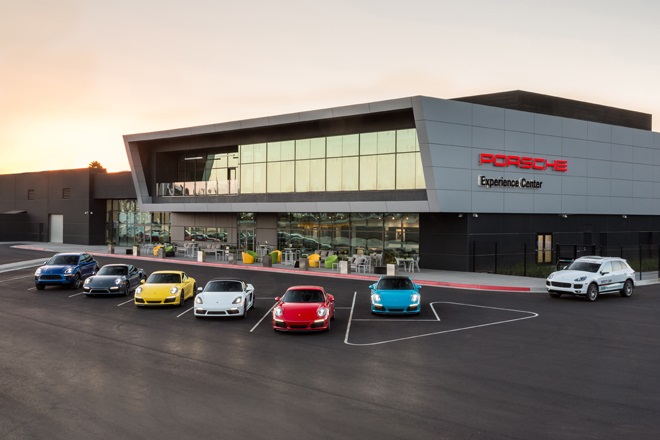
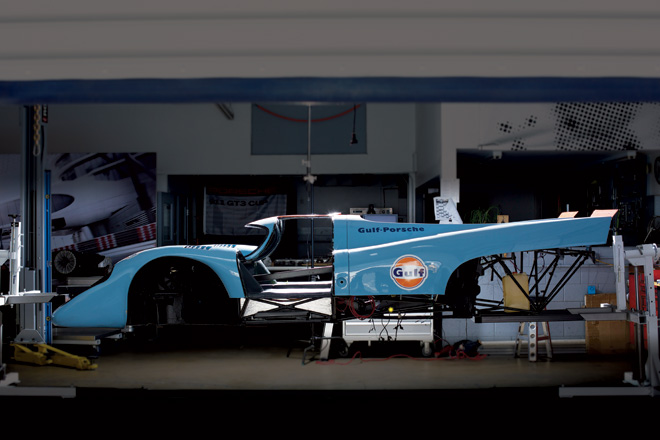
So when the Porsche Museum in Stuttgart-Zuffenhausen, Germany, decided it was time to restore the No. 21 J.W. Automotive Engineering Gulf Porsche 917K back to its glorious Spa 1,000kmwinning specification of 1971, the honor and privilege fell to Porsche Motorsport North America’s (PMNA) Historic Motorsport division in Santa Ana, Calif.
According to Klaus Bischof, employee of Porsche Historic Motorsport and a member of the Porsche race team when the car was in action, this 917K is one of the most original examples remaining.
“In reality, every 917 is important for Porsche, but this one has a spectacular legacy,” says Bischof. “It has always been owned by Porsche AG, having been loaned to John Wyer’s Gulf team. Since winning the Spa 1,000km, it has always stayed in its original technical condition.”
Restoring a production car to original spec is a definitive exercise, since all car models in a given year are the same. Racecars on the other hand often differ from race to race, and from others of the same type number. Bodywork, ride heights, and gear ratios, to name a few, are optimized for each race, which means that a true baseline is impossible to pinpoint.
Forty years later, tracking down the specific details is a formidable undertaking. So an essential first component of a PMNA Historic restoration is deciding with the client to which spec (usually based on a specific race) the car will be restored in order to establish a clear goal and eliminate any ambiguity as to what constitutes original or authentic.
And then there’s the priceless knowledge contained in the recollections of people who were hands-on with the car in 1971. This is where Porsche has a relative advantage. From employees like Bischof, to links with former J.W. Automotive Engineering chief engineer John Horsman, PMNA’s connections to those with the most intimate knowledge of the cars it restores couldn’t get any more authentic.
“I was thrilled to be contacted about the restoration,” says Horsman. “I enjoyed recounting fond memories of developing these cars, and it was clear that PMNA was taking extra effort to uncover the specific details of how we ran the car in the day.”
In a word, authenticity is what the PMNA Historic Division strives for. Whether it’s referring to original Porsche schematics, or using factory-original tools and techniques, every effort is made to restore and preserve the car in the same manner as when it was built in Zuffenhausen.
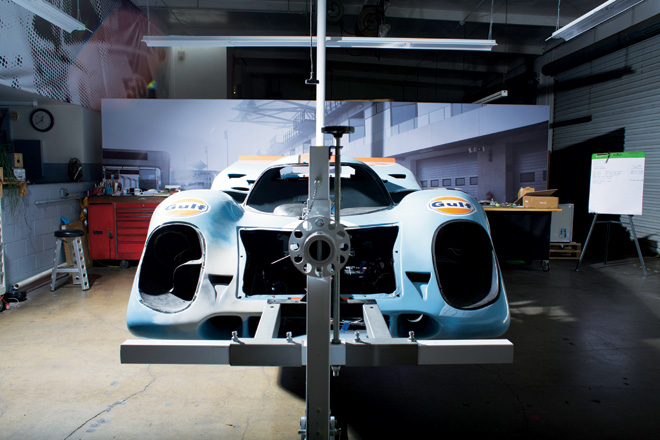
For the 917K project, repairs to the chassis and refinishing of magnesium components were both performed using the same techniques as back in the day. The magnesium work was particularly challenging, since few people remain who are skilled in such a task. But such a person was found and the result is fully in keeping with how the parts were produced originally. It’s just one example of the lengths to which PMNA Historic Motorsport is willing to stretch beyond its internal resources to bring an amazing network of expertise to each restoration project. In the end, being faithful to the car is what matters most.
The bodywork restoration involved repairing and repainting to replicate the configuration and livery from Spa ’71. The work included fabricating from scratch the rear aerofoil developed by J.W.A.E. to keep the 917K’s tail more planted. The process included studying images taken from a variety of angles and period documents to make sure that the wing angle was just right. Additionally, there was a large effort to replicate the luster of lacquer, ensuring the car appears period correct despite having to use contemporary paint.
In other instances, the question of restoration or preservation is more persnickety. As PMNA President and CEO Jens Walther states, the mission of restoring a Porsche racecar is to keep it where it belongs, namely on the racetrack, or at the very least in a state where it can be run. This can often lead to questions surrounding safety, which for the car’s owner must be foremost, and utility.
The utility challenge presented itself with the engine, perhaps the most complex part of the 917K and the restoration as a whole. Drivetrains are a particular specialty of PMNA, for both current and past racecars.
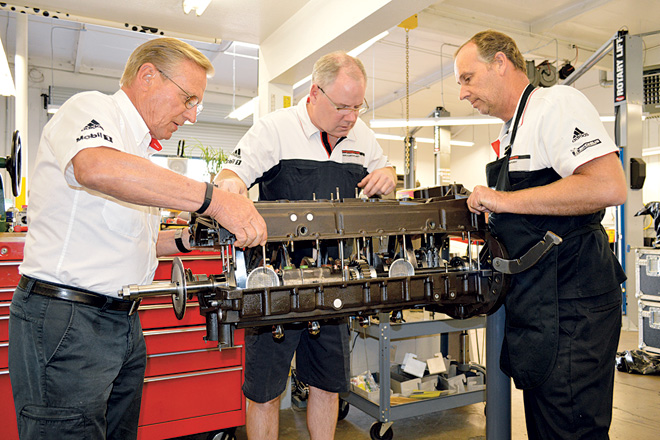
Former PMNA president Alwin Springer assists PMNA Historic Motorsport’s engine experts in reassembling the 917K’s flat-12. It’s an example of the in-house expertise, past and present, that Porsche is able to draw on.
According to PMNA vintage engine specialist Eric Bloss, “Rebuilding an engine of this complexity, when new parts aren’t readily available, is a huge challenge. Through our partners in the industry, we were able to source what we needed and, in the end, it was very rewarding to bring the heart of the car back to life.”
In prepping the wholly rebuilt engine, the team refined the assembly details to exacting measures, such as adjusting the complex fan drive system and tuning the 24-plug ignition system for the demands of how it will run in the future, rather than how it was raced in the past.
The collective effort made by PMNA Historic Motorsport raised a smile from Alexander Klein, director of the Porsche Museum, who will take over as the car’s custodian when it arrives in Stuttgart- Zuffenhausen later in 2015.
“The Porsche 917-015 is a unique exhibit for the Porsche Museum,” says Klein. “It achieved major successes at many long distance races around the globe, including the Spa win. PMNA restored it with the utmost emphasis on maintaining the highest level of originality. Starting in the latter part of 2015, the racecar will continue to be actively used by the Porsche Museum and will be participating in many international historic motorsport events.”
With the 917K set to return “home,” it leaves behind a group of people at PMNA, along with their partners, who are proud of their role in restoring a car of this magnitude to its former glory. When the engine ran once again for the first time, everyone at PMNA gathered and, through its magnificent bark, the sound of Spa in 1971 rang in their ears.
{igallery id=1298|cid=374|pid=2|type=category|children=0|addlinks=0|tags=|limit=0}
The painstaking work of restoring the Porsche 917K to the condition and specification it raced in at the 1971 Spa 1,000km began with extensive research. The end goal of PMNA’s restoration wasn’t just to make the 917K look authentic, but to keep it in running condition, too. Ensuring that the car is safe to drive is also key.

Latest News
Comments
Comments are disabled until you accept Social Networking Cookies. Update cookie preferences
If the dialog doesn't appear, ad-blockers are often the cause; try disabling yours or see our Social Features Support.