SportsCar's Project T4 Civic Si
RACER.com and SportsCar magazine build a Honda Civic Si for SCCA's Touring 4 Club Racing class
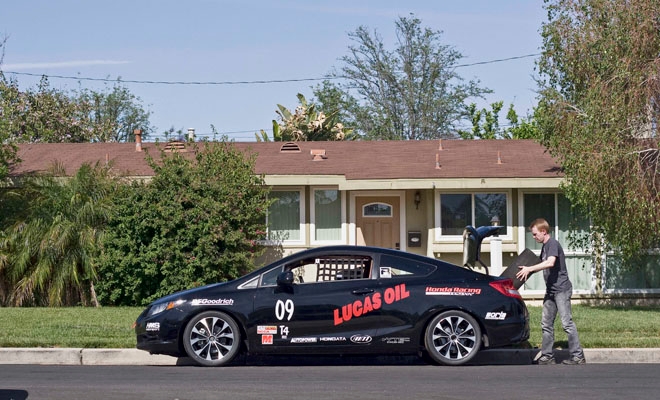
We love it when a plan comes together. The problem is, while plans have a way of beating the odds, they rarely do so exactly the way you planned. With that, meet RACER.com and SportsCar magazine's latest project car: a 2013 Honda Civic Si.
The goal was simple: Transform a Civic Si from street car into an SCCA Club Racing Touring 4 racecar in just four weeks. The snag? Those weeks contained Christmas and New Year's Day, with the first race taking place Jan. 16-18, 2015, at the opening round of the Western Conference of the SCCA U.S. Majors Tour at Fontana's Auto Club Speedway. A four-week Touring 4 build? Easy, right?
Early Days
Honda Performance Development, the racing arm of Honda, had a 2013 Civic Si that was at the end of its life with the company, and they sacrificed it for our build. Honda Racing Line is HPD's program for racers just like us, with free membership. Once enrolled, those competing with Honda power have access to an immense parts catalog, Honda's healthy contingency programs, and HPD's ingenious support team. We signed up, ordered parts and, within a week, had all the HPD offerings for a Touring 4 Civic Si build.
HPD's lineup includes almost everything needed to turn a street car into a racecar, including tow straps, A/C delete belts, brake pads, brake ducts, and brake lines. The Honda Racing Line site is also the place to buy the Touring 4 spec line-approved suspension kit for the Civic Si (as well as the Fit B-Spec kit, and more). In our case, we ordered both parts of the T4 kit, which includes a damper assembly and separate springs that were designed specifically for T4 by HPD and H&R Special Springs.
What HPD doesn't sell are some of the more basic safety and personal items, like seats, harnesses, window nets, and so on. They also don't sell items like tires, fire extinguishers, motor oil, and an engine ECU programmer – all stuff you'll need if you're going T4 racing.
It's raining parts
Like good SCCA members, we waited until most of the parts had arrived before beginning any work on the car. This is otherwise known as procrastination – something we've perfected over the years. So, on Dec. 27, 2014, we finally thought it time to turn a wrench.
All of the HPD parts went on first. Day one, we threw the HPD shocks, springs, upgraded radiator, and A/C delete belt at the car. The next couple of days saw the installation of the HPD braided brake lines, HPD/Cobalt brake pads, and the HPD tow straps. We then prepped the interior for the roll cage, which included stripping stock parts and mounting the super comfortable, HANS compatible HMS Motorsports Cobra Sebring Pro-Fit seat, both allowing for correct roll-cage installation. Then, on Jan. 2, the car went to Autopower Industries in San Diego, Calif., for the roll cage.
Autopower is probably best known for its bolt-in roll cages, but they also do excellent work with custom, welded-in cages. With our tight deadline, they cleared the decks and knocked out a Touring 4 legal roll cage built to our specifications in less than a week. On Jan. 9, we picked up the car and finished the racecar prep. At this point, we were seven days from the car's first race and we still had too much work to do. Time to panic.
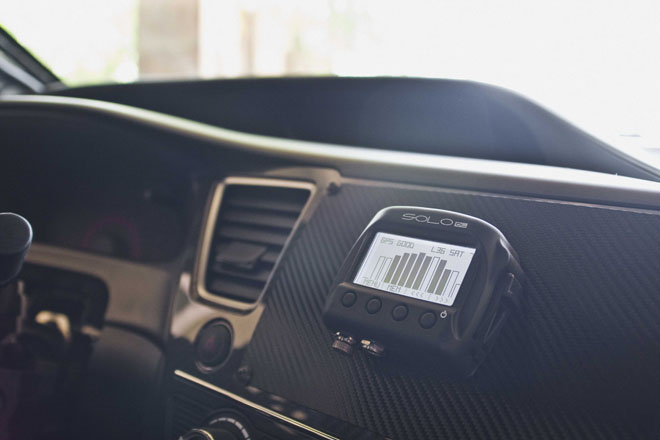 Don't Panic!
There are several finite truths to building any racecar. The first is that there's always more work to do than anticipated, making the procrastination that seemed so harmless earlier a complete nightmare. Another truth is that you'll never finish the build in time for the car's first race. Never. Don't fool yourself into believing you will.
With a week to go, we discovered we really only had three days to wrench on the car (work always gets in the way), so we had to figure out what would make it on the car for the debut race and what could wait. Stickers were a necessity, as was reinstalling the dashboard; meanwhile, an exhaust installation and ECU tune were axed from the list. The BFGoodrich R1-S tires had to be mounted on the stock wheels and the Lucas Oil race oil needed to go in the motor (we've blown up too many engines in our day to skimp on oil), but we could probably hold off on changing the transmission fluid. Something we absolutely had to do, however, was weigh the car.
In Touring 4 trim, our Civic Si had to weigh 3,125lbs with driver, for the January race (this would change to 3,025lbs with a 52mm restrictor by the second race weekend). Putting the car on our Intercomp scales, we had mixed emotions when we saw the 2,701 flash on the screen. Thus started another truth of racecars: mounting ballast takes forever.
By adding 140lbs for the weight of our driver to the number, we were left scrambling for 284lbs. We figured we would end a race with six or seven more gallons of gas than what the car had in it at the time, and the spare tire weighed 28lbs, so we could put that back in. When all was told, we bolted 210lbs of lead to the car and burned a full, precious, irreplaceable day doing so.
The R1-S tires were mounted, the oil was changed, the Intercomp alignment toe plates came out, and we broke out our vinyl cutter for car classifications and numbers. By Friday, Jan. 16, the first day of the Western Conference U.S. Majors Tour kickoff, we were ready to load up, tow to the track, and hope our car was legal enough to get its logbook.
All's well that ends well
So, how did it go? Despite installing the Schroth Profi II harnesses from HMS Motorsports (incidentally, some of the smoothest-action FIA harnesses we've ever used) moments before heading to tech, the car got its SCCA competition logbook, and later that day we ran a qualifying session and only spectacularly exited the racing surface once. Maybe twice. That weekend at Auto Club Speedway we also completed every race lap and had more success than we ever anticipated with this being the car's first outing, with one race ending in a victory!
Following the car's first race weekend, but prior to the car's second, we installed a 52mm restrictor, chucked 100lbs of ballast, and removed the stock catalytic converters, as the rules of the game had changed for SCCA's Club Racing Board. We also installed the Borla cat-back exhaust and headed to Church Automotive Tuning in Wilmington, Calif., and let them loose on the Hondata FlashPro ECU tuning software. Interestingly, we'd talked to racers of the Civic Si who had built custom exhausts to maximize backpressure for optimum power output of Honda's K24 motor. Meanwhile, we bolted an off-the-shelf Borla system on and squeezed out just about the same power. The power gain over the stock ECU was a healthy seven peak horsepower once restricted.
There are many morals to this story. One is that four weeks is, indeed, enough time to build a Honda Civic Si into a Touring 4 racecar. Another is that procrastination will always bite you in the end. And, finally, no matter how much the family says it's OK to build a racecar over Christmas and New Year's and miss several family functions, it's not. They were just being polite.
This story originally appeared in SportsCar, the official member magazine of the Sports Car Club of America. To join the SCCA and receive SportsCar for free, head to www.scca.com.

Latest News
Comments
Comments are disabled until you accept Social Networking Cookies. Update cookie preferences
If the dialog doesn't appear, ad-blockers are often the cause; try disabling yours or see our Social Features Support.