MILLER: Danger with a capital D
In his first year on the job as CEO, Randy Bernard gave an interview and said IndyCar was an intoxicating mix of speed, talent and danger. He was quickly admonished by a former IRL employee and told never to use the word dangerous.
Bernard was familiar with danger since he came from bull riding and he was instantly hooked on Indy car and sprint cars after his introduction, because they sported that edgy balance between thrilling and chilling.
Of course it's because midgets, sprints, Indy cars and F1 cars were beyond dangerous that people became loyal fans of all these disciplines in the '50s, '60s and '70s. They didn't watch to see anyone lose his life, but they couldn't look away because they were in awe of the bravery and ability it required to survive.
Nowadays, the cars and tracks are safer than could ever be imagined back in the day when Parnelli, A.J., Lone Star J.R., Mario and Uncle Bobby ran the Midwest fair circuit with light poles a couple feet from the groove, no roll cages and dust so thick a driver couldn't see 10 feet in front of him. Or when Dan Gurney was lapping Spa or the Nurburgring at 175mph with trees serving as guardrails.
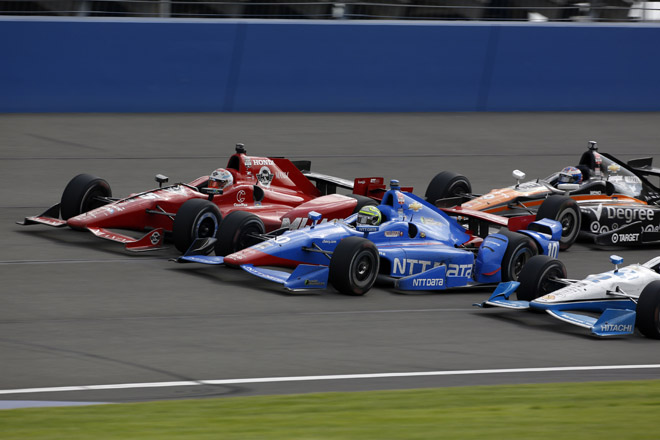
And what we witnessed Saturday at Auto Club Speedway was somewhere between the measured insanity of the 1960s and a jaw-dropping display of reflexes and reaction at 220mph.
It was incredible theatre, with a record 80 lead changes among 14 of the 23 drivers and three hours of intensity that's hard to be imagined or duplicated.
In terms of pure excitement, it ranks as one of the best ever. And it wasn't a Handford Device race from the CART era where nobody wanted to lead and passing was so artificial. It also wasn't one of those old IRL pack races where eight rows of two ran in formation for 30 laps.
Saturday's MAVTV 500 seemed to have four or five grooves on any lap and non-stop diving, dipping, chopping and filling holes.
But the guys who put on this modern-day version of Hell Drivers were divided on what they'd just done.
Some of the young guns like Josef Newgarden and Sage Karam enjoyed the experience while winner Graham Rahal and third-place Marco Andretti admitted it was an adventure.
"It was intense racing, but it was fun," said Newgarden who got taken out by teammate Ed Carpenter.
"I passed a lot of cars, led my first laps in IndyCar, pissed off a few people and got my first top five," said Karam.
"It was a lot of fun and dangerous but that's the risk vs. reward and what we sign up for," said Andretti.
"It was nuts and it was fun with four different lanes of racing," said Rahal.
Despite being clipped and flipped on the last lap, Ryan Briscoe confessed: "I enjoyed myself, coming from the back to the front a couple of times and it was awesome racing."
Veteran Tony Kanaan drove like he was 20 instead of 40 and reasoned it was "nerve wracking but great for the fans" while teammate Scott Dixon said he felt it was more about "maneuvering the car rather than driving it."
At least three of Team Penske's armada were against the added downforce before taking the green flag. "I warned IndyCar that's what we were going to get and we're lucky nobody got hurt," said two-time Indy 500 winner Juan Montoya.
Polesitter Simon Pagenaud said afterward he was "not a fan" of that type of racing, while 2014 IndyCar champ Will Power labeled it as "insanity" and compared it to the 2011 race in Las Vegas that claimed Dan Wheldon.
"Someone is going to die," fumed Power to USA Today.
Which prompted Carpenter to say: "If you don't want to do it, go somewhere else. There are plenty of other guys who want to be here. It wasn't pack racing like Vegas, guys would spread out enough."
The divided camps were easy to identify. Everybody with USAC roots and sprint car ties loved the action. "Winchester was always a pack race at 130mph on a half-mile," said Dane Carter, former driver and son of USAC legend Pancho. "That's what racing is all about," said Jeremy Milless, engineer for Newgarden and a former midget racer.
A.J. Foyt said he didn't think Saturday was any crazier than running a 100-lapper at Langhorne with no power steering. "It's supposed to be dangerous," said Super Tex.
Some of the road racing set seemed more appalled than impressed but hopefully Kimi Raikkonen was watching. The 2007 world champion said a few weeks ago that Formula 1 would benefit if it were "a little more dangerous. That's part of the game. We don't want anybody to get hurt but it does make it more exciting."
It was both dangerous and exciting Saturday afternoon but some of the social media critics were a bit harsh by calling Power and Montoya "pussies." Nobody in today's racing is any better or braver than those two and throwing an Indy car into a corner next to somebody at 235mph at IMS takes plenty of balls. They just felt the extra downforce created unnecessary risk taking and voiced their opinion.
But many of the old-time fans didn't want to hear any complaining because drivers didn't do that in those lethal years. They strapped on their helmets and dealt with it – like everyone including JPM and Power did last Saturday.
And that's the slippery slope, isn't it? We don't lose many drivers nowadays and that's a good thing. But IndyCar lost a lot of that edge it used to have and, in the process, it lost a lot of followers.
That's not an opinion it's a fact. A.J., Parnelli, Mario, Dan, J.R. and the Unsers are still revered because they were the gladiators of their day and we were in awe of their commitment and cajones. Rahal, Marco, T.K., Sage and company put their cars and their lives in some precarious places on Saturday. It was fast and furious and riveting television.
That's why ESPN's SportsCenter actually talked about it for two minutes. And why NASCAR stars were tweeting about the "insane race at Fontana." It's also why people were still buzzing about it Sunday night on social media.
It was a showcase of why IndyCar is the most competitive and compelling series on four wheels. It was wildly entertaining as much as it was wild west.
And it was much like the '60s in that drivers hung their asses out for a paltry purse that was as embarrassing as the attendance.
But it was also dangerous with a capital D. And whether we want to admit it or not, that's the real hook.

Latest News
Comments
Comments are disabled until you accept Social Networking Cookies. Update cookie preferences
If the dialog doesn't appear, ad-blockers are often the cause; try disabling yours or see our Social Features Support.