IndyCar: "One of my first questions was, 'When can I drive again?'" Hinchcliffe says
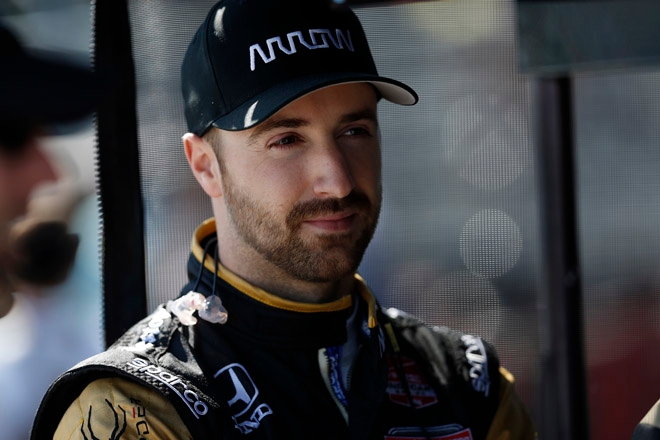
James Hinchcliffe doesn't remember his accident or gallant rescue from the May 18th accident at Indianapolis that nearly took his life but the popular Canadian's first recollections sounded like a typical race driver.
"When I was fresh out of surgery, still on a ventilator, communicating by pen and paper, one of my first questions was: 'When can I drive again?'" recalled Hinchcliffe on Wednesday during his national teleconference with the media. "I think some people in the room found it so bizarre and confusing that somebody in the state I was in, hooked up to 10 different machines, recently sewn up would say, 'How can I get back into the machine that did this to me?
"I think that's how racing drivers are wired. I certainly never contemplated it (retiring). If anyone around me was thinking about it, they were smart enough not to say anything. I think everybody close to me knows that wouldn't be something that was on my mind."
That kind of spunk isn't surprising, it's standard operating procedure for many drivers that have been maimed or wounded at speed. But the 28-year-old native of Toronto doesn't have any flashbacks of a savage crash in Turn 3 that produced 125 lateral Gs and sent the car's suspension into his left leg on the day after qualifying. He lost 14 pints of blood, and thankfully, his memory.
"Despite being conscious throughout the whole process, I have mercifully been spared any memory of the accident whatsoever, of the extrication," referring to the Holmatro Safety Team's quick reaction when they discovered the suspension had him trapped in the cockpit. "Even the first couple days at the hospital are a bit of a blur.
"For me, I remember waking up in ICU, knowing that obviously I'd had an accident, that I was somewhere I probably shouldn't be, all the rest of it. But it really wasn't until several days later when I'd been moved out of ICU, was kind of sitting around with some friends and family and some of the doctors, really hearing all of their first-person accounts of how that day was for them, that it really began to sink in just how serious the injuries were and how very close it was to being a different story.

Asked if he'd been able to speak with Mike Yates, leader of the safety team or any of Holmatro crew (LEFT, IndyCar photo), Hinchcliffe replied: "I haven't had a chance to connect with Mike specifically yet.
Andrew Stevens, who is a member of the team, managed to see me and I'm very anxious to get to the track. Unfortunately, not all these guys live in Indy, so it's not easy to get them all together.
"When I'm able to get back to the track, have a sit-down with them, I still have a lot of questions about the day, to be honest, because I don't remember so much of it. Look forward to chatting with them. I look forward to treating them to a steak dinner, if that's what they want."
From the rapid response at the car, to Stevens & Company's performance in the ambulance and then Dr. Timothy Pohlman at Methodist Hospital, everything was synchronized perfectly and, for the first time since Alex Zanardi in 2001, a driver's life was saved on the track.
"You know, you can have the best surgeon in the world, but if he doesn't have a grasp of what could potentially be wrong, it's going to take him that much longer to really diagnose the problem," he continued. "In a situation like mine, there wasn't any longer to diagnose the problem. So, you know, for us to have a group of guys like we do that have the experience, that have the particular skill set that they do, it's the best insurance policy, in a sense, that you can have. It's tough to put into words how comforting it is as a driver to know that we have that on hand.
"I'm not just saying this because I had an accident. I've said this for years. I know other drivers, every other driver out there, mimics this thought. We are so fortunate in IndyCar to have the safety team. It is no doubt in my mind a contributing factor to me surviving that accident, was not only having a safety team there, but one with the kind of skills and experience these guys have.
"I know myself and my family will never be able to thank them enough."
As for recovery, The Mayor of Hinchtown is making steady progress, walking daily despite a fracture in his pelvis and trying to get back the 12 pounds of muscle he's already lost.
"Honestly, it's going better than expected really. Every doctor that I've seen, every specialist that we've been with has been very, very pleased and in some cases surprised at the level of recovery, which is obviously great news. I guess we're quick in that sense, too, which is good.
"Without going into details, it's another surgery where I have to be opened from the abdomen to undo some things that were done during the emergency surgery, just to keep me healthy and safe.
"Unfortunately it's the kind of surgery that is of the nature that will put me down again for another couple weeks. Anytime you go into the abdomen, there's a lengthy recovery. That's kind of the difficult part to swallow. At the same time it's necessary to be done. The sooner we get that one going, the sooner I can get the rest of the recovery, get back to the gym, think about getting back into the car."
The personable kid who grew up idolizing Greg Moore is easily one of the most well liked drivers by fans, fellow competitors and media. And he says the out-pouring of support has been humbling.
"It's been probably the most surreal element of this whole adventure," said Hinchcliffe, who won the NOLA race in April. "You know, as we talk, I'm sitting here looking at my mantel and bookshelf that is literally covered top to bottom, left to right, with get well cards, messages.
"Seeing the support from absolutely everybody, the giant banner that Firestone had done at the track, the amount of people that came to visit me in hospital, the number of people that have been by to visit since I've gotten out of hospital, the emails, text messages, comments on social media, whatever it is, the sheer volume of support from people has really just been the most overwhelming thing.
"I can't tell everyone how appreciated it is and how much it does help. I mean, part of the reasons all of these cards are sitting on my mantel is because this is where I sit for a big chunk of my day. I get to sit there and see reminders of people that care about you, people that are wishing you well. For me, part of my motivation to get better is for the people that took time to reach out to me as much as anything else. It's just been incredible."

Latest News
Comments
Comments are disabled until you accept Social Networking Cookies. Update cookie preferences
If the dialog doesn't appear, ad-blockers are often the cause; try disabling yours or see our Social Features Support.