.jpg?environment=live)
Blue Sky Thinking
For Dunlop’s Future Racecar, the question isn’t if the technologies it uses will be available, it’s when. And it may be sooner than you think...
Trivia question: Name a racecar that is fully electric, is powered via induction pads embedded in the race track, is so efficient at harvesting its own energy that it doesn’t need traditional brakes, and has a body and tires that change shape in response to the conditions.
The answer, of course, is that you can’t – well, not yet. And the “yet” bit is the most important point for former Formula 1 designer Sergio Rinland (LEFT), who was tasked with injecting viability into the ideas borne out of tire manufacturer Dunlop’s “Future Racecar Challenge.”
The project began as a “blue-sky thinking” report commissioned by Dunlop to explore what motorsport might look like in 125 years. Futurologist Dr. Ian Pearson came up with a vision that may seem slightly Jetsonion, The Jetsons cartoon being the ultimate benchmark for an idealized future. His car is powered by linear induction plasma thrusters and powerful electric engines, and built from composites that change aero profile on demand. It accelerates and brakes so rapidly that human drivers would need to be replaced by androids.
This concept formed the basis for Dunlop inviting fans and industry insiders to submit their own ideas for technologies that could be incorporated into motorsport in the shorter term, with Rinland – whose F1 résumé includes stints with Williams, Brabham, Benetton and Arrows – tasked with hammering it all into some sort of reality. What Dunlop didn’t know when it approached the UK-based Argentinean was that he already had a head start.
“When they first came to me, they didn’t know that I’d actually designed a car already,” he says. “It was supposed to be the Formula E car!
“The technologies that all the people proposed were very similar to the ideas that I’d been thinking should be in the car of the future, so I didn’t have to dig deep into what they all meant.”
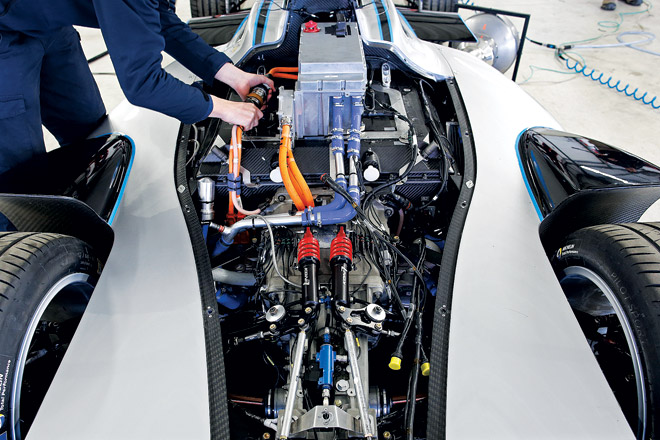
“At the moment, battery technology is the limiting factor,” says Rinland. “In the foreseeable future, the energy will be generated by hydrogen fuel cells. Right now, if you want to generate electricity within the car, you need an internal combustion engine.
“A lot of prototypes are being built around the world to use hydrogen fuel cell technology, but we’re not yet at a point where we can say it’s ‘today’s technology’. It’s still at the research stage.”
The main problem electrical power faces in racing at the moment is that it’s not in the same league as fuel in terms of energy density. Rinland believes that the increasing scarcity of fossil fuels will inevitably tilt the world – motorsport included – toward electric-powered cars. But he also recognizes an opportunity spun from racing’s strong history as an incubator for technology.
“I’ve always believed that racing improves the breed faster than any other means, because in racing you simply have to do it,” he says. “It’s not like you’ve got a decade to develop lighter electric motors and if you save five kilos, you’re good. In racing, you need to do it for next week.
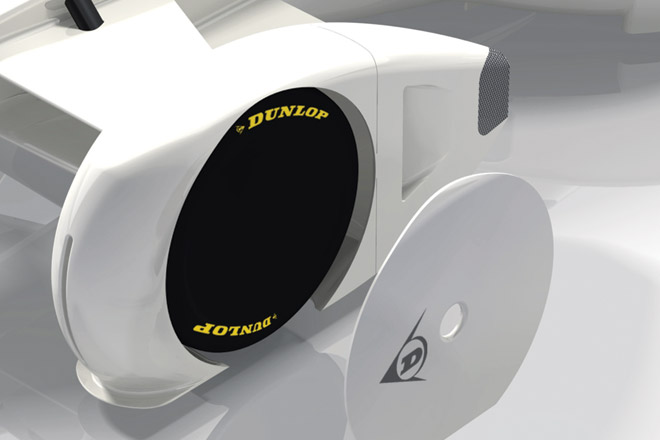
“But the future is developing energy generation within the car, and then later, hopefully, transferring energy from the racetrack to the car, but with a limitation on power because you can’t have speeds that exceed the race track. So this car is all about where our ambition and imagination can take us with technology that’s being developed today. We didn’t describe any technology that isn’t already being discussed or isn’t under development.”
Indeed, headway’s already been made on the power-unit front: in a street car, an electric unit developing 150-170kW (200-225hp) currently weighs around 75kg (165lb), but a racing version exists that weighs just 12kg (26lb) without its inverter.
Longer-term, the need for cars to carry vast amounts of energy on board could potentially be countered by racing on tracks that have induction pads built into their surface. Again, the technology is not yet at a point to make it viable, but there have been steps in that direction: Drayson Racing’s B12/69EV, which was built around a Lola B1 chassis, is induction-charged. That car broke the electric vehicle speed record a couple of years ago, although its batteries can only hold 15 minutes worth of charge at a time, and it can only recharge while stationary in its pit.
Another intriguing aspect of the Future Racecar is its target of near-100 percent energy recovery, eliminating the need for conventional brake systems as the car’s energy recovery systems do all of the stopping. The technology, Rinland believes, is relatively close…
To read the full story, you'll need the Fall 2014 issue of RACER magazine: The Technology Issue. Take a video tour of the issue...
click here
, or to buy The Technology Issue online, click here. To learn where to buy RACER in your area,click here
.RACER is also available digitally for Apple, Android and Kindle Fire devices. RACER Digital has the complete content of the magazine's print edition formatted for mobile viewing. With RACER Digital, you'll have access to your RACER content all the time, wherever you are.
The RACER app can be found by searching for "RACER Magazine" in the Apple, Android or Amazon App stores. The app is free and includes issue previews and the RACER.com newsfeed. Individual issues can be purchased for $1.99 and an 8-issue annual subscription is $9.99. Back issues are also available.

Latest News

Comments
Comments are disabled until you accept Social Networking Cookies. Update cookie preferences
If the dialog doesn't appear, ad-blockers are often the cause; try disabling yours or see our Social Features Support.