.jpg?environment=live)
Steven Tee/Motorsport Images
Opposing views on Formula E – Gil de Ferran and Robert Clarke
Two of the smartest brains in U.S. motorsport have differing opinions on FIA Formula E, although each admits to slight bias...
Robert Clarke
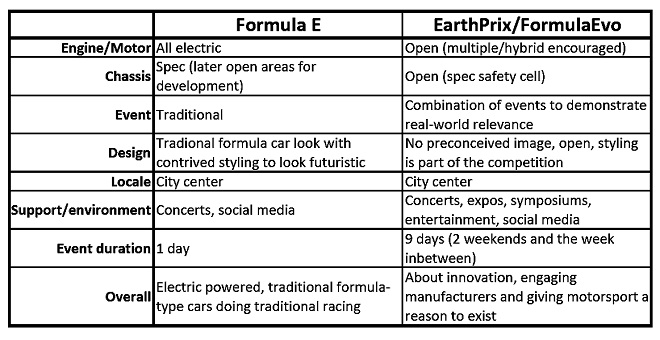
The man behind the EarthPrix concept (see table below to see how it compares with Formula E), Robert Clarke – former boss of Honda Performance Development – was underwhelmed by the inaugural Formula E race. The format of the cars and the racing, he believes, need major modifications.
What did you think of the first race?
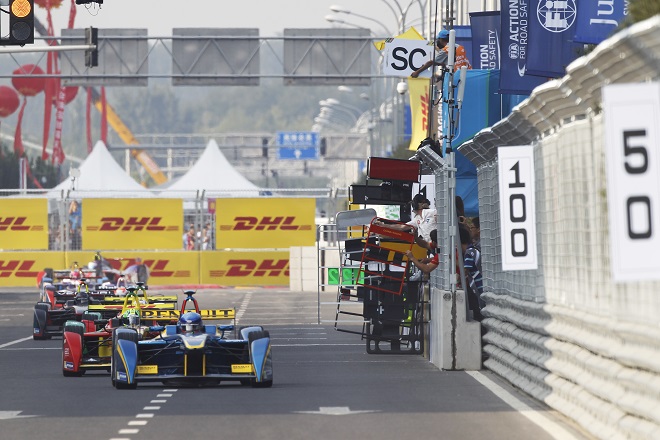
Sadly, it just kind of confirmed that the technology of fully battery-powered racecars is not there yet. They were 200hp in race spec but they could only do 24 or 25 laps before having to change not battery packs but cars. On the positive side, it was good to see the motorsport world trying something different.
Formula E's concept is very different from your EarthPrix concept, which is about a common tub and then "run what ya brung..."
Yes, EarthPrix was conceived to allow innovation and evolution. It's not a fixed spec, so manufacturers can choose the technology of their cars, whether it's based on the event concept, their marketing platform or their future vision. They can pick the energy source or the combination thereof and that can change or evolve as the event matures. It's not like sticking a stake in the ground and saying, "We will be full-electric."
The Formula E advocates are saying it's innovative, and of course that's true in one sense, but they're spec cars. Apparently there will be development allowed going forward, but again it's limited to certain areas of the car.
EarthPrix ideas were more than just about the car, right?
Yes, it was a much larger event platform that's about energy conservation and energy source solutions – not just cars but everything. The expos were about wind and solar energy and converting trash to energy, that sort of thing; the race was just the cherry in the center of the cake, the focal point. It's demonstrating that advanced technologies are viable and not just for the sake of being different: they're green but also better. And that's true if you can pick relevant technologies that are proven and work.
What could Formula E have done better?
If Formula E had gone hybrid, that would have been a steppingstone to one day going full electric. I think we agree the series was premature in that pure electric is not yet ready. But the other thing is, it just takes a different energy source but a traditional-looking open-wheel racecar – albeit with somewhat contrived styling to make it look futuristic – and does the same things with it that you'd expect to see at any race. EarthPrix was about building an event around a race, like the earliest forms of auto racing at the start of the 20th century. Formula E doesn't demonstrate that the technology is superior or advanced over what exists already. It's just different. It's a novelty but not one that grabs the attention.
Pure electric in itself isn't a bad thing though, right?
Absolutely not. I went to the Emerging Technology day at Indianapolis a couple of years back, in one of the weeks leading up to the Indy 500. Purdue University hosted an electric go-kart race, open for development of motors, and you build your own battery packs and so on. I was really curious what it would be like – would it be slow and boring or would the absence of engine noise hurt the show, etc.? In fact, I was fascinated by it. The karts were quick, they weren't noiseless, but you could hear the announcer, hear the fans, and it was actually a really appealing experience that I hoped Formula E might capture. And these karts made pit stops, changed battery packs – in just 15 seconds, by the way! – but their power-to-weight ratio was far more conducive to the batteries lasting a decent amount of time. Overall, it was very entertaining.
Given that Formula E exists and is pursuing an all-electric route, is there a solution to perhaps disguise the short duration of the cars' battery packs?
Well, I don't know if you remember but Honda sponsored a design event at Art Center College of Design, I think in 2006, for the future of IndyCar. We had done it before, in 1994, but this time, rather than just use students who were transportation majors, they formed teams. Students were transportation design majors, industrial design, entertainment design, fashion design, etc. and each team came up with various concepts, but as you'd guess from their backgrounds, the concepts went beyond just styling of the car itself. Designing the event, the uniforms worn by the teams, etc.
Anyway, in answer to your question, an interesting aspect that all of them had was team-vs.-team competition, not individual car competition, which is obviously quite a fresh approach to what we're accustomed to in open-wheel racing. One of the students had an idea that would work well for Formula E, particularly if they keep having to use two cars. You know how in 4 x 100m or 4 x 400m relay racing in athletics, the runners have to pass the baton to their team? Well, this version of the concept meant that when a car neared running out of fuel/energy, the driver would enter a "tag" zone on the track where his teammate would enter from the pits and accelerate. Now, near the same speed, he would "tag" his teammate via laser on a certain target on the second car, which would change color, and then carry on the first car's work in the race. It meant fans knew who'd made a stop and which of the team's car was currently the "race" car. If they missed the tag they'd have to do another lap risking the first car running out of fuel/energy and losing valuable time. That would fit in very well with Formula E.
Anyway, you're then rooting for a team, and I thought it was interesting that all these design teams automatically thought in terms of team effort rather than individual driver endeavor. The most popular sports in this country and around the world are team sports. If you doubled your driver count in this way, you'd double your social media outlets from the stars of the show.
I guess my overall take from Formula E is this: If you want a pure electric series, assess the technology of what's possible and design the cars and events around that. Always remembering that it is not just about the car – the real key is the Event.
Gil de Ferran
Gil de Ferran's opinions on Formula E are quite in opposition to those of Robert Clarke, who was once CEO of Gil's de Ferran Motorsports' team. De Ferran, of course, is an ambassador for Formula E, and while he acknowledges the validity of some of the criticisms thrown the series' way, he says for a first-time effort, the series and participants have much to be proud of.
So, your position notwithstanding, what did you think of Formula E's first round?
your story
andMarshall [Pruett]'s story
and I understand your points. It's true that the cars are not 1,000hp machines and they're not super-spectacular, but I thought it was a good first step. The venue was well-presented, and I think that's important on TV for the image of the championship. And it created good racing, even though I did not really care for the layout of the track.I admit I was nervous before the start. I was thinking of all the things that could go wrong on the first event. I still think that the most interesting part is where they move from here. How does it evolve next season and the season after that, if there is that level of interest? For now, Formula E's big appeal is the curiosity factor. [Series CEO] Alejandro Agag is a very tuned-in guy, and he helped portray quite a glamorous atmosphere at the event, and also his team had done a decent job of promoting the race beforehand.
But there are two parts to promotion – one is getting people to the party, and then second, getting the people to stay at the party. Alejandro did the first part quite successfully. Did he create enough glamour and excitement and curiosity for people to stay tuned? Only time will tell, to be honest.
What did you think of the cars themselves? And if they have to change cars mid-race, doesn't that suggest that maybe the series has been created two or three years too soon?
Formula E not only gives us a new car but is a whole new championship – new tracks, new power supply, new everything. And there are so many factors to putting a new championship together from scratch, it's almost impossible to appreciate how much effort went in. I think Marshall observed that there were 100 ways it could have gone wrong! So when you're putting together something so complex, you have to start somewhere, you know? If you have a car that is overly complex and expensive from Day 1, you may not be able to get the series started. If you make the cars overly simplistic or too slow, you may not create enough appeal.
So it's unfair to look at one aspect in isolation. If you look at the Formula E chassis and say, "Well that's not revolutionary at all," you have to balance that out with the fact that this powertrain is the first of its kind. So would you have gotten so many teams and sponsors involved if the cost had been 10 times what it is, due to the cars also having a completely different type of chassis? That's why I think the FIA made a good first step.
Do you think the cars looked too easy to drive?
They're not super-fast, but they require quite a bit of smarts – there's a lot that the drivers have to do in the cockpit, and maybe they could have found different ways to show that on TV. Lap time, efficiency, how much energy one guy can regenerate compared with another guy. Is that exciting? Probably not, but it's a curiosity to a technical mind. I'm thinking, "Hmm, I wonder how they're going to deal with this problem or that problem, I wonder how this is going to influence the race, how it will evolve..."
The huge gap before the next round – November 22 – could be positive or a negative. It will give the series time to fix the technical issues that struck a couple of the cars on race day. But it could also mean that the momentum of the series will die away between races.
I wasn't at Beijing but I can only imagine there were a number of issues, but that was to be expected. It would be unrealistic to expect it to be trouble-free. And I assume there are a number of people looking at those problems, trying to improve them and yes, this large gap before Round 2 will help.
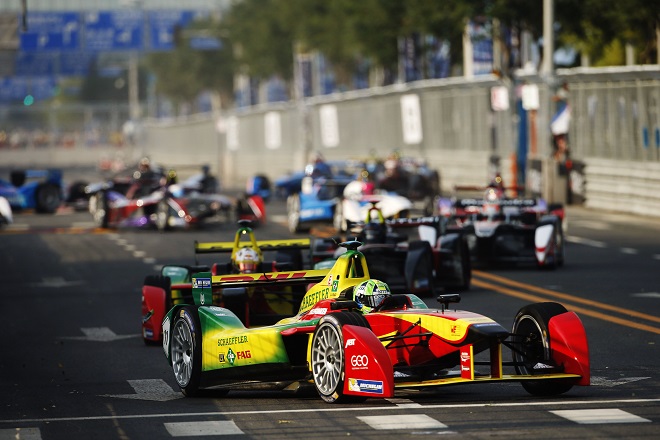
Will people remember to tune in? Honestly, I don't know. But you mentioned Formula Ford in your story, and in basic racing terms, that's a good comparison to make – Formula Ford with more glamour and a higher caliber of drivers throughout the field. Would I turn on the Formula Ford Festival if Sebastian Vettel and Fernando Alonso were racing in it? Definitely I would! I don't have a crystal ball, I really don't know, whether people will keep coming back for more. At the end of the race, I thought, "Hmm, I would have done this different, I would have done that different," but I didn't turn off the TV at the end of the race and feel dissatisfied. Even my wife, who was watching the race with me, said, "Yeah, not bad at all."
But again, maybe I'm influenced by the thought of so many things that could have gone wrong and the relief that they didn't! I felt positive. As I mentioned earlier, the track was very presentable considering it had been constructed in one day. Most of the cars started. Most of the starters made it to the end. There were a few interesting battles going on, even aside from the dumbass move at the end. And the last two laps weren't full of cars grinding to a halt on track...
If you asked me, based on just one race, to give Formula E a grade based on just one race – pass, neutral or fail – I'd give it a pass.

Latest News
Comments
Comments are disabled until you accept Social Networking Cookies. Update cookie preferences
If the dialog doesn't appear, ad-blockers are often the cause; try disabling yours or see our Social Features Support.