.jpg?environment=live)
YOUR favorite racecars – 7. Lola T70
Back in January, we ran a story about favorite racecars and asked RACER.com readers to select their top five. Your votes flooded in and, in the end, we had more than 400 different racecars to consider… but 10 clear favorites emerged.
Many of you had found it tricky to narrow your favorites down to just five, yet some of you had a clear No. 1 and no others. And, like ours, many of your selections were ones that fulfilled multiple criteria from a personal point of view – aesthetic beauty, period when you were first becoming addicted to racing, success, livery, piloted by your heroes. We understand, completely!
7. Lola T70
Much as the Lotus 49 tubular shape came to symbolize a whole era of grand prix racing, the Lola T70 became an iconic form in sports car racing during the 1960s, even though its sleekly simple shape morphed considerably with the years and the requirements of the various categories in which it competed.
Developed by Eric Broadley’s Lola Cars company in 1965, Lola's T70 Spyders in Mk 1 and Mk 2 specification were among the most successful cars ever offered by the prolific British constructor. Designed for both FIA Group 7 and Group 9 categories, T70 Spyders were a staple of European and Can-Am races through the mid-1960s.
Winner then, winner now: (TOP) Hobart Buppert (T70 Mk3) and Dan Cowdrey (Mk2) en route to their 1-2 at Indianapolis in SVRA vintage competition earlier this year. (ABOVE) 48 years earlier, Mark Donohue wins the Can-Am race at Mosport with his Chevy-powered Mk2.
Walt Hansgen scored the first major win for the T70 in the 1965 Monterey Grand Prix at Laguna Seca with a John Mecom-entered T70-Ford. F1 world champion John Surtees then drove the first Lola T70 Mk 1 to the 1966 Can-Am championship, while Mark Donohue and Dan Gurney also scored victories in Lolas to prompt a surge in customer orders. More than 100 examples of the type would eventually be sold.A full-size clay model of the Lola T70 nearing completion in 1965.
First constructed on an aluminum monocoque – steel bulkheads were used after the early alloy units proved insufficient to cope with suspension loads – most T70s were powered by Chevrolet V8 engines of both the small- and big-block variety, although they could be ordered with other engines. Indeed, Gurney's win was the first Can-Am victory for the Ford Gurney-Weslake 350ci engine.But Broadley had wider ambitions, and used the Can-Am racer as a baseline for a coupe version to take on the factory teams for outright victory at Le Mans in 1967. The result would be the beautiful, yet star-crossed T70 Mk3 coupe, built to suit Le Mans Group 4 regulations.
Your favorite racecars #10: Porsche 956/962
Your favorite racecars #9: Chaparral 2K
Your favorite racecars #8: Lotus 49
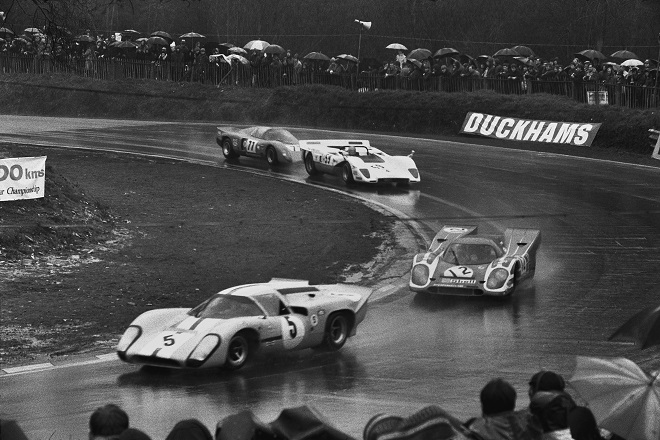
Usually if a design looks right, it is, but the Mk3 was caught between a clash of titans. (ABOVE) John Surtees/David Hobbs (Lola T70 Mk 3 Aston Martin) at the Nurburgring in 1967. (TOP) Jo Bonnier/Reine Wisell (Lola T70 Mk3B) leads Richard Attwood/Hans Herrmann (Porsche 917K) and Chris Craft/Trevor Taylor (McLaren M8C-Ford) at Brands Hatch in 1970.
The resulting Mk3 shares some styling cues with the Ford GT40, a project in which Broadley was also involved. In some ways, though, it actually improved on that legendary car, as Broadley and his design team, which included aerodynamicist Tony Southgate, sought ways to avoid the Ford's propensity to lift at speed. And the Mk3's sleek shape did prove more stable than the GT40 down the 200mph Mulsanne.Unfortunately, the Lola would be going up against some of the most legendary Le Mans cars and works teams ever in the GT40, Porsche 917 and Ferrari 512M, and couldn’t quite measure up. Engine problems attributed to the lower-octane fuel requirements of European racing also took a toll on the Chevy-powered cars in the endurance events, while a factory-backed Aston Martin-powered Lola proved neither fast nor reliable.
In a story that would be repeated later with other cars, Roger Penske and Mark Donohue got the most out of the T70 coupe. Penske Racing replaced its McLarens with Lola Mk3 Bs, tweaked its suspension, and swept to victory in the Daytona 24 Hours in 1969 (LEFT) with Donohue and Chuck Parsons. That would prove to be the last major victory for the Mk3B, however, as the reign of the Porsche 917 was about to begin.
Other notable T70 victories include Denny Hulme at the TT, the Players and Martini Trophies and Frank Gardner with the Brands Hatch and Mallory Park Guards Trophies.
Although most T70s have had a hard life and are difficult to maintain, they remain highly coveted at auctions and a popular choice in vintage meetings like the Goodwood Festival of Speed and SVRA vintage races, where their boldly curvaceous styling proves as seductive today as it was 40 years ago.
Some of your comments…
David Tremayne: “Specifically, the Lola T70 MkIII Aston Martin (Surtees' Le Mans/ Reims longtail special) from 1967. I remember seeing Eric Broadley's new coupe at the Racing Car Show in January 1967 and being utterly captivated by it; the longtail that Big John used at the two French races made it even more handsome without the fussy original rear deck.”
Rick DeBruhl: “It has to be the T70 coupe that Mark Donohue and Chuck Parsons used to win the 24 Hours of Daytona. Similar styling to a Porsche 917, but not as aggressive. Make it Sunoco blue, with yellow Von Dutch pin striping, and it's a thing of beauty.”
Ben Wedge: “Simple + effective = versatile racecar. I prefer the coupes and in John Surtees livery”
Bruce Davison: “Lola T70 Spyder, maybe the most beautiful of them all”
Ray Schmudde: “This Lola is in the same school as the D-type Jaguar: pure shape, wheels unnecessary to its beauty of line. From its low, wide mouth to its prominent fender bulges to its upturned tail, the Lola T70 was a sensuous shape, probably the sexiest car ever to grace a starting grid. The T70 has better proportions than its squeezed-narrow McLaren M1B competitor. As competition and aero effects became more important, spoilers and whisker fins starting being attached to this pure shape, but even pieces of sheet metal couldn't spoil a shape that seemed to be descended from the great sports racing cars of the 1950s.”

Latest News
Comments
Comments are disabled until you accept Social Networking Cookies. Update cookie preferences
If the dialog doesn't appear, ad-blockers are often the cause; try disabling yours or see our Social Features Support.
