.jpg?environment=live)
RETRO: Le Mans' greatest races of the last 40 years
Some have described the 1969 24 Hours of Le Mans as the greatest of all time; the nip-and-tuck fight between Jacky Ickx’s Ford GT40 and the Porsche 908 of Hans Herrmann through the closing laps resembled a sprint race. But it would be wrong to assume that a 45-year-old race was the event’s peak. Gary Watkins highlights the five greatest Le Mans of the last four decades.
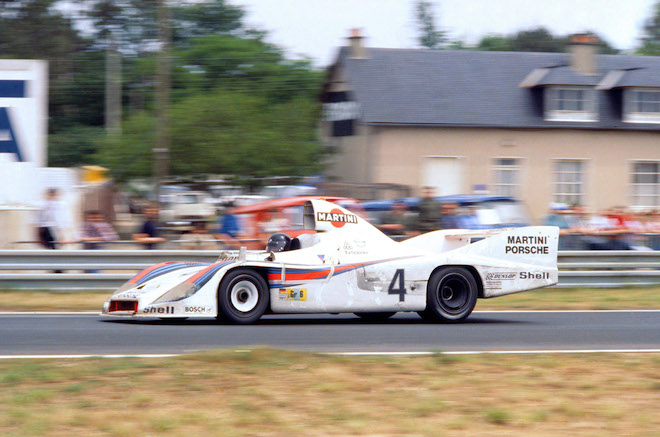
1977 – A GREAT'S GREATEST DRIVE
Jacky Ickx was on the way to “Le Mans legend” status when he pitched up at the Circuit de la Sarthe in 1977 looking for 24 Hours victory number four. It seemed, however, that he would have to wait to add to his tally when the factory Porsche 936 he was sharing with Henri Pescarolo retired an hour into the race with engine failure. Yet, 23 hours later, Ickx had attained legendary status.
The second of Porsche's Group 6 prototypes had also been delayed in the second hour when the fuel injection pump had to be replaced, and the second-string lineup of Le Mans first-timer Hurley Haywood and Jurgen Barth were hardly likely to make up the lost ground against the might of the big-spending Renault and its Alpine A442s. So Porsche gave its remaining entry the boost it needed: Ickx.
Ickx eased himself into the cockpit of the remaining 936 at 8:21 on Saturday evening. Nearly three hours later, he emerged from the car with a new lap record and a top-six position, albeit still eight laps behind the leading Alpine-Renault. He'd lost almost nine pounds of body weight for his efforts, but that didn't stop him from taking back the controls from Haywood 90 minutes later.
After another three hours, the Porsche was up to third and Renault had suffered its first engine failure. Ickx was taking giant-sized chunks –sometimes as much as 10 seconds per lap – out of the Renaults' advantage. The French manufacturer had to respond and more failures followed.
Just 15 hours after Ickx had taken the wheel, the Porsche was in the lead and on the way to a historic victory. Not even the loss of a cylinder in the closing stages could spoil the story.
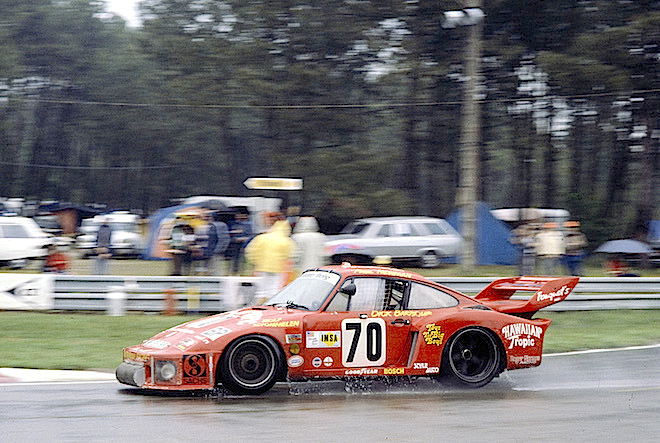
1979 – HOLLYWOOD COMES TO TOWN
If someone had walked into a Hollywood studio peddling this as the story line for a blockbuster they would have been laughed right out of Tinseltown. There have been a long line of actors and French TV stars the rest of us have never heard of taking up the challenge of Le Mans, but the idea of an Oscar-winning actor and hobby racer going to Le Mans and coming within a jammed wheel of victory would have been deemed too fanciful.
Yet that's what happened at Le Mans in 1979. Paul Newman, already an SCCA amateur champion, pitched up at Le Mans in a Porsche 935 shared with car owner Dick Barbour and star driver Rolf Stommelen. It wasn't a likely winner, even in a weak year for prototype entries. Yet after the pure-bred machinery ran into problems, the 24 Hours developed into a battle of sorts between Kremer Racing’s Group 5-spec 935K3 and Dick Barbour Racing's slower IMSA-rules 935, which trailed by 15 laps in second place.
The Kremer car, shared by Klaus Ludwig and Don and Bill Whittington, looked home and dry until more than an hour was lost when the drive belt to the fuel injection pump failed. The Barbour car was about to take the lead when the left-front wheel nut jammed solid. The only solution was to replace the whole corner.
Stommelen's subsequent attempt to make up for lost ground rooted the engine, and the car limped home seven laps down, but it was still in second place and Newman got to stand on the podium. Amazing, but true.
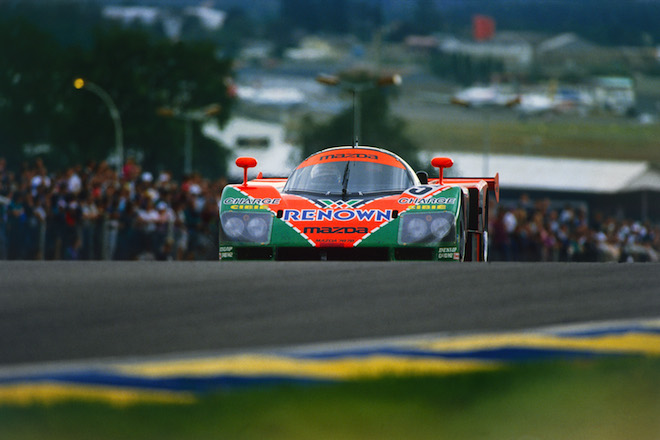
1991 – DAVID TRIUMPHS OVER THE GOLIATHS
Mazda didn't look like one of the favorites for Le Mans glory in 1991. Not with Mercedes, Jaguar and newcomers Peugeot on the entry. But the Japanese manufacturer pulled off a giant-killing result one year on from a disappointing campaign at the 24 Hours.
The new R26B four-rotor engine was late arriving and proved unreliable, and the aerodynamics of the original 787 were unsuited to a Circuit de la Sarthe now that it had two chicanes on the Mulsanne Straight. Yet Mazda's 1991 Le Mans victory with Johnny Herbert, Bertrand Gachot and Volker Weidler and its rotary-powered 787B Group C racer was born of that failure.
Mazda brought in the French ORECA team to replace Alan Docking Racing as its European partner, while Mazda competitions boss Takayoshi Ohashi persuaded the rulemakers that his cars needed a helping hand. This resulted in a 50kg [110lb] weight reduction from the previous year's 880kg [1940lb] minimum at a time when the weight of the Jaguars and Mercs was increased to 1,000kg [2205lbs]. No one in the smoke-filled room appeared to care: they obviously didn't regard Mazda's whining rotaries as a threat.
Mazda not only had new resolve, but it also had a new mentality. The message to young guns Herbert, Gachot and Weidler was to drive hard and fast.
Everything came together to allow the best of the 787Bs to battle with the Jaguars — and to be in prime position to take over at the front when the Mercedes-Benz C11s hit trouble. Third became second when one Merc hit gearbox problems and second became first when the leader's engine failed.
Mazda became the first – and, so far, only – Japanese manufacturer to win Le Mans. It shocked the sports car world and surprised Mazda's hierarchy. So much so that there had been no thought of a post-race party.
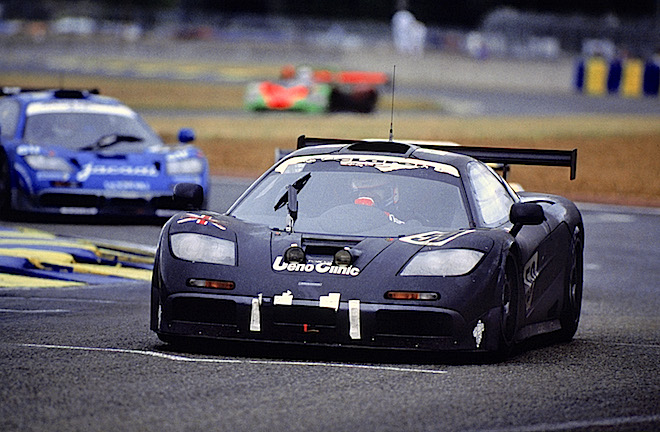
1995 – THE SHOCK RESULT
McLaren wasn’t even planning to go to Le Mans. Or rather it didn’t want customers of the new GTR racing version of its F1 supercar to enter the 24 Hours. Yet it ended up not only helping those buyers, but running what was a pseudo-factory team. And it pulled off a shock of monumental proportions by triumphing over the prototypes with what was, in reality, a lightly re-worked road car.
The BMW-engined McLaren wouldn't have had a sniff at victory without one overwhelming factor that dominated that year's Le Mans. Rain, and lots of it for the better part of three quarters of the race, allowing the F1 GTR to get on terms with an admittedly motley bunch of prototypes at the same time as masking the inherent reliability issues of the car. That not only allowed the “factory” car to triumph in the hands of JJ Lehto, Yannick Dalmas and Masanori Seikya, but for McLaren's true customers to finish third, fourth and fifth.
The best of the McLarens qualified 11 seconds from the pole in the hands of Lehto, who was also more significantly 8.5sec from the pre-race favorites, the Porsche-powered Courage prototype driven by Mario Andretti, Bob Wollek and Eric Helary. But the narrow-tired GT cars came into their own in the horrendous weather. What's more, Andretti crashed the Courage-Porsche in the Porsche Curves.
The Harrods-liveried David Price Racing car driven by Le Mans great Derek Bell and son Justin and Andy Wallace led for much of the way. They remained ahead until the closing stages when a clutch-release bearing failed.
That allowed the 'works' to take the lead and hang on in front to take victory from the recovering Courage.
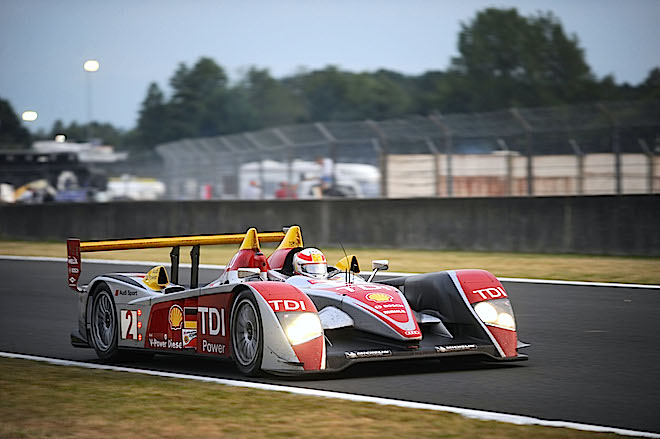
2008 – THE GREATEST RACE
Audi might have been unbeaten at Le Mans since 2002, but it wasn't favorite for honors in any shape or form in 2008. Its aging R10 TDI had been trounced by Peugeot's 908 HDI in the opening rounds of the Le Mans Series in Europe. But that was counting without the combined talents of Tom Kristensen, Allan McNish and Rinaldo Capello, not to mention the tactical acumen of Audi's Joest Racing squad.
Peugeot, in its second year back at Le Mans, had the faster car, but Kristensen and Co., uniquely among the three Audi driver squads, were able to keep their R10 in contention through the first half of the race, "driving every lap like a qualifying lap," recalls McNish. Important, too, was their decision to quadruple stint their Michelin tires.
The game changed when it began to rain in the small hours. The Audi drivers came into their own and were able to exploit a compromise setup that had been devised with a wet track in mind. Peugeot also encountered minor cooling issues that blunted its challenge, at the same time as struggling with a traction control system inferior to that on the Audis. But the race wasn't over as the track started to dry in the closing stages.
There was still time for some high drama. Kristensen spun in the 22nd hour and then Peugeot rolled the dice by leaving Nicolas Minassian out on slicks after one final rain shower. The gamble failed, and McNish, Kristensen and Capello completed an amazing victory.

Latest News
Comments
Comments are disabled until you accept Social Networking Cookies. Update cookie preferences
If the dialog doesn't appear, ad-blockers are often the cause; try disabling yours or see our Social Features Support.