
Presented By
Ford Racing
Baja-bred: How Ford Racing is making its production Raptors even tougher
Ford’s been using the tagline ‘Built Ford Tough’ to sell cars for years, but does it actually mean anything?
Well, as the brand’s Baja program shows, yes it does. For three years in a row it has scored double class wins in the stock classes at the off-road crown jewel, and this year it’s chasing another.
The off-road racing world is littered with purpose-built monsters, but Ford is using a production base for its Baja beasts.
“There used to be a very distinct line in off-road between factory vehicles and spaceframe fully-built dedicated race cars, and what's so exciting to me is Ford is really blurring those lines,” Brad Lovell, Ford Racing team manager and driver explains to RACER.
“With the start of the Raptor program 16 years ago, I can remember being a consumer then and saying, ‘No way they're going to build a truck like this and give us a warranty. Like, we're going to go tear it up.’ And sometimes I still wonder how that works. But ever since that initial move, they keep pushing the boundaries for capability of these stock vehicles.
“I've raced spec Trophy Trucks, and I can remember going 100 miles an hour down a tight two-track road and thinking, ‘Oh, this is crazy! I've never been this fast in my life.’ And we're doing that in stock vehicles now.”
Of course, being a competition vehicle, the Bronco Raptor Race Truck that Ford will be campaigning again at Baja does have the expected refinements: a roll cage, racing seats and harnesses, fuel cell, improved lighting, and more robust skid plates and bumpers.
“That's a lot to do with really the interaction with the different surfaces we're going over. There's a lot of rock,” Lovell explains. “There's other trucks, and it's customary in desert racing to… we call it ‘nerfing’ – if you catch somebody, you hit them to get them out of the way. So we need some robustness to support that.”
But the important parts – the powertrain, the axles, and the suspension – are all stock, albeit beefed up to take the rigors of high-speed running in the desert. Hydraulic jounce bumpers have also been integrated into the suspension set-up in what Lovell describes as “a big benefit” for the stock platform. The BF Goodrich KDR3 race tires that have stronger sidewalls to handle rocky terrain are also used and do add weight, but that’s offset with the use of Method race wheels.
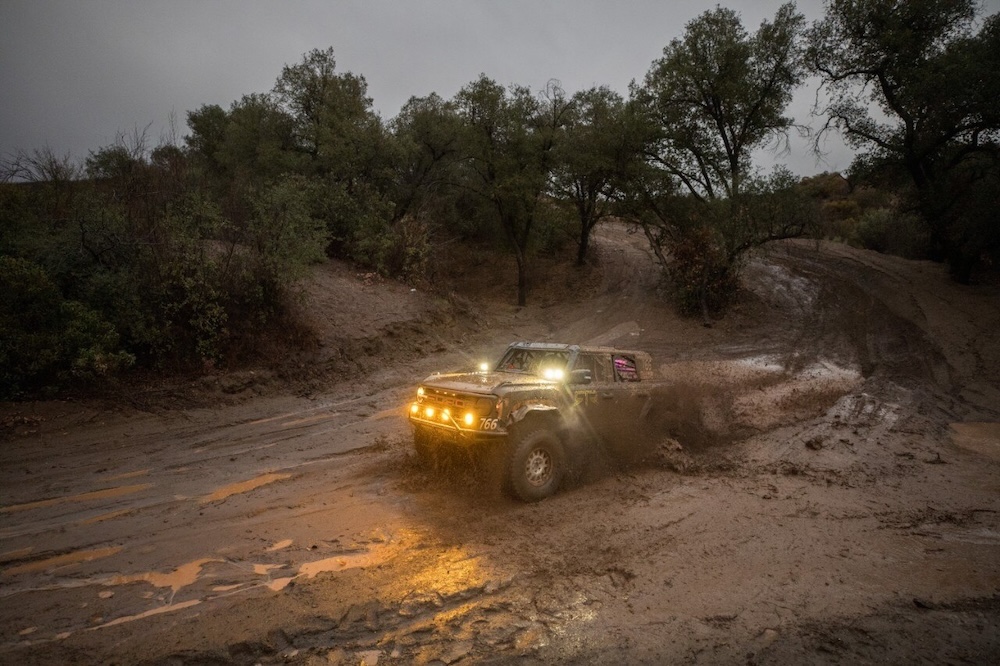
Overall, Lovell says the philosophy is “we're not changing it unless we have to change it. Otherwise, it stays a Ford factory part.”
All of that combines for something owners of showroom-ready Raptor owners should be able to relate to.
“We have a saying on the team of ‘OPR’,” Lovell explains. “OPR stands for ‘Other People's Raptors’, and it's easier to drive another person's Raptor harder than you would your own. But I really take a lot of pride in sharing with other Raptor owners exactly what you can do with these vehicles, especially in the factory form because they're highly tested and validated.
“And the capability, just like sports cars, probably far exceeds the drivers buying those vehicles, and that's fine. That's what it should be. That's why we all want these fancy cars, but I take a lot of pride, and I really look to encourage Raptor owners to get out and appropriately exercise the vehicles they have.”
Baja is validating Raptors, but it’s also helping inform Ford as to what to do next. Lovell says that the collaboration between racing and development entities, and the major culture shift that has resulted, has been the biggest thing.
“To me, the number one thing is the culture,” he says. “Ford Racing changed their name from Ford Performance for a reason – because they're very focused on racing, and the production side and the race side are seamlessly intertwined within Ford Racing.
“And it's that culture, and the culture from all of us race guys talking to engineers and bringing engineers to the desert, that influences the products holistically to make them more appropriate.
“I was just looking at my phone this morning because I I've had this email drafted up on an idea I have about braking powertrain controls to make the production vehicles better from my standpoint. Obviously we can't get into the nitty gritty of things like that, but it's also that technical exchange. As a full-time dedicated racer, I don't have access to all the technology that Ford does, and because the engineers are so focused on the technology, they don't understand all the needs [of the drivers].
“So, one thing I think we've really done tremendously well over the last decade is tie those two things together. All my race people, I call them ‘desert people’ and the engineers I call ‘the nerds’. So the nerds and the desert people are working together with trust and without being threatened, and that is the magic.”
It’s been 16 years since Ford introduced the Raptor performance range, a range inspired by Baja. Now with Ford competing at Baja with production-derived machines which will bleed into the next generation of products you can buy, the whole thing has come full circle. Ford was inspired by Baja, now uses Baja to prove its point – and it does it in the face of a fear that may well be affecting other brands.
“Baja has always been the ultimate proving ground, and that's why there's not a lot of OEM participation down there – because of these challenges and some of its logistics, but it's also very easy to go down there and and not finish the race,” Lovell says. “I think externally, OEMs always worry that there's shame in not finishing a race, but that is the challenge of Baja. It's surviving. This year, it's 971 miles, and it's surviving those miles.
“So to me, there's no shame in not finishing, but we will fall on our sword trying to get that vehicle to the finish line if that's what it takes. There's a 40 hour time limit, and mentally we're prepared to get to the finish line no matter what, whether it's in that time frame or not. We've had a good track record, but I think we've always had a good track record because we're always kind of running scared or making sure that every box is checked.”
For more insight on Ford Racing and how it’s always striving to redefine possible in motorsports series across the globe, check out fordracing.com. And to find out how Ford is taking lessons learned in the world’s fastest laboratories, from the 24 Hours of Le Mans to the Baja 1000, to help design the vehicles you drive, check out ford.com.
Dominik Wilde
Dominik often jokes that he was born in the wrong country – a lover of NASCAR and IndyCar, he covered both in a past life as a junior at Autosport in the UK, but he’s spent most of his career to date covering the sliding and flying antics of the U.S.’ interpretation of rallycross. Rather fitting for a man that says he likes “seeing cars do what they’re not supposed to do”, previously worked for a car stunt show, and once even rolled a rally car with Travis Pastrana. He was also comprehensively beaten in a kart race by Sebastien Loeb once, but who hasn’t been?
Read Dominik Wilde's articles
Baja-bred: How Ford Racing is making its production Raptors even tougher

Latest News

Comments
Comments are disabled until you accept Social Networking Cookies. Update cookie preferences
If the dialog doesn't appear, ad-blockers are often the cause; try disabling yours or see our Social Features Support.