The RACER Mailbag, August 26
Welcome to the RACER Mailbag. Questions for any of RACER’s writers can be sent to mailbag@racer.com. We love hearing your comments and opinions, but letters that include a question are more likely to be published. Questions received after 12pm ET each Monday will be saved for the following week.
Q: What is your guess as to likelihood of IndyCar somehow returning to Washington, D.C. for annual races?
Do you think IndyCar will have a lot more fans watching races now and in the future as a result of the fine racing and production of the Freedom 250?
Tom Fitzgerald, Las Vegas, NV
MP: Like the Freedom 250, which was written into existence by the President, I’d expect a return to include Mr. Trump’s involvement in some capacity. Repeating the same event, with the same layout, at the same level of expense and production seems like it would be a lot to ask, but if something closer to a normal street race was possible within D.C., I’d imagine there would be a higher percentage of making a trip back to the DMV (D.C., Maryland, Va.).
The question on an uptick in fans is the big question waiting to be answered. Through the Nielsen ratings folks, IndyCar and FOX will be able to gather area-specific data to measure how many people watched Markham, for example, within the DMV region, and then D.C., and this weekend in Milwaukee to get an initial before-during-and-after look at whether the Freedom 250 generated more viewers.
Penske Entertainment claims 140,000 people attended the two-day event, which is a great number if it’s real, and within that figure, I’d expect Penske has cross-referenced the applicants with those who are in IndyCar’s database as ticket buyers, merchandise, buyers, etc., to quantify how many were new attendees and how many were existing fans.
Once the new-attendee number is known, we’d have a better idea of how many truly new folks interacted with the series to gauge how many might stay and add to the current base. If it’s 100,000, then that would be amazing. If half of them fell in love with IndyCar and want to stay involved, that would also be amazing. But that wouldn’t move the needle – be it 50,000 or 100,000 – in a massive capacity.
As we saw with the ratings, the Freedom 250 was a huge hit, but on its own, it was never going to turn IndyCar into an overnight sensation. FOX, which is almost done with its second season of all-network broadcasts, is already known as the one and only home for IndyCar races. If the series is fortunate, the TV audience, which was triple the normal number, includes many who found something new or interesting about IndyCar to make tuning in for more a regular habit.
There’s only upside with the big debut in D.C., but the event itself was never going to transform IndyCar into the country’s No. 1 racing series. Given time, hopefully the Freedom 250 put down roots in DMV and will be proven to have brought in a healthy amount of new fans who actively engage with IndyCar. For the series to catch NASCAR, it will need more events like the Freedom 250.
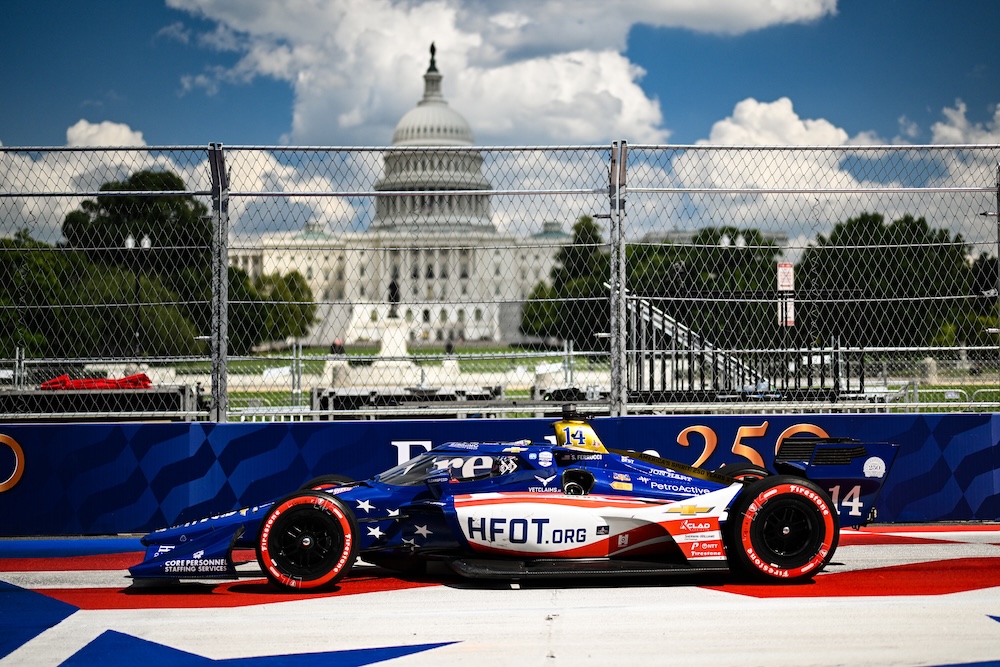
Let's just keep calling future editions the Freedom 250 but move it back to Baltimore. Job done. James Black/Penske Entertainment
Q: What contributing percentages would you assign to car setup, race strategy, driver skill, and budget, to Alex Palou winning five IndyCar championships (assuming he wins 2026) in the past six years?
What skill(s) would you assign that Alex Palou possesses, which other current day IndyCar drivers do not?
Lynn, VA
MP: On the first question, there’s no percentages to attach since they’re all interrelated and combine for success or failure as a unit. A driver that’s miles above the rest won’t be able to show it on all but the rarest of occasions if the race engineer is poor, or the strategy is bad, and the budget is weak. A huge budget that surpasses all the other teams won’t make a winner out of an underwhelming driver, etc. That’s the key thing to understand.
All are required to be in place, and at an obviously high level, in order to win one championship, much less multiple crowns. All four categories are at elite levels with the 10 car, and if one were lacking, which is the most common reality, you don’t win championships.
On the second question, the timing is odd to write this after their self-induced fiasco in D.C., but the consistent absence of mistakes by the team is what sets the 10 car apart, and Palou from his peers. Every quality entry pushes as hard as possible, and while doing so, a lot of little mistakes happen.
Palou is able to perform at the highest level, lap after lap, with the least amount of variance, and that comes from his machine-like ability to function on the edge without going over the edge. There are reminders that he isn’t a machine, as D.C. provided, but those have been exceptions.
Some interesting stats, since you like numbers: Palou has won seven of the 15 races. He’s also earned seven poles. But he’s only set the fastest race lap twice while leading the most laps five times. He’s the best qualifier in IndyCar since 2025 with 13 poles, but he rarely pushes to extreme levels in the races and lives at the fastest possible pace without welcoming undue risk. The two fastest race laps is where to look, and it’s quite telling.
That’s the Palou formula, and it’s powered by a comparative lack of mistakes which allows the machine-like consistency from lap to lap that most others struggle to match. He doesn’t need to drive like a wild man to win; he tends to leave that to others, and so far, no driver has won more than twice this season while he’s sitting at seven. Just wild.
Presented by:
Marshall Pruett
The 2026 season marks Marshall Pruett's 40th year working in the sport. In his role today for RACER, Pruett covers open-wheel and sports car racing as a writer, reporter, photographer, and filmmaker. In his previous career, he served as a mechanic, engineer, and team manager in a variety of series, including IndyCar, IMSA, and World Challenge.
Read Marshall Pruett's articles
Latest News
Comments
Comments are disabled until you accept Social Networking Cookies. Update cookie preferences
If the dialog doesn't appear, ad-blockers are often the cause; try disabling yours or see our Social Features Support.