Andy Hone/Getty Images
Why F1's push for overtaking is oversimplified
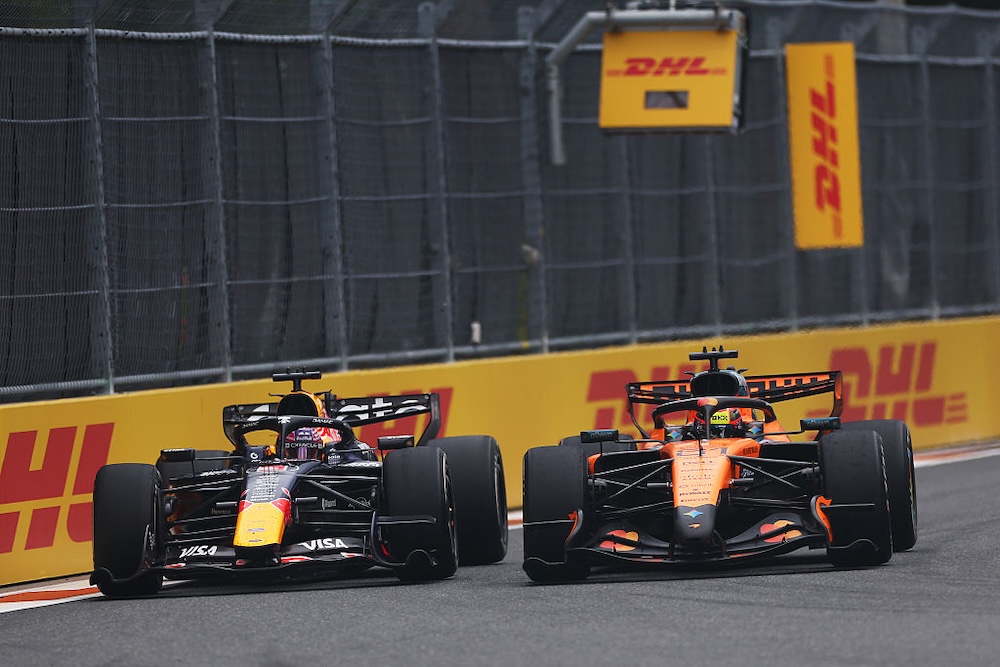
What is overtaking? The obvious answer is that it’s one car going past another. When it comes to racing, not just in Formula 1 but all forms of motorsport, built on cars physically battling with each other wheel-to-wheel, it is considered central to its appeal. The trouble is, even if the majority of fans regard passing as a positive, they are a broad church when it comes to what that really means.
Therefore, the question must be answered in a more qualitative way. When considering the appeal of ‘the show’, or whatever you want to call it, you cannot consider all passes to be equal, but Formula 1 does this with its misuse of overtaking statistics. Yes, it uses other measures, and there is no question that the fact more passing has generally happened this year is a positive based on that. However, the implicit belief is that is more, and therefore better, and if you listen to the relentlessly positive F1 supremo Stefano Domenicali, anyone who even attempts to argue that there could be more to the concept of quality of racing than sheer volume is just plain wrong.
Partly, that is his job. Devotees of any major sport will be painfully familiar with the way they are talked down to by corporate leadership, which is in place primarily to serve its shareholders and forever chase a bigger audience. You could argue that this is indirectly beneficial to fans, because for the healthiest business, you need the strongest product. However, the profitability of an entity, particularly in the short-to-medium term, doesn’t always correlate with quality, which is a dangerous path to go down when it comes to sport.
Formula 1 is in a great position. It has grown spectacularly in popularity, reached new demographics, geographical territories and drawn investment from new sectors of business. F1 is one of the biggest beasts of global sport and that has attracted investment from an array of companies that makes it the envy of the majority of its rivals. Liberty Media has done an outstanding job, without doubt, but success breeds the pressure for continued growth and the need for the on-track product to hold the audience’s attention. And that brings us back to the quandary about overtaking.
The frequency of passing is primarily the consequence of two factors in F1: how easy it is to stay close enough to make a move, be it on the straight or through a corner, and how disordered the field is overall. Since 1933, when practice pace was used to form the grid for the first time at the Monaco Grand Prix, grids have been increasingly well-ordered, overtaking has become harder in the aerodynamic age, and teams and drivers have more consistently delivered on the potential of the machinery. To that we can add variables such as strategy creating pace offsets, allowing a slower car to be quicker for a spell, or vice versa. The strategic lever is one F1 has yanked at endlessly in recent years with the aim of livening up the on-track offering, with mixed success at best.
Whatever you do, there will always be a correlation between the amount of overtaking and how easy it is to do. If it's easy to pass, as it is in F1 given the potential for a power offset of many hundreds of horsepower on a given straight if one car is deploying using the electric motor and the other either isn’t, then there will be more passing until the field is sorted into its pace order. What people usually appear to want is lots of overtaking, but for the passes themselves to be extremely difficult and right on the limit, which are mutually exclusive demands.
What’s clear is that these aren’t the types of pass that F1 today encourages. Perhaps the best recent example of a brilliantly executed overtake was Kimi Antonelli to beat Lewis Hamilton to victory in the Silverstone sprint. He attacked on lap eight on the blast down the Wellington Straight, forcing Hamilton to defend using boost. The definitive pass came later in the lap on the Hangar Straight, with Antonelli able to get ahead and, crucially, stay there given Hamilton’s battery was depleted.
If you were to write a manual on how to pass at an energy-poor track in F1 2026, this is the perfect case study. It’s just a shame F1’s refusal to run battery state-of-charge graphics in its coverage means that it was difficult for some to realize exactly how sharp Antonelli had been. But as Domenicali argues, the majority of people are “not interested in what was the [cause of] the pass." He could be right, but this seems at odds with the drive to grow F1 in the U.S., where fans are used to a data-rich viewing experience.
Wherever you fall on that argument, nobody is going to talk about that Antonelli pass as one of the great all-time overtakes. It’s likely that if you ask a sample of fans to describe their ideal pass, you’ll get variations on the theme of it being a late-braking, side-by-side, possibly even wheel-banging fight through a corner. The current rules in F1 actually act to disincentivize this, because why risk a difficult move like that when you have the means to do it on the straight? On top of that, changing corner lines, speeds and throttle usage can have direct knock-on effects on deployment for the following stretch of track that mean you might immediately lose the position.
If you ask yourself what makes a good race, you probably have a straightforward answer. But then if you consider what races stand out in your memory, whether it's from F1 or any other category, there’s no single style of answer. In F1, we celebrate Nigel Mansell and Ayrton Senna toughing it out on the straight in Spain in 1991, Mika Hakkinen swooping around Ricardo Zonta’s backmarker BAR on the Kemmel Straight at Spa in 2000 to make a move on Schumacher, Nelson Piquet’s sideways, around-the-outside, Turn 1 move at the Hungaroring in 1986, Jacques Villeneuve’s bold move around Michael Schumacher at the fast last corner at Estoril in 1996, or the whole Gilles Villeneuve v Rene Arnoux battle at Dijon in 1979. The list is endless, and everyone will have their favorites.
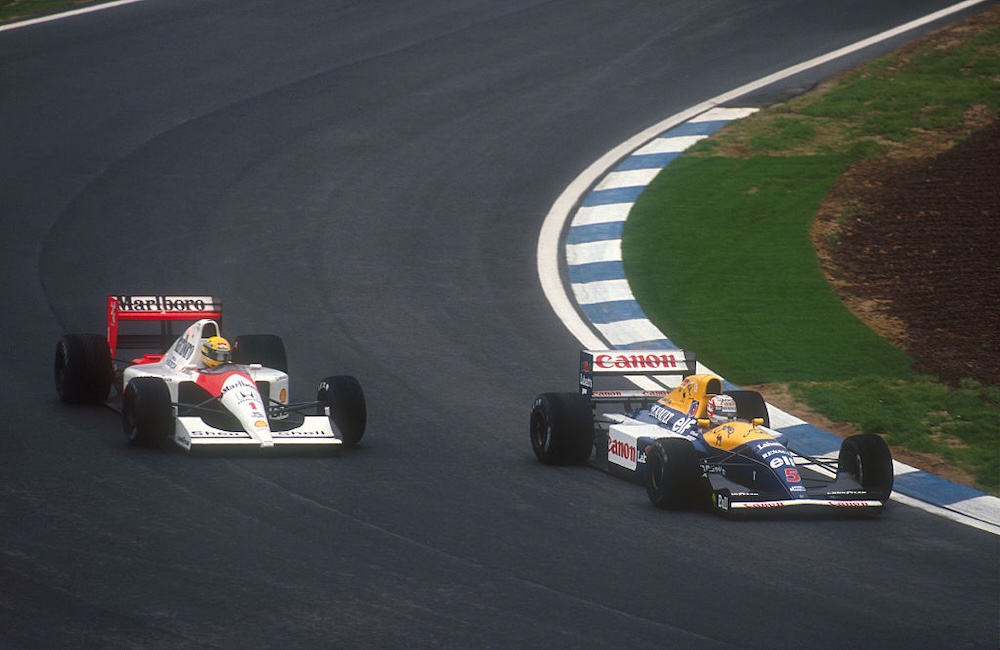
Nigel Mansell came out ahead after battling Ayrton Senna down the straight in Spain in 1991. Getty Images
However, we also celebrate races like the 2005 San Marino Grand Prix precisely because there was no overtake; it was all about Renault’s Fernando Alonso defending against Schumacher’s Ferrari in the closing stages. Then there are displays of crushing dominance where a driver simply vanishes, particularly in wet conditions, with Ayrton Senna’s 1985 Portuguese Grand Prix win standing out, or Hamilton’s at Silverstone in 2008. In the latter, nobody talks about Hamilton overtaking McLaren teammate Heikki Kovalainen, but rightly focuses on his massive pace advantage.
This exposes how impoverished a quantitative approach to overtaking is. Not only are such statistics misleading because they say nothing about how spectacular or mundane a pass is, but more really is not more. There are countless ways for a motor race to be exciting, and a big part of the appeal is that they should not be formulaic. That’s why any declaration of a characteristic that makes good for racing is limited and not to be trusted.
Fundamentally, the key objective should be unpredictability. You can have a season where races are won dominantly, but if there are constant performance swings and a variety of winners, it would be enjoyed by most. Have the same shape of races, but without that variety and the same winner every week, it would be derided. You ideally want a wide range of races stylistically – those decided by wheel-to-wheel fights, those decided by strategy, those decided by sheer, pulverizing pace. This is the lifeblood of any sport, the ability to surprise and offer something different on any given day despite the rules being unchanged.
If there is one lesson from motorsport in the 21st century, where ‘the show’ is the focus, it’s that engineering this reliably while maintaining integrity as a sporting competition is almost impossible. Simple solutions often have unintended consequences, as well as lacking the nuance required to create the racing that any group of fans will want.
And the rhetoric about ‘new’ and ‘old’ fans, which both decision-makers in F1 and the masses on social media propagate, is an unhelpful prism through which to see this. After all, everyone was ‘new’ at one stage, but any fans interested in the on-track action (and one of F1’s many successes is that there are now additional fans who engage more with what goes on off-track) will be unified by wanting to see a varied spectacle that blends different types of races. And this has to be created organically rather than artificially, which also means there needs to be the potential for what some would call dull races. This is the most inexact science.
The FIA and F1 must keep this in mind as they formulate the next generation of F1 regulations. The power units are set to change in 2031, and given the current chassis rules were driven by a need to compensate for the limitations of an energy regime that simply doesn’t add up in terms of the battery capacity and harvesting opportunities (hence the phased changes implemented in ‘27 and ‘28) there is an opportunity to redefine the way the racing works.
Yes, one lesson is that overtaking is too easy on most tracks, but that’s not the biggest takeaway. The real problem is that it has become so one-dimensional with the vast majority of overtaking moves a consequence of a massive power offset. F1 has the opportunity to make a big step with its next rules package, but if the prevailing attitude is that high overtaking numbers are the key objective then mistakes will be made.
That’s what makes F1’s banging of this particular drum a concern. In the corporate world, more is always seen as positive regardless of the consequences, but when you are steering a sporting product, you must grasp the need to put ‘better’ front and center.
The big question is, when it comes to the need to delight those watching with excitement and unpredictability, what really constitutes better? It’s only by answering that question without reaching for the simple conclusion that there’s any chance of getting it right in 2031 and beyond.
Edd Straw
Edd Straw is a Formula 1 journalist and broadcaster, and regular contributor to RACER magazine. He started his career in motorsport journalism at Autosport in 2002, reporting on a wide range of international motorsport before covering grand prix racing from 2008, as well as putting in stints as editor and editor-in-chief before moving on at the end of 2019. A familiar face both in the F1 paddock, and watching the cars trackside, his analytical approach has become his trademark, having had the privilege of watching all of the great grand prix drivers and teams of the 21st century in action - as well has having a keen interest in the history of motorsport. He was also once a keen amateur racing driver whose achievements are better measured in enjoyment than silverware.
Read Edd Straw's articles
Latest News
Comments
Comments are disabled until you accept Social Networking Cookies. Update cookie preferences
If the dialog doesn't appear, ad-blockers are often the cause; try disabling yours or see our Social Features Support.