From the pages of RACER: JR Hildebrand and the ’Vette ZR1X vs. Pikes Peak
9m30.104s. It’s a region of laptime at the Pikes Peak International Hill Climb that’s been reserved only for purpose-built racecars.
Until now.
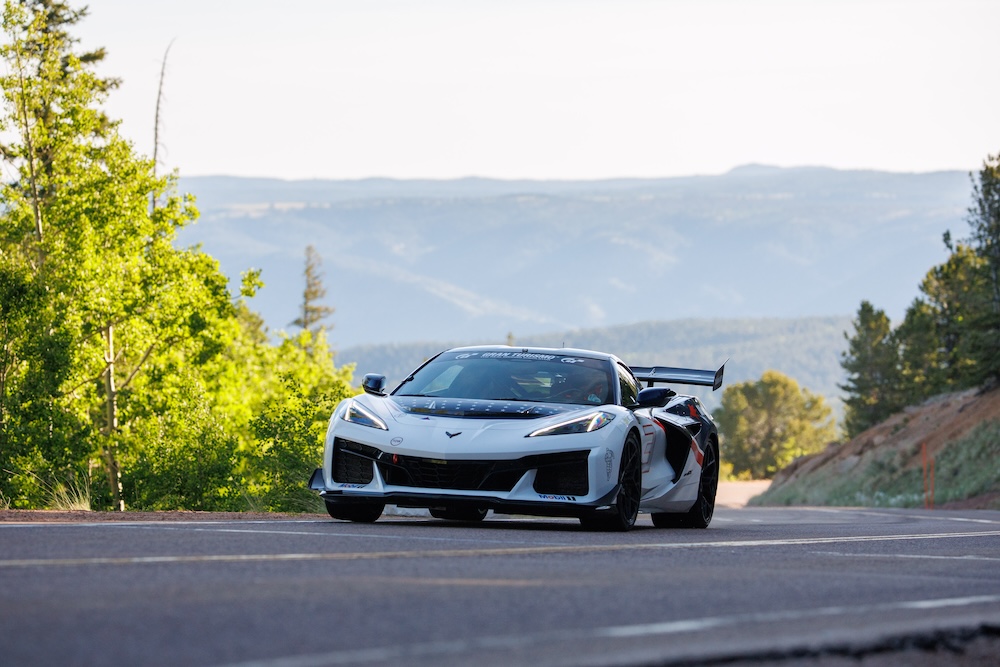
We hit the number in the full production-spec Corvette ZR1X (main image) using the same DOT-rated Michelin Pilot Sport Cup 2 R tires it’s on as it rolls out of the dealership, and even without taking advantage of production rules that allow for unrestricted exhaust and engine calibration for race gas on the mountain. Not only is it the fastest production vehicle ever, of any kind, on PPIHC – and by a healthy 23s margin, it leaves a destructive trail of pure racecars in its wake on the historical time sheet.
But you know what’s really scary?
The reason it should be feared is not because it’s so absurdly fast. It should be feared because this is just the beginning.
Pikes Peak is an exceptionally badass place to spend the month of June. The stakes just to be out there are high. It’s 156 corners with no gimmes, broken down into three distinct sections for all but private testing and race day.
The Lower Section is smooth, flowy and fast – the most like a typical road course. The Middle Section transitions above treeline into the series of switchback hairpins known as “The Ws.” The cornering is technical, but the risk profile ratchets up dramatically as your visual references disappear off the side of the cliff into the clouds. The high-elevation Top Section is the most challenging of all – a mix of high-commitment, high-speed blind entries and bumpy terrain with minimal margin for error.
There are places where you simply must not have a serious problem.
Add the fact that all your testing and practice occurs before 8:30am, you typically only see the course one section at a time, and there’s just the single opportunity to put it all together once per year in a race-day run, and you have yourself a degree of difficulty that makes the juice worth the squeeze.
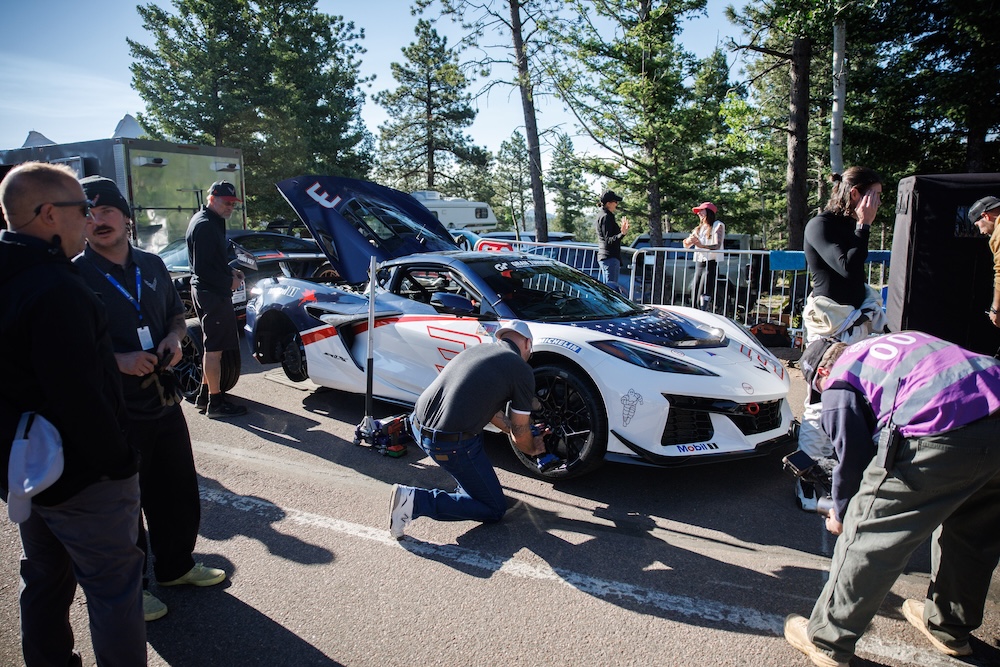
Corvette’s engineering team prep the ZR1X for its full, 12.42-mile ascent of the course on the Pikes Peak International Hill Climb’s race day.
My prep in the ZR1X started at GM’s Milford Proving Grounds Road Course (MRC) a few weeks prior to official testing. The car’s reputation preceded it – I had no doubt it would feel fast, but I was also prepared to spend time simply wrapping my head around it. It’s a complex machine; the C8 is the first mid-engine Corvette platform, there’s an all-new engine architecture that’s also turbocharged for the first time, a first-gen hybrid system and…well, it’s still a street car with several street car systems. I had many questions before heading to the mountain, particularly on battery regen and deployment.
The hybrid system in the ZR1X is deliberately designed for fast discharge and regen. The relatively small battery sits vertically in the car’s center tunnel and connects to a single e-motor that drives the front wheels – an elegant and entirely separate physical system from the engine or drivetrain at the rear of the car. The smaller battery, the simple drive hardware, and the lack of a plug-in charging system (it purely uses fast-regen
to build charge back into the battery) make it exceptionally lightweight. The system’s integration into the overall dynamics of the car – in combination with the LT7’s power delivery through the 8-speed transaxle, the Performance Traction Management (PTM) system, and the electro-hydraulic braking system that can operate all four corners independently – blends many layers, but feels shockingly seamless.
You feel the e-motor front axle working, but the eAWD feeds in perfectly in phase with the natural behavior of the car. I quickly concluded that there was virtually no downside to the Race traction control modes, so I left them on. We’d use the more tactical “Charge+” hybrid mode, which gives you full wick on the initial full-throttle acceleration off a corner, but progressively trims the electrified torque out to conserve it for a longer run. With a bump of the cruise-control roller with your left thumb you can manually latch full battery output up to 160mph as a “Push to Pass” function whenever you want. Regen back to full charge from near-empty only takes a couple minutes on a cool-down lap. Data outputs through the car’s onboard Performance Data Recorder (PDR) drop right into Pi Toolbox, or you can just sit there in the car and browse through it on the center screen with your race gloves on.
Turns out, you just fire the car up and go drive the hell out of it...
Up on the mountain, the feeling of the front axle literally pulling the car out of a 25mph switchback hairpin up into the turbocharged ICE powerband into warp speed off the corner was a whole different level of “Holy s**t, this thing is going to absolutely rip at this place!” By the end of the first day – on the course’s treacherous high-altitude “Upper” Section that combines the Middle and Top – we knew we could produce serious performance.
My mindset going in was simple: we are not here simply to become the fastest vehicle in any production category to ever ascend Pikes Peak; we are here to do so by the widest margin possible. After that first day on course, we collectively flipped that switch.
Between a joint private test day where we’d have the chance to make full runs and the second test weekend that immediately followed, we arrived at race week laser-focused on race-day execution.
Qualifying on the Bottom Section for us was Day 1 of race week. Three sticker-tire runs, each fully pinned, each good for pole in class, each showing the speed we were looking for. However, despite the same hybrid mode and similar lap times across the runs, I was using up noticeably different amounts of battery each lap; I could see it clear as day when I pulled up the data overlay in the car while waiting to head back down the mountain.
This was the last thing to get totally dialed. Our strategy was to use the more conservative Charge+ deployment mode as a baseline, then either switch out of it to the higher deployment setting or use the manual P2P function as I got higher up the course. Using up more energy down low, even if it was faster there, was going to cost me more time higher up the mountain than it was worth.
There was really only one variable at that point: yeah, it was me.
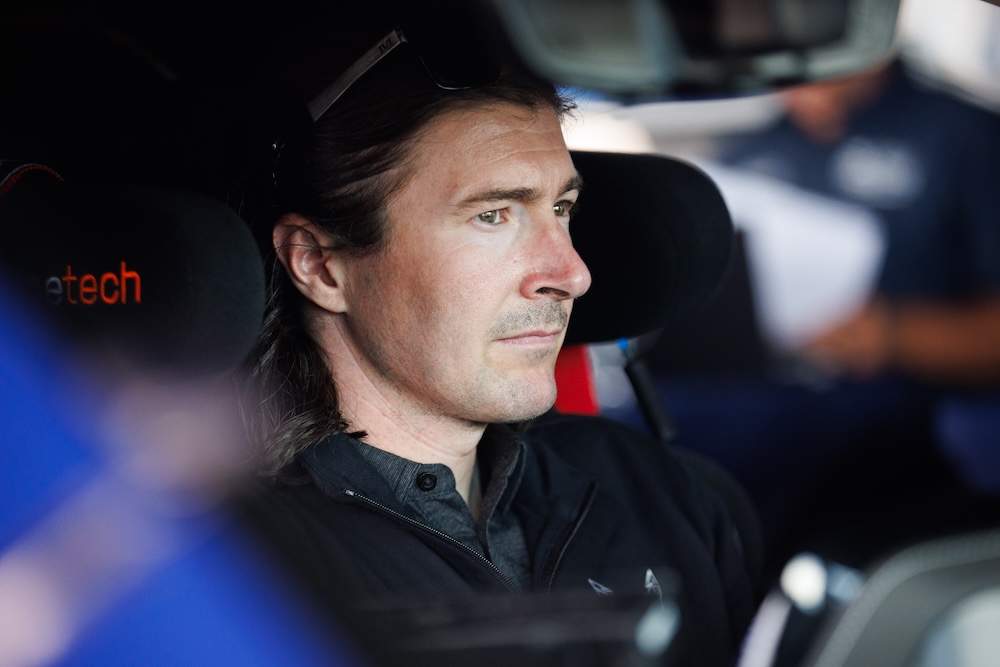
The biggest variable according to JR Hildebrand? That would be the guy behind the wheel…
The eAWD system deploys torque through the front axle for one of two reasons. One is for pure acceleration based on which mode you’re in; the other is for yaw control. If the car is in yaw, as long as you’re using the throttle even slightly, the system will send torque to the front axle to counteract it (more yaw, more torque) – and this aspect of torque deployment overrides the scheduled torque from either of the acceleration-based modes.
I had been warned that driving through egregious oversteer would cost me battery life as the eAWD system would use charge overtime to keep yaw at bay. I had an awareness of this from the first day at MRC and made sure not to indulge my intrusive sensibilities on the mountain. I did, however, tolerate and even prefer the car to be rather “free,” where it had a tendency to rotate mid-corner. The more I ran with it this way, I could lean on it harder and harder and it remained entirely composed throughout. Turns out, it was staying composed as I pushed it this way because the eAWD system was sending more torque to the front axle to keep the car’s attitude in check. It was doing it so seamlessly,
In fact, that I was just blissfully enjoying the ride.
After a quick analysis by the Corvette engineering team, it became clear: bring the driving approach and handling dynamic back toward center, get that bit of extra charge back, and have more to play with in the areas of the track where it counted most.
By race day morning I knew we were going to go rip an absolute heater.
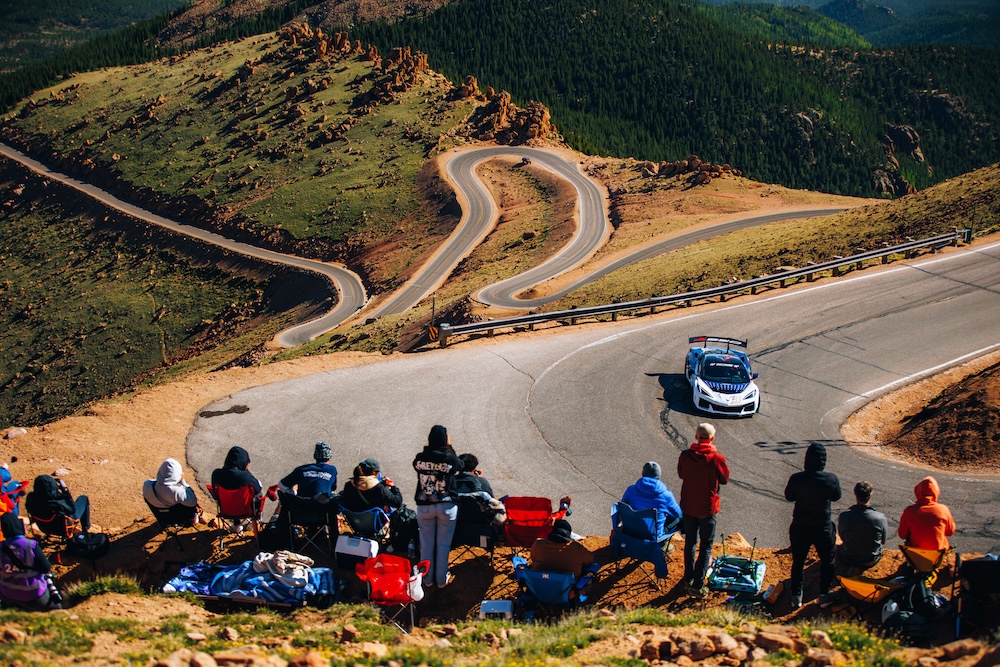
JR Hildebrand knew he was going to “rip an absolute heater” in the Corvette ZR1X come the full race run. That proved to be the case.
Sitting at the 14,115ft summit, it seemed like it ought to feel like a moment to celebrate another historic record for the remarkable ZR1X. But after driving the car as much as I did, and interacting with the incredible teams behind it, I couldn’t shake the notion that this car is only scratching the surface. It’s extraordinary in every way, no doubt. But zoom out a little, and the C8 ZR1X is still just the first draft. You really think the designers and engineers back in Michigan just gave all the components and systems that make this car what it is a first pass and are sitting back with their feet up?
Now, I’ve not been cc’d on the product roadmap from here, but I can tell you with certainty after my experience working with these groups for Pikes Peak: If you think this is the best they can do, you’ve got another thing comin’.
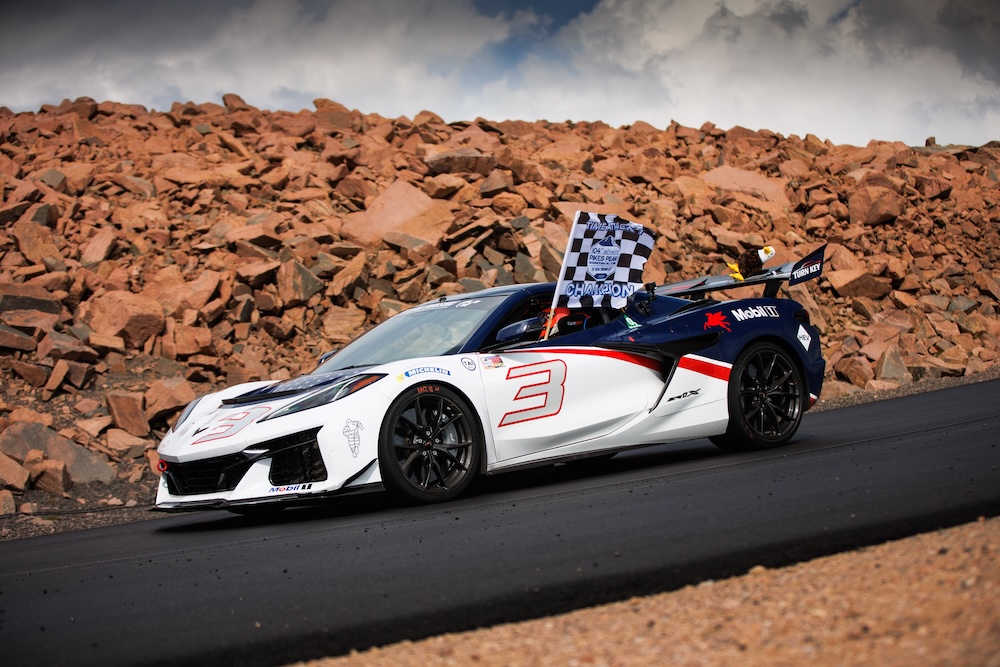
After a 9m30.104s ascent in the ZR1X and a Time Attack 1 class win, JR Hildebrand was already thinking about 2027…
CLICK HERE to purchase the new issue of RACER. Get 6 print issues of RACER Magazine, unlimited digital access to the RACER archive, and 24/7 motorsports streaming on the RACER+ App for one year at only $8.33/month, two years at $7.71/month, or three years at $7.22/month. CLICK HERE and subscribe now.
And for the ultimate motorsports fan experience, join R92, RACER’s all-access membership, for just $99 for one year. You’ll get 24/7 motorsports streaming on the RACER+ app, six print and digital issues of RACER magazine, unlimited digital access to the RACER archive, and exclusive member perks. CLICK HERE.
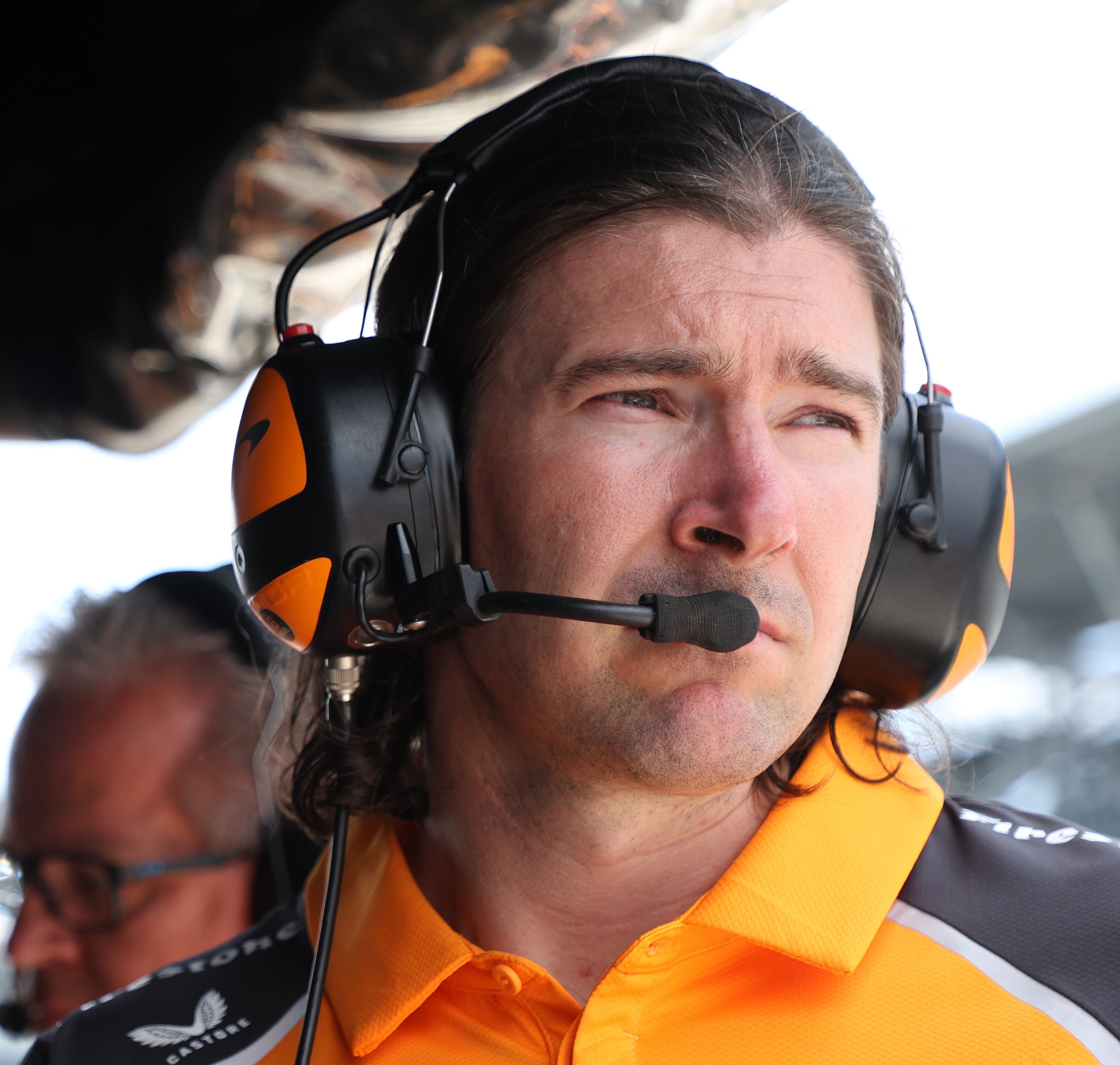
JR Hildebrand
Read JR Hildebrand's articles
Latest News
Comments
Comments are disabled until you accept Social Networking Cookies. Update cookie preferences
If the dialog doesn't appear, ad-blockers are often the cause; try disabling yours or see our Social Features Support.