David Jensen/Getty Images
Cup Series field ready for a long night with 450-lap North Wilkesboro race
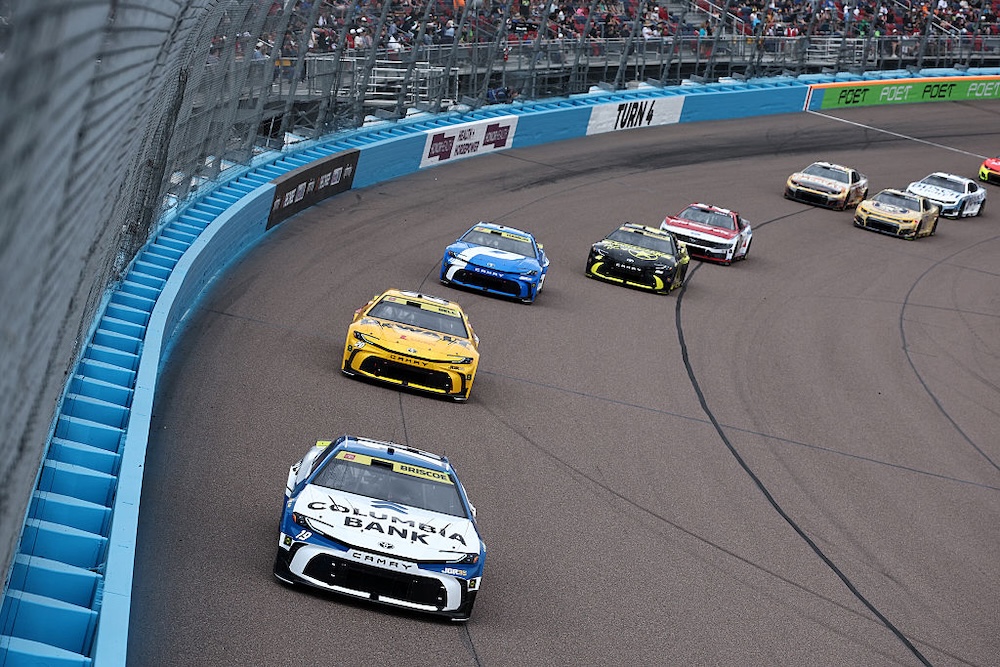
Sunday’s NASCAR Cup Series race at North Wilkesboro Speedway is going to be long.
It's an obvious statement, given the 450-lap length. That means it will be the longest Cup Series race ever run at the track.
The length will be felt not only in how much time it takes to run the first points-paying race at North Wilkesboro in nearly 30 years, but also in the toll it takes on the drivers. Although not unfamiliar with long races, given that Bristol Motor Speedway and Martinsville Speedway – also short tracks – run 500 miles, the field is set to face a new challenge at a track they’ve not run that long on before.
“It’s a long race, no doubt,” Joey Logano said. “That is a long one. A night race will be a little cooler. I was watching the truck race, and those guys were falling out at the end of it. They looked like they had enough when they got out.
“So, at least it will be cooler for us.”
The green flag will fly after 7 p.m. ET. It is forecast to be around 85 degrees for race time, whereas it was over 90 degrees Saturday afternoon for the Truck Series race.
“I think a lot of the driver comments came from when it was announced it was supposed to be a day race in July, so that was going to be really bad,” said William Byron. “It would have been kind of like what you saw in the Truck race, plus or minus whatever the temperature was. These cars are very hot – extremely hot. They’ve gotten a little bit better, but it would have been tough as a day race.
“I think a night race is going to feel like Richmond. It’s going to be kind of that nature of very long green long flag runs, I would think, and heavy braking and tire management. So, it’ll be tough on us, but I don’t think it’ll be unnatural with it being a night race.”
The longest race the current Cup Series field has run at North Wilkesboro is 250 laps during last season’s All-Star Race. In 2023 and 2024, the race distance was 200 laps.
It was a 400-lap race back in the track’s heyday, including the last points race in 1996.
“It’s going to be long. It’ll be long, for sure,” Denny Hamlin said. “It depends on how many cautions there are and things like that, but ultimately, it’ll be a long, grueling race. It’ll be one where you have to be very patient. But I don’t know; I’ve never experienced it here at this racetrack, even as old as I am, so I’m going to find out with everybody else.”
Hamlin believes it will take more of a toll on the drivers than on the race cars. So good are the cars these days, and so well put together and strong, that mechanical issues are not impossible but rare. It is all but uncommon to hear the “man versus machine” narrative in Cup Series races anymore.
“They all are pretty reliable from that standpoint – mechanically,” Hamlin said. “The brakes and all seem like they could go for quite some time. I don’t foresee it being any kind of issue. It will probably be more driver than anything else.”
There are a few elements that will be new for drivers, however.
A field of 37 means there will be more cars on track at once than they are used to at North Wilkesboro, as the All-Star Race did not run full fields. The largest in the last three years was 23 cars last season. It will also carry over to pit road, where there will be fewer empty pit stalls than in past years.
With more cars, they will catch fellow drivers more quickly when the field gets strung out during long green-flag runs. It also means more rubber will be laid down. And, as Logano described, it will mean more challenges for a position on a congested track where it is hard to complete a pass.
Chris Buescher said the track “is going to feel really small pretty quick.”
The one element to watch, if anything, is the brakes. Logano was in the minority in stating they will not be an issue because they are ginormous.
“I would think the brakes would potentially wear out as the race goes, but you’ll still have, fingers crossed, them at the end of the race unless you have a failure,” said Byron. “But we have seen brake issues with this car [with] heavier braking tracks; we’ve seen some rotors explode. Hopefully we don’t have anything like that.
“But overall, nothing on the car is going to give out. You’ll have tire wear and long-run cars that come toward the front, just like we see at Martinsville with this tire.”
Ryan Blaney, who starts on the pole, said that attrition is a good word to use. Blaney will be curious to see how the brakes hold up through the race, as well as how he and his fellow competitors hold up.
“Then it’s the first race with the new bumper structure, and there’s nothing behind that bumper,” he said. “All the foam is gone. It’s just bodywork, so they’re going to be pretty flimsy, for sure. I was fortunate in the previous generation car that that was what it was. You had to be really, really careful with the nose and the right side and stuff like that, so I feel like I have some experience on [how] you have to really be mindful of that stuff.
“Some guys, I think, who have only driven this car, they didn’t get to experience that in the other car, but that stuff is going to be flimsy, so you’re really going to have to be careful on stack ups, laying the bumper to somebody. But I think just the length of the race and the pace that this place is – it’s not a slow racetrack. It’s really fast, kind of a physically demanding racetrack, and while it’s a night race, it’s going to be fairly warm, so I think you’re going to have some people really physically having to dig down deep at the end of this thing because you’re going to be worn out, for sure.”
Kelly Crandall
Kelly has been on the NASCAR beat full-time since 2013, and joined RACER as chief NASCAR writer in 2017. Her work has also appeared in NASCAR.com, the NASCAR Illustrated magazine, and NBC Sports. A corporate communications graduate from Central Penn College, Crandall is a two-time George Cunningham Writer of the Year recipient from the National Motorsports Press Association.
Read Kelly Crandall's articles
Latest News
Comments
Comments are disabled until you accept Social Networking Cookies. Update cookie preferences
If the dialog doesn't appear, ad-blockers are often the cause; try disabling yours or see our Social Features Support.