McMurray's post-driving career isn't what he expected. But he's all in
Jamie McMurray thought he was going to be Ricky Rudd.
Not as a driver. McMurray was already nearing the end of his NASCAR career when, as the last few years wound down, he began to feel confident he would do the same thing Rudd did. McMurray would run his last race, walk out of the track, and for the most part, disappear.
“I really thought that would be me until I got introduced to TV,” McMurray tells RACER. “And TV is really fun.”
McMurray ran his last Cup Series race as a full-time driver in 2018, ending a career that began with a call-up to sub for an injured Sterling Marlin at Chip Ganassi Racing in 2002. He claimed his first victory in his second start, and signed off with seven career wins, including three crown jewels, and rookie-of-the-year honors.
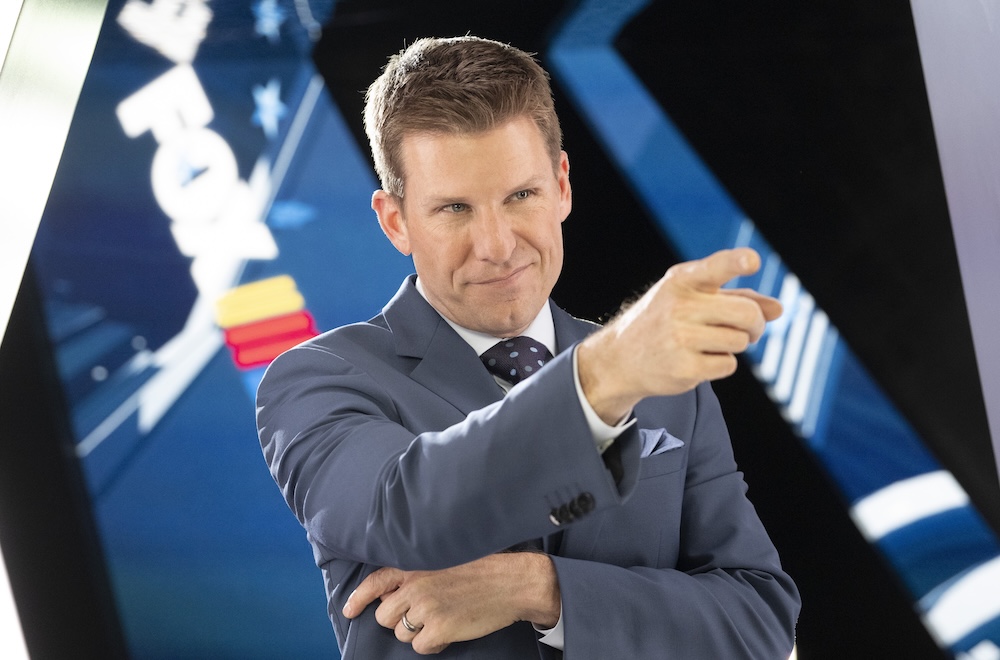
Eight years later, McMurray is ever-present in the sport. He immediately shifted to analyst work with Fox Sports for the now-shuttered “Race Hub” program and weekend prerace shows. Then came slots in the broadcast booth for O’Reilly Auto Parts and Craftsman Truck Series races.
And as of last year, McMurray splits his time between Fox Sports, where he still appears on the pre-race show, and being a race analyst in the booth alongside Adam Alexander and Parker Kligerman for The CW.
“I can’t tell you how much I enjoy the little bit of prep work that you do for it, the getting on air and talking about what you see and giving your opinion,” McMurray says. “Calling the races almost feels like you’re driving again, and the endorphins that get released when calling a race or when it comes down to the end. When you’re calling those, you’re pulling for somebody. Not because it’s your friend. Maybe it’s because somebody’s come from the back and you’re like, ‘Oh my gosh, he might be able to win this from a pit road speeding.’
“You just get excited because you’re like, I can’t believe it might happen. So, the answer is no, I never thought (that I’d be around this long in TV). But the reason is I had no idea how much fun it was going to be.”
The CW booth is in Concord, North Carolina, at the state-of-the-art production facility built by NASCAR. As a remote booth it gets mixed reviews: some believe that announcers should be at the racetrack. However, the facility that McMurray and his colleagues work out of has more than enough resources for a broadcast, with more than 25 cameras at their disposal, live timing and scoring, and other data.
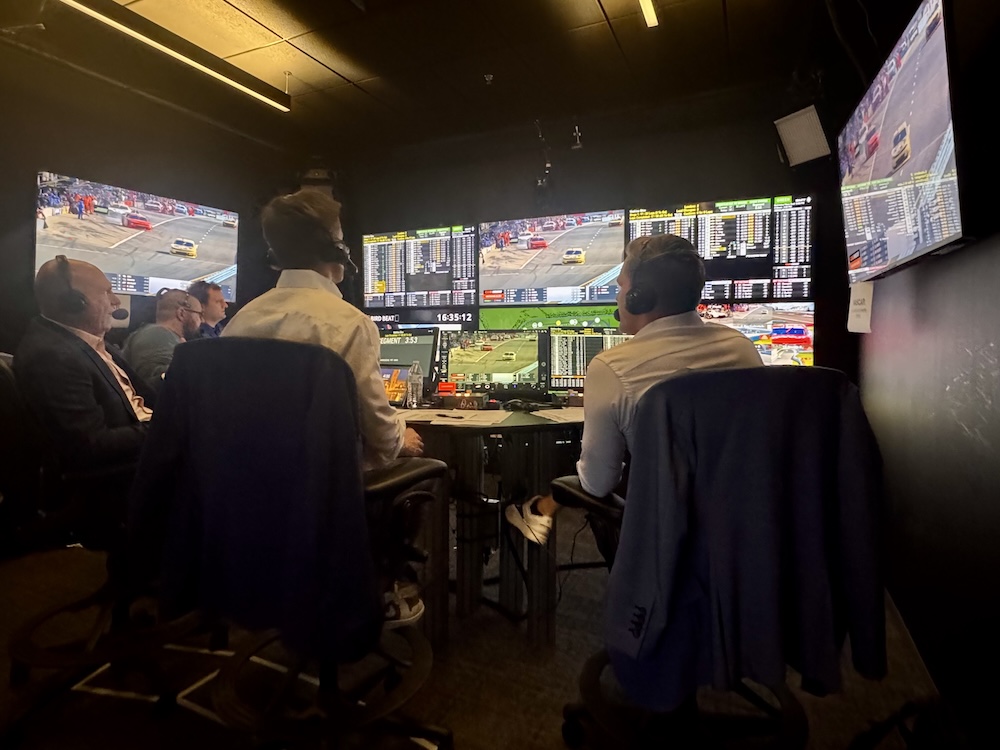
The CW's remote booth allows McMurray more of what's going on than if he were at the track. Photo by Kelly Crandall
McMurray, when given the chance to speak on the topic, has plenty to say, including his argument that those who are against remote booths are uneducated about them. The only downside is not being able to go into the garage, but it has no effect on calling the race. It’s a pet peeve of McMurray’s when he sees people say The CW has the best broadcast, "but imagine how good it would be if it were at the racetrack."
“I’m kind of bitter about this,” McMurray said. “I’ve seen people be like, 'it’s not fair to Adam, Jamie, and Parker to not be at the track', and that’s simply not true. The balance of CW will be at more races this year than any other network. But the studio is exceptional – the monitors that we have and the different camera angles actually let us see more than we can see at the track. The racetrack is nice to look out the window at pit stops because you can see all of pit road.
“However, you can’t look out the window and call the race. We’ve heard broadcasters talk about a spin that you don’t see on TV, and one thing that Adam really emphasized when we started doing this is that people at home can only see what’s on our screen. So it doesn’t do us any good to talk about anything that’s not happening with what they can see.”
McMurray's Sundays start early and run long. He is up at 5:00am to begin the day and get to the airport, flying into wherever the Cup Series event is running. There might be preshow meetings and obligations before getting on television for the broadcast, and then he is not home until late at night or the early hours of Monday. It does beat staying in a hotel when it’s an in-and-out schedule for one day.
Mondays are hard, though. McMurray likes to exercise, and by the time he wakes, he is feeling the effects of the weekend. The analogy is that he feels like he got drunk the night before, and McMurray is not a drinker.
“One thing that I don’t know if people can comprehend is that TV is exhausting mentally,” says McMurray. “You always have to be on. You always have to smile. You always have to act like you’re in a good mood. If you’re sick, you act like you’re not sick. And if you do that for three or four hours a day, you’re just tired when it’s over.”
McMurray hardly knew Kligerman before they started working together for The CW. On the flipside, he and Kevin Harvick, one of his Fox Sports colleagues, go back many years. He met the former Cup Series champion when he was 10 years old and then went on to race against him. Clint Bowyer was also another on-track rival.
No matter which broadcast McMurray is working, the chemistry comes down to playing off each other. But for any driver, it’s an adjustment going into television work.
“What’s hard when you stop driving … you’re not comfortable praising other drivers immediately,” McMurray says. “It’s not that it’s hard to say nice things, you’re just like, ‘I don’t know what I’m going to say about him because I know him on a different level.’ That takes a year or two to get over, and give a perspective that’s not biased based on your history with somebody.”
It’s much easier these days, given how long McMurray has been on the other side of the camera. Plus, it helps when the former driver is no longer yearning to drive and has become content with life away from the car. Sometimes, those who make the move to television might still want an opportunity to race if the chance comes, and might not be as critical of those they might run against again.
McMurray has proved to have no such qualms about fitting into the Saturday booth or Sunday pre-race desk. Rather than outright disappear or slowly fade away after a few years of television, McMurray has become one of its prominent voices.
“There really is not enough work to just do one of them,” McMurray says of working with both The CW and Fox Sports. “I want to do more. I either want to do it or not do it at all.”
Kelly Crandall
Kelly has been on the NASCAR beat full-time since 2013, and joined RACER as chief NASCAR writer in 2017. Her work has also appeared in NASCAR.com, the NASCAR Illustrated magazine, and NBC Sports. A corporate communications graduate from Central Penn College, Crandall is a two-time George Cunningham Writer of the Year recipient from the National Motorsports Press Association.
Read Kelly Crandall's articles
Latest News

Comments
Comments are disabled until you accept Social Networking Cookies. Update cookie preferences
If the dialog doesn't appear, ad-blockers are often the cause; try disabling yours or see our Social Features Support.