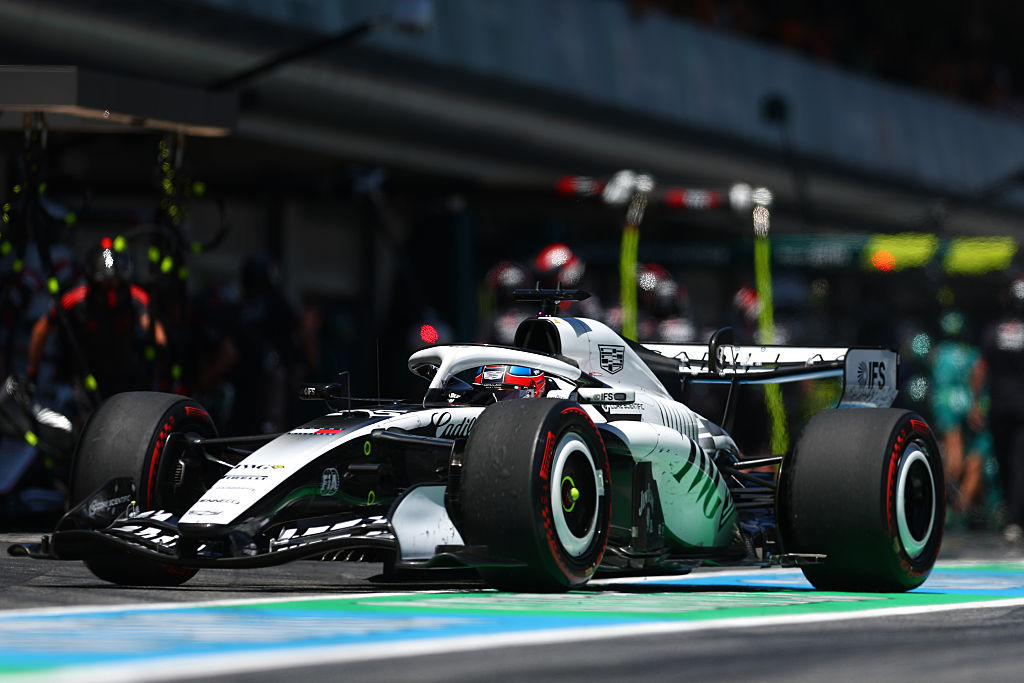
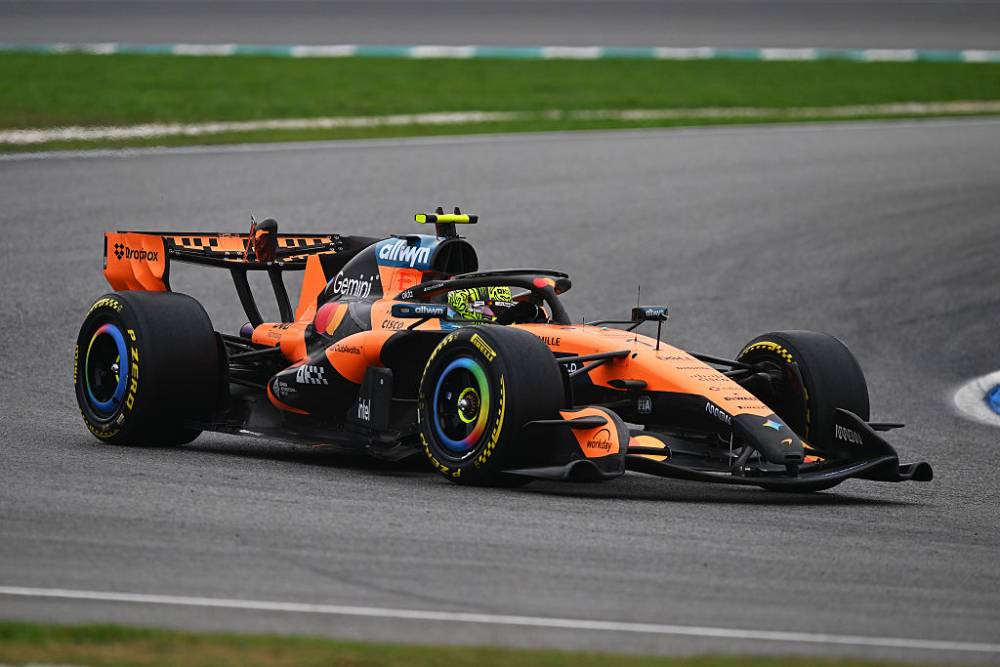
Guido De Bortoli/Getty Images
The opposing challenges of Mercedes' championship chasers
Russell v Antonelli: The fight to lead Mercedes fighting for a Formula 1 world championship tests you like never before. This season was always likely to subject George Russell to unimaginable pressures, and winning just one of the first four grands prix in a dominant Mercedes while teammate Kimi Antonelli took a hat-trick of victories can’t fail to have an effect on him. The question that will be answered in the coming months is whether it has opened cracks in Russell exposing hitherto undetected weaknesses.
This was always going to happen to a greater or lesser extent. The path to winning a world championship is rarely straightforward, something often underestimated given great drivers often seemingly cruise to a title without ever being truly tested. The reality is that even in the best car in the field, to rack up relentless wins is not easy, it’s just that certain drivers make it seem that way. And even they are typically at their most vulnerable before they’ve clinched that all-important first title. Russell, who has ‘only’ won six grands prix in his career, doesn’t have the experience of coming through such a searching examination yet, meaning the current situation of being 20 points behind his 19-year-old teammate can’t fail to prey on his mind.
While some are clamouring to write him off, it will require a bigger sample set of races to draw any definitive conclusions about where the balance of power in Mercedes has settled. Russell’s task, and it could be a career-defining one, is to ensure it swings in his direction. To call the next race in Montreal a must-win is hyperbole, but it will feel like that to Russell.
“I want to get back onto the top step of the podium,” he said after finishing a slightly fortuitous fourth in the Miami Grand Prix. “The first three races, I had the performance to do that, but this weekend I absolutely did not have the performance to do that. So, I could be standing here now with three very different results in previous races, with this one being a bit of a one-off, but obviously things worked out differently in Japan and China, but that’s Formula 1 sometimes.”
He’s right that the China and Japan defeats can be rationalized easily enough. In Shanghai, a problem in Q3 left Russell second on the grid, then problems at the start meant he was bogged down battling while Antonelli checked out. In Japan, a set-up error left Russell with a tricky rear end but he was in contention for victory before pitting just before the safety car. While Antonelli had a pace advantage on Sunday and might very well have beaten Russell even without the safety car, the combination of circumstances and the car troubles at least explained the speed difference. He also had the consolation of sprint-race victory.
Miami was a different story, a weekend where Antonelli was simply faster than Russell. It’s never been a good track for Russell, where the combination of low-grip track surface and high temperatures makes life difficult for him. He has a little in common with Piastri, who late last year struggled in similar circumstances, most obviously in Mexico, given a driving style that doesn’t gel well with the unavoidable micro-slides on such a surface. For certain drivers, Russell and Piastri included, that can create a disquieting vagueness, requiring a slightly more livewire approach to get the best out of the car - something that comes more naturally to respective team-mates Kimi Antonelli and Lando Norris. That’s not an excuse, it reflects a weakness to be tackled, and to Russell’s credit he’s proved adept at improving specific problems such as tire management and eliminating the errors that blighted his 2024 season. It also means what happened in Miami cannot simply be extrapolated to Canada and the races that follow.
The trouble is, F1 drivers are human beings prone to all the psychological traits – both positive and negative – that everyone else deals with. The fact he’s made it to a top seat in F1 and has a resume that even if he retired today would make for a more successful career than the vast majority who start out on the path to grand prix racing proves that his psychological makeup is robust. That’s something Russell himself is leaning on, as he discussed in an interview with Britain’s Radio 5 Live Chequered Flag podcast before Miami when asked how he goes about what he characterized as not thinking about the world championship.
“Because I know what it takes from seeing others achieve it,” said Russell, “And also, I've been in this position, not in Formula 1, but I've been in that position as a kid in all of those various championships, and I knew what it took to win those championships at the time. You can say the stakes are bigger today, they are bigger, but when I was in F4 fighting for the Championship, that was the biggest thing in my life. And then when it was F3, that was the biggest thing in my life, so actually the pressure was no smaller because that was F4 and this is F1. That felt like F1 to me at the time and that's what allowed me to fight for those victories.”
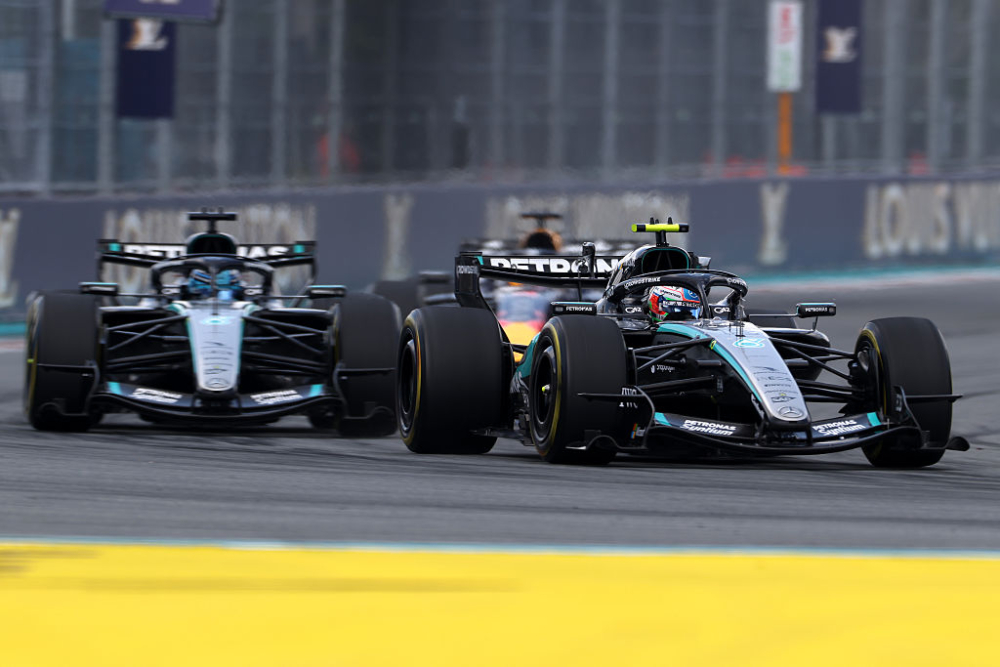
Antonelli once again had the upper hand in Miami, but it's a place where Russell has usually struggled. Dom Gibbons - Formula 1/Formula 1 via Getty Images
Russell is right to lean on his three car-racing titles on the way to F1, culminating in his Formula 2 success in 2018, but they aren’t the same. What’s different is the external scrutiny; the questions, the knee-jerk social media waves of opinion that even if you do your best to ignore them threaten to multiply any doubts lurking in your own mind. Every driver knows the formula is to ignore the noise and focus on doing your job, but to do that when the stakes are sky-high is easier said than done. That’s why Russell, and just about every other professional athlete, will always say they aren’t concentrating on whatever the goal is. To succeed, you can be driven by a goal but the objective must never become the focus. Instead, stay process-focused, put one foot in front of the other, execute your skills corner by corner, lap by lap, session by session and the result will be positive. The trouble is, doing that is not easy.
It’s impossible to say what’s going on in someone’s mind, even if there are times where you get a glimpse of it from their actions. The first challenge for Russell is ensuring that he compartmentalizes properly. Three of the first four race weekends haven’t gone as well as hoped, but he can’t change that. Make an error at one corner and you can’t correct it, all you can do is execute as close to perfectly as you can for the hundreds of corners that are to come.
Piastri produced a good case study for this last year. While sliding from a strong position to finishing third in the championship late on is usually cast as succumbing to pressure, much of that was down to the aforementioned technical weaknesses on certain track surfaces combined with Norris troubleshooting his own problems. However, the Azerbaijan Grand Prix weekend that started the slump was at least partly the consequence of the mindset being counterproductive. There, he crashed in qualifying, which necessitated an overnight chassis change, then made a terrible misjudgement by jumping the start and dropping to the back after triggering anti-stall before crashing at Turn 5 while trying to recover more quickly than was possible. He later admitted to “over-driving”, the consequence of the hangover of the team orders in the preceding race at Monza where he had to cede position to Norris after a pit stop blunder.
Russell’s position is completely different, but he must avoid falling into similar traps. The obvious one is the risk that he regards Antonelli as the ‘anointed one’ at Mercedes. Signed by Mercedes as a 12-year-old and promoted into an F1 seat with the team earlier than expected by Toto Wolff – and rightly so given his ability – you can see why Russell could convince himself of this narrative. Once the idea that one driver is favored takes root, it can have a corrosive effect and this could be the biggest threat posed to Russell’s hopes of winning the world championship. The reality is that the stopwatch will decide, certainly when it comes to the long-term, and what he must avoid is making this a self-fulfilling prophecy. The best drivers in F1 seize control of a team, and while it would be naive to deny that politics and emotional factors play a part, it’s always in the driver’s control to ensure they are the spearhead.
That, of course, is not easy. Antonelli is already an outstanding, but one still with enormous potential so is only going to get better. It remains to be seen which of the two will prevail, and whether doing so represents a decisive victory or, as in the case of the McLaren drivers, is unresolved heading into next season, but what is clear is that what happens over the next six months could decide whether Russell becomes a world champion or is cast as one of the ‘nearlies’ of F1 history.
Russell will know that. The trick is that he has to deliver his prodigious skills without letting that knowledge undermine him. And if he does that, he will have to hope that Antonelli, even in only his second season, doesn’t turn out to have a higher ceiling.
Meanwhile, Antonelli’s task is the inverse: he knows that this is the moment to assert himself and seize control of Mercedes.
Edd Straw
Edd Straw is a Formula 1 journalist and broadcaster, and regular contributor to RACER magazine. He started his career in motorsport journalism at Autosport in 2002, reporting on a wide range of international motorsport before covering grand prix racing from 2008, as well as putting in stints as editor and editor-in-chief before moving on at the end of 2019. A familiar face both in the F1 paddock, and watching the cars trackside, his analytical approach has become his trademark, having had the privilege of watching all of the great grand prix drivers and teams of the 21st century in action - as well has having a keen interest in the history of motorsport. He was also once a keen amateur racing driver whose achievements are better measured in enjoyment than silverware.
Read Edd Straw's articles
Latest News

Comments
Comments are disabled until you accept Social Networking Cookies. Update cookie preferences
If the dialog doesn't appear, ad-blockers are often the cause; try disabling yours or see our Social Features Support.