Chris Owens/Penske Entertainment
Is this an answer to IndyCar's testing problem?
It was late in November when I got a DM from an IndyCar fan who’d just spoken with former Indy Racing League entrant Tom Kelley and had some interesting information to share.
Along with two partners, Kelley had bought six 2007 Champ Car Panoz DP01s and, in an unbelievable turn, acquired Gerry Forsythe’s gold mine of Cosworth Champ Car turbo V8s.
Forsythe, the veteran CART and Champ Car team owner whose Player’s/Forsythe outfit was a title-winning powerhouse, became a co-owner of Champ Car and Cosworth in the 2000s. He also kept an impressive inventory of cars and engines from the era. Many had offered to buy some or all of the collection since Champ Car folded in 2008. They were rebuffed.
But the Fort Wayne, Indiana-based Kelley, along with fellow Fort Wayne businessman Rick Rohrman, and Steve Moore, who was part of the Forsythe’s championship days and won the Indy 500 with Tony Kanaan as KV Racing’s team manager, arranged to meet with Forsythe and present an offer for the six Champ Cars and 50-plus engines.
Remarkably, the deal was accepted and MKR Racing – Moore Kelley Rohrman – was formed to fill a much-needed void in the IndyCar universe.
Drivers find themselves sitting idle for the majority of the six-month-long offseasons, all thanks to the continually shrinking number of test days provided for teams within IndyCar’s rulebook. Most show up for the opening races with a bare minimum of preparatory mileage, which isn’t so much of a problem for the experienced drivers who know what they’re doing. But the restrictive testing policy slows and stifles the development of IndyCar’s newer and younger drivers in ways their predecessors never knew.
Look back to CART in the 1990s, and rookies like Dario Franchitti, Greg Moore and Juan Pablo Montoya were damn near exhausted by the time the first race arrived. After spending 20-plus days in their cars with pre-season testing alone, then a similar number of in-season test days and more with post-season tests, it wasn’t uncommon for first-year drivers to cram 50-60 days of testing into and around their debut seasons.
Throw in the added education from taking part in 15-20 CART races during the year, and there’s a reason why the Franchittis and Moores and Montoyas were ready to perform from the outset and shot to immediate stardom. Compare the fast-tracking of their IndyCar curriculum to today’s rookies, who might get four to five days in an IndyCar before going live at the first race.
There’s a reason for the giant change in approach. As costs crept up in the 2010s, team owners asked the series to find ways to reduce their operating costs, and one popular method of saving money is to eliminate track testing. And it’s also the reason why today’s IndyCar Series rarely has a rookie phenomenon to promote.
Due to the scarcity of track time, the learning curve is slowed and stretched to their detriment. If a team wants to see something spectacular from today’s rookies, they’ll need to give them a second season and probably a third before an honest call can be made on whether they’ve got a diamond in their midst.
Exceptions exist, of course, like Andretti Global’s Kyle Kirkwood, who won two races as an IndyCar sophomore. But most young drivers aren’t in the league of a driver who won three straight junior open-wheel championships before landing in IndyCar.
The majority of newcomers are extremely good, but need IndyCar’s version of a finishing school to be fully prepared to perform, and not so long ago, significant track testing was that school for incoming drivers.
For most of IndyCar’s young drivers, the widescale reduction of testing means they have to participate in the races to make mistakes, learn from those mistakes, and deliver incremental gains during the six months of championship action. And once the last race is run, they go back to sitting on the sidelines for almost six months, waiting for the sporadic chance to be inside the 200mph classrooms that unlock their greater capabilities.
If "practice makes perfect," as the old saying goes, IndyCar's least knowledgeable drivers are all but barred from practicing while being asked to perform like they're perfect. It's a glaring Catch-22. And as easy as it would be to call for a return to the freer approach to test days, the times and spending habits of manufacturers and sponsors have changed.
In 2026, the majority of IndyCar teams do not have CART-era budgets to fuel dozens of days at test tracks with their inexperienced drivers. The financially lush 1990s, when multiple auto manufacturers, Fortune 100 companies and warring tire brands poured vaults of cash into those teams, aren’t on the horizon. That makes complaining about how the olden days were better a waste of time.
Even so, improvements can be made by adding a few more days into the rules, but until that happens, workarounds for those who can afford them will continue to be the norm. Which takes us back to the business plan developed by Moore, Kelley, and Rohrman.
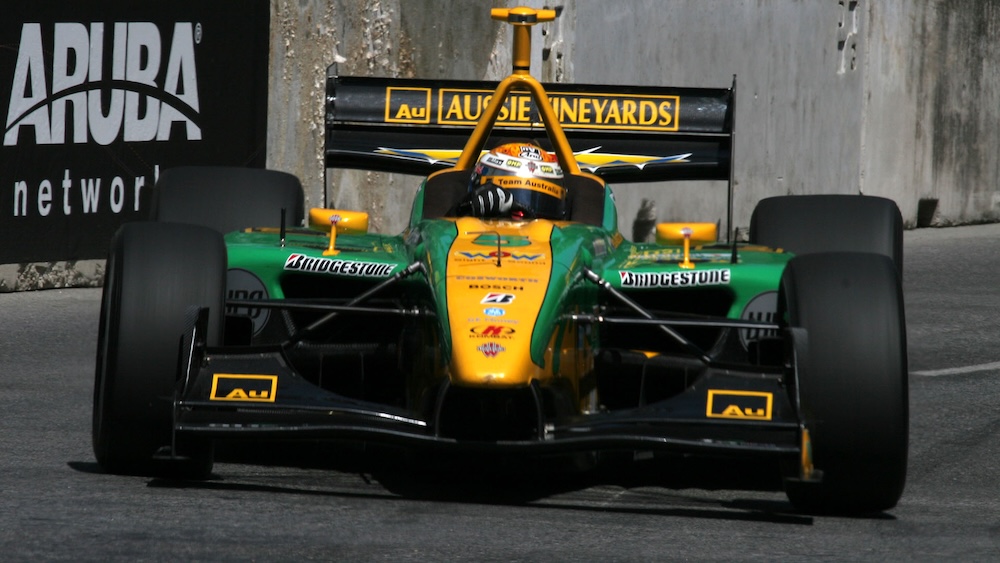
The DP01 was a favorite of Power (pictured) along with most other drivers who got to put it through its paces. Now it might get a second lease of life as a workaround to IndyCar's testing restrictions. Marshall Pruett photo
If the problem to solve is one of insufficient testing mileage for young drivers, and even some veterans who want to prepare themselves ahead of their first IndyCar test of the season, assembling a fleet of six Panoz DP01s with 800-plus horsepower Cosworth turbo V8s is one heck of a solution.
“It really is the closest you can get to today’s car,” Moore told RACER. “The DP01s are lighter, but horsepower-wise, they’re very similar.”
As a singular design, the DP01 was a dream. Ask a Will Power, or Sebastien Bourdais, or Graham Rahal, or any of the others who raced DP01s, and they’ll tell you it was their favorite car with the best blend of downforce, power, and handling.
Readying a pool of turnkey Panoz Champ Cars for today’s drivers, tomorrow’s aces, and others who are capable of wielding the fearsome machines, seems like a wise move.
“I have one team owner, and I can’t say who, who called and asked about using us because he says he has a lot of drivers who want to test with him, but he can’t because they have so few days they can offer,” Moore said.
“He said he gets a lot of calls from Europe with drivers who want to try an IndyCar (the current DW12) but he’s unable to do that, so we discussed being an outlet for that to happen with our cars. There’s definitely a market for this service.”
And to be fair, while MKR is the first local and readily available answer to IndyCar’s testing problem that’s for hire, it’s by no means the first solution teams have found in recent years.
On approach to Kyffin Simpson’s rookie season in 2024, Chip Ganassi Racing crafted a globe-trotting testing plan for the 19-year-old to address his considerable shortage of open-wheel experience by arranging international tests.
Simpson was rumored to have tested Formula 2 cars in Europe, Super Formula cars in Japan, and a Panoz DP01 alongside Power at a road course in Texas. CGR and Simpson saw and felt the protracted development cycle that comes with IndyCar’s testing restrictions, and set about filling in the gaps by repeating the process leading into 2025. It clearly worked and accelerated Simpson’s growth, as he earned three top fives and stood on his first IndyCar podium.
The cars were slightly different than his CGR Dallara DW12-Honda, but the curriculum made an obvious difference in Simpson’s ability to compete more regularly towards the front of the grid.
Racers are problem solvers at heart, and here, with an on-track testing issue to resolve, the responses have been amazing. Place an obstacle in front of IndyCar teams and drivers, and for those who have the means, the obstacle will be cleared.
There’s even a rumor of an IndyCar team being hired to assemble a dedicated operation – using a car sourced from the Formula 1 open-wheel ladder – for workaround testing.
MKR just returned from a few days of running DP01s in Arizona where one of Moore’s drivers, 2003 Champ Car champion and RACER contributor Paul Tracy, was reunited with the last Panoz he drove.
There’s also a solid rumor regarding a current IndyCar team dispatching its drivers to the same event in an effort to get themselves warm and ready in DP01s before blasting over to Sebring for the Monday-Tuesday IndyCar test held earlier this week.
“We keep our clients’ details private,” Moore said. “So I can’t give any specifics, but I can say IndyCar drivers were present.”
With his extensive history in IndyCar, Moore also wants MKR to be seen as an ally to the series and paddock.
“We told IndyCar we won’t run the cars at the tracks they use in the season, so we want to be respectful of their testing rules,” he said. “And these cars are good for the soul. Having them run, it's good for the sport. We can run two guys in a car a day, or one guy could run a whole day, and we can give them the closest thing to an IndyCar and give them that experience.
“And on the flipside of that, teams can evaluate the drivers and get feedback on what they think. So I think there's huge potential. A lot of teams are interested. The phone's ringing a lot now, and I think it's only going to get bigger. The flipside of that, too, is the gentleman driver side of it. We know there's a lot of people that run Ferrari Challenge or a series like that, and their goal, their dream, is to go run an IndyCar, Well, now they're going to have that opportunity.”
Marshall Pruett
The 2026 season marks Marshall Pruett's 40th year working in the sport. In his role today for RACER, Pruett covers open-wheel and sports car racing as a writer, reporter, photographer, and filmmaker. In his previous career, he served as a mechanic, engineer, and team manager in a variety of series, including IndyCar, IMSA, and World Challenge.
Read Marshall Pruett's articles
Latest News
Comments
Comments are disabled until you accept Social Networking Cookies. Update cookie preferences
If the dialog doesn't appear, ad-blockers are often the cause; try disabling yours or see our Social Features Support.