Michael L. Levitt/IMSA
Despite setbacks, Nasr and Porsche Penske's historic hat-trick felt inevitable
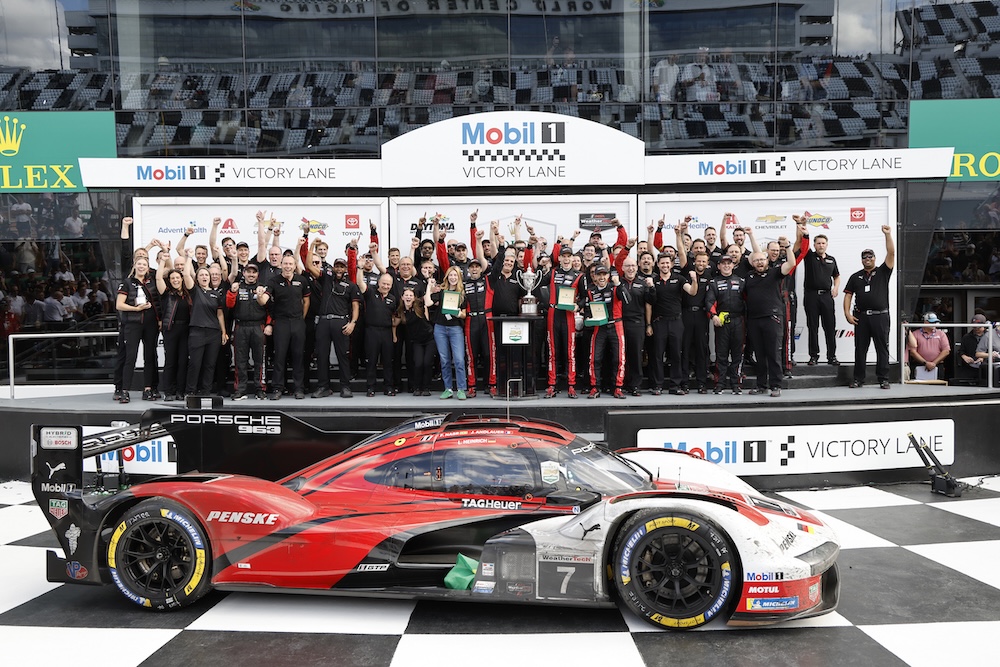
It may not have looked like it during the final hour when the lead battle was on fire, but Porsche Penske Motorsport’s third consecutive Rolex 24 Hours at Daytona win this year felt inevitable for the majority of the contest.
The 2026 edition of the race was a curious one. It had a chaotic start, a metronomic period into darkness, a huge caution period for low visibility overnight that lasted more than six and a half hours, then an all-out brawl at the end. On one hand, it was a race that took too long to truly get going; on the other, it delivered superb action in the closing stages to entertain the record-breaking crowd that toughed out the fog.
The stats tell a story for Porsche, Penske, and for the three drivers in the No. 7 963 who collected Rolex watches after the race.
Felipe Nasr, as well as Porsche Penske Motorsport, now has three wins in a row at Daytona, cementing his position as one of the most talented and accomplished drivers of the current era.
“It’s pretty amazing. I drove from my heart. It was amazing to be present today and feeling it," Nasr said. "I thought one was good, two was better, three, it’s going to be hard to beat that one.
“We did our homework over the winter, brought evolutions to the car, tested them, but you never know until race time because everyone else is doing the same and the whole field has improved. But Penske was in good form from beginning to end."
The Brazilian was in at the end, tasked with fending off Jack Aitken’s late surge forward for Cadillac. But a huge chunk of the hard yards in this one were dealt with by his new teammates, Julien Andlauer (27) and Laurin Heinrich (25), who both captured their first-ever IMSA GTP wins in fine style.
“Everyone who comes on board [at Porsche] races to a really high level,” Nasr said of his teammates. “All I could do was pass on my experience as a driver, and that’s what I kept doing. We stayed calm, paid attention, and stayed out of contact. It’s our first time in the car together, so to start the year with a victory like here in Daytona is a dream come true.”
In a wider sense, this achievement meant a huge amount to all involved. It was a tough end to 2025 for the PPM program following Porsche’s decision to step away from the WEC. But that adversity and change seemed to serve only as extra motivation for Roger Penske’s group, who remained entirely unfazed by the noise surrounding the team during the build-up to the race.
“Winning the 24 Hours of Daytona three consecutive times with this Porsche Penske Motorsport team is an incredible accomplishment,” Roger Penske said. “That sustained success is only achieved with great teamwork, focused and determined drivers, a resilient crew and a commitment to winning.
“Our success at this event helped put our team on the map over six decades ago, and winning here in Daytona is a perfect way to celebrate the start of Team Penske’s 60th anniversary season. I also want to congratulate Porsche Motorsport on a great beginning to their 75th anniversary in 2026 as we continue to build on our winning legacy together. Today’s victory reflects the efforts and dedication of all those committed men and women working on the Porsche Penske Motorsport program, from Mooresville to Germany.”
In GTP’s battle of the brands, Porsche Penske Motorsport, with its pair of upgraded 963s, was the only team that consistently looked like it had something in the pocket to fend off the other cars in the race for the overall win. This is despite the fact that both cars suffered setbacks, with the No. 7 requiring attention on pit lane overnight and the No. 6 hindered by a hole in its left side and floor damage from contact early in the race.
“It [the fog caution] gave us an opportunity to make sure our race cars were as sharp as they could be for the end of the race,” Travis Law, Penske’s competition director, added when asked about the impact the caution period had on the team's outlook and result. “We need to look back at everything. On the 6, we used a lot of tape!”
The IMSA technical team will no doubt study the numbers to see if the BoP set for the race achieved its intended goals for the first race of the year. All but one of the GTP cars (the Valkyrie) was updated with performance "Jokers" and put through the WindShear wind tunnel as part of the new-for-2026 streamlined process to homologate the top-class prototypes in IMSA and the WEC. There will no doubt be fine-tuning needed as the season progresses.
It wasn’t total domination by Porsche - the No. 6 faded late and finished fourth, and the winning margin for the No. 7 was 1.5s - but as one of Cadillac's runners-up, Earl Bamber, pointed out post-race, it wasn’t a clash of the titans between the majority of the cars in the field when the chips were down.
“It was clear from after the first hour that there were only three cars in this most of the time, the No. 6, No. 7 and No. 31,” he said. “It was similar to last year at the end of the year. We knew they were going to be strong, we put our best foot forward, and we should be proud.”
In the end, there can only be one winner, and in a race as important as this, one team that basks in glory while the others lick their wounds. And in 2026, it was Porsche Penske Motorsport, once again, that got the job done. It's the team that everyone else in GTP will be even more desperate to beat when the trucks unload at Sebring in March.

Stephen Kilbey
UK-based Stephen Kilbey is RACER.com's FIA World Endurance Championship correspondent, and is also Deputy Editor of Dailysportscar.com He has a first-class honours degree in Sports Journalism and is a previous winner of the UK Guild of Motoring Writers Sir William Lyons Award.
Read Stephen Kilbey's articles
Latest News
Comments
Comments are disabled until you accept Social Networking Cookies. Update cookie preferences
If the dialog doesn't appear, ad-blockers are often the cause; try disabling yours or see our Social Features Support.