Getty Images
From the vault: Power Trip
There’s an oft-recounted narrative to the tale of Porsche’s Can-Am domination with the 917 and Penske Racing in 1972 and ’73. It goes something like this: Porsche’s Group 5 coupe is legislated out of the World Championship for Makes; Porsche cuts the roof off the car and sticks a turbocharger on the thing; the 917/10 and then the 917/30 turbocars sweep all before them in North America, and then the Group 7 version of the car is shown the door again by the rule makers.
Which is all highly simplistic…
The presence of the 917 in the Canadian-American Challenge Cup, to give the series its full name, some three seasons before Penske’s entry is often overlooked. That’s perhaps because it barely got a look in against the all-dominant McLarens of the "Bruce and Denny Show." An open-cockpit, Group 7-spec 917 never finished better than third prior to Penske’s arrival in ’72, although a 917K Group 5 coupe did grab second at Watkins Glen in 1970, when six cars racing in the six-hour WCM event joined the following day’s Can-Am grid.
A turbocharged 917/10 did win the title with George Follmer, and with relative ease, in year one of the Penske program in 1972, but that’s to ignore a difficult gestation for the latest incarnation of arguably the most famous sports racing car of all time. That included a monster testing accident for Penske talisman driver and engineering guru Mark Donohue.
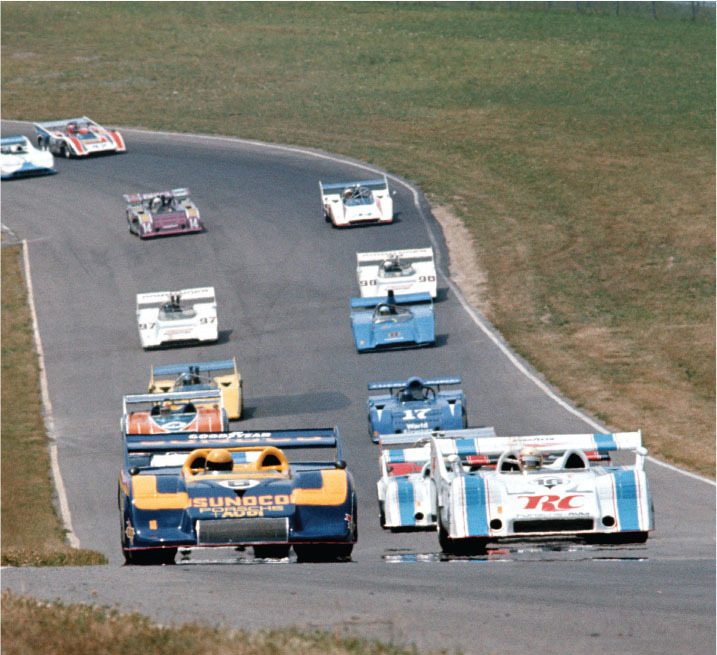
A familiar sight in the 1973 Can-Am… Mark Donohue starts from the pole at Watkins Glen in the 917/30, with George Follmer’s 917/10 alongside. Getty Images
The Can-Am story started for the 917 in the debut season of the car in 1969. Porsche factory driver Jo Siffert, a wheeler-dealer from humble origins who’d run his own team in F1 in 1963 and ’64, had seen potential in Can-Am: the prize money on offer was unheard of in Europe. He found a sympathetic ear in Josef Hoppen, competitions boss of the Volkswagen concession holder in North America that had just set up its new Porsche+Audi division. Hoppen agreed that Can-Am would be a great way to promote this latest venture.
The result of some lateral thinking on the part of Siffert and Hoppen was the 917 PA Spyder. The car was purchased by the driver and the running costs paid for by Porsche+Audi. A 4.5-liter, naturally-aspirated flat-12 straight from the Group 5 car and a lack of development ensured it was never a match for the Chevy powered McLaren M8Bs, in which Bruce McLaren and Denny Hulme shared out the victories in all 11 rounds. The Porsche engine was rated at 580hp, but the M8B’s 7-liter Chevy V8 was pushing out the better part of 100 horses more. Still, a run of top-six finishes brought in more than $50,000 in prize money over the course of a program run from the workshops of grand prix winner Richie Ginther.
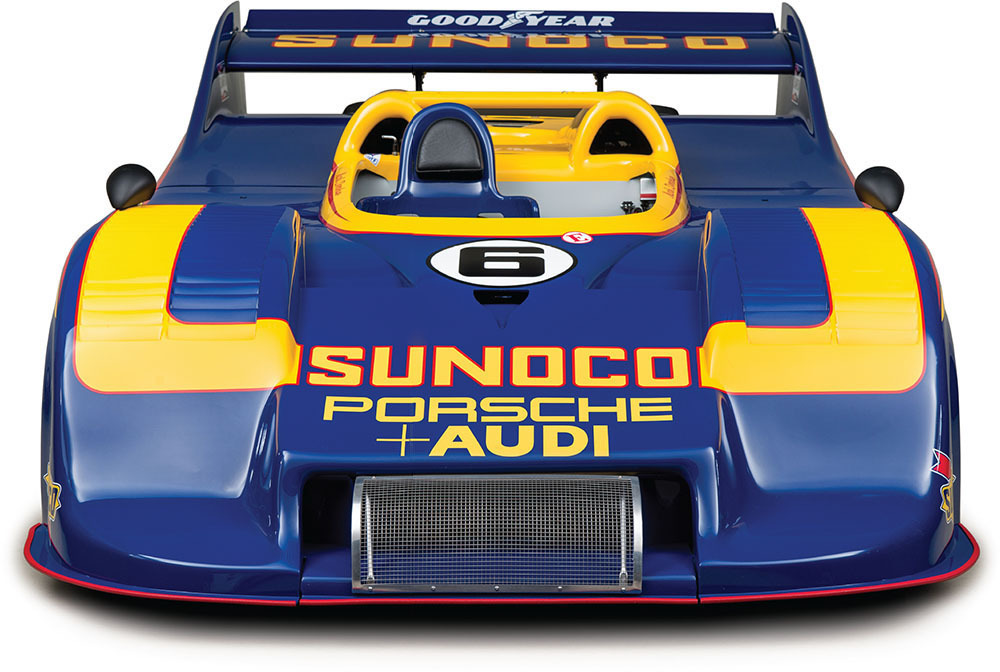
Porsche’s 917/30 of 1973 took racecar power to new extremes, putting out 1,100hp in race trim and a dyno-busting 1,500hp with the wick turned up. Image by Canepa
The 917 wouldn’t race in Can-Am in 1970, save for the outing at the Glen when a fleet of 917Ks took second, third, fourth, sixth and seventh, with Siffert best of the bunch in a Gulf-liveried JW Automotive car. But Porsche’s interest in Can-Am remained strong, Siffert testing a 917 PA with a 6.5-liter, flat-16 engine that would never race. That interest resulted in the first car to carry the 917/10 moniker.
The new Porsche Group 7 racer for 1971 incorporated some of the developments from Siffert’s ’69 program, as well as a 917K-type tail. The Swiss returned to North America running again under the banner of Porsche+Audi, with a car loaned to him by the factory this time and sponsorship from Marlboro and STP. But the battle between the Dayglo red Porsche and the papaya orange McLarens was still an unequal one. Siffert never managed to win a race, although he twice finished second on the way to fourth in the final points.
By the time Siffert raced the 917/10 for the first time in round four at the Glen at the end of July, the seeds of Porsche’s future domination had already been sown. Realization that the flat-16 would never become a workable race engine pushed Porsche down the turbo route, while contact between the German marque and Roger Penske about continuing the 917 success story beyond the end of the car’s life in the WCM had already been made.
The story of Porsche and Penske, one that stretches through to the present with the new 963 LMDh prototype competing in the IMSA WeatherTech SportsCar Championship and the FIA World Endurance Championship this season, began at the 1971 24 Hours of Le Mans, where the U.S. team was running its Ferrari 512M. Ferdinand Piech, the architect of the 917 and Porsche’s development boss, made contact over the course of race week.
"Too good to be true" was how Donohue recounted the offer put to them in his autobiographical "The Unfair Advantage," published posthumously in 1975. Piech wanted Penske to fly the flag for Porsche in Can-Am with a new turbocharged version of the 917 spyder. It was, Donohue added, "something we should have to fight to get" rather than being offered an "opportunity of a lifetime" on a plate.
Yet Donohue wasn’t impressed with Porsche’s latest stab at a Can-Am racer on a first viewing at Watkins Glen in July ’71. "The ugliest car in the entire world" and "a patch-up job" were the phrases he used to describe Siffert’s 917/10. The lack of cleanliness of the car also offended the Penske and Donohue sensibilities. The spaceframe German machine stood in stark contrast to the McLarens, the latest F-spec version of the M8, with their monocoque chassis and all-aluminum Chevy V8s: "I said to Roger, ‘I wonder if this is a smart thing to do after all,’" recounted Donohue.
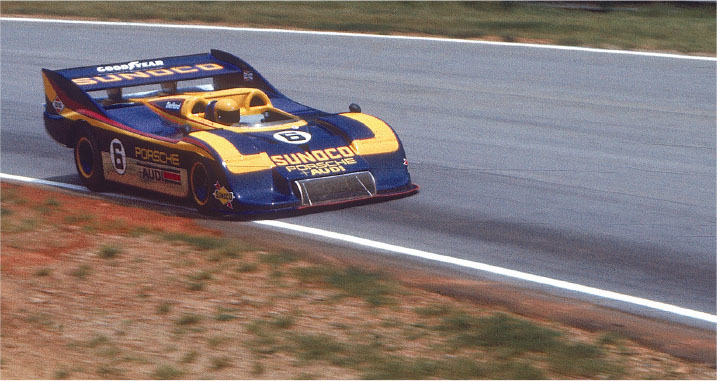
Domination of the 1973 Can-Am didn’t come immediately for Mark Donohue and the Porsche 917/30, seventh and second in the first two races giving a glimmer of hope to the opposition. But after that it was game over, with six wins from the remaining six rounds for Donohue and Penske Racing. Image by Porsche AG
Nor was Donohue impressed when he first drove the Porsche Can-Am contender, still with a naturally-aspirated flat-12. It didn’t help that he’d been out drinking the night before. The Porsche/Penske relationship was initiated with a hungover driver behind the wheel at Porsche’s Weissach test track…
He wrote that the car was "terrible" (note his italics for added emphasis). "I had to jam my legs against the steering wheel to keep in a straight line at 150mph," he bemoaned.
Donohue set to work on honing the handling of the 917/10, eschewing the newly-built test track in favor of two skid pans. He sorted the suspension geometry on the smaller of the two, with its 100ft radius, and then the aerodynamics on the larger, 400ft pan. Even then, Penske still set to modifying the aero once it got a car to its headquarters in Reading, Pa., at the end of the year.
Development of the turbo version of the 917’s flat-12 had started late in 1970. Twelve months later, a blown 4.5-liter unit had successfully come through an eight-hour run on the test bench, although it’s said that the dyno didn’t emerge unscathed. The problem facing Porsche with the engine was one of drivability. Just starting it was a problem initially. When Donohue first drove a 917/10 TC fitted with the five-liter turbo motor destined for Penske’s exclusive use at a cold Road Atlanta in Feb. ’72, the car had to be towed in gear around the track before the engine would come to life.
Donohue opted against trying to overcome problems with extreme turbo lag in the U.S., deciding that he needed to undertake development back at Porsche. Extensive work on the dyno with the Bosch fuel injection pump eventually reduced the lag issues to something usable. By May, Porsche had a workable five-liter engine that was good for 900hp, or 1,000hp with the boost wound up.
That was the first "victory" for Donohue that month. He would then win the Indianapolis 500 with Penske’s McLaren-Offenhauser M16. He knew by that time that he also had a car that could win him Can-Am races. What he couldn’t have predicted is that it would take him until the Edmonton round in October. That was the result of his major accident in testing ahead of round two at Road Atlanta. He’d finished second to Hulme in the Mosport season-opener, and then crashed heavily on the Georgia track’s back straight when the rear deck parted company with the car. Donohue was left sitting strapped in his seat with no structure ahead of him. Knee surgery put him out of action until September.
Follmer came in to fill his seat and did so admirably, taking five victories – one of them handed to him by the returning Donohue – and finally bringing McLaren’s run of Can-Am titles to an end. McLaren’s successor to its line of M8s, the M20, hadn’t proved a success and it withdrew from the series at the end of the ’72 season.
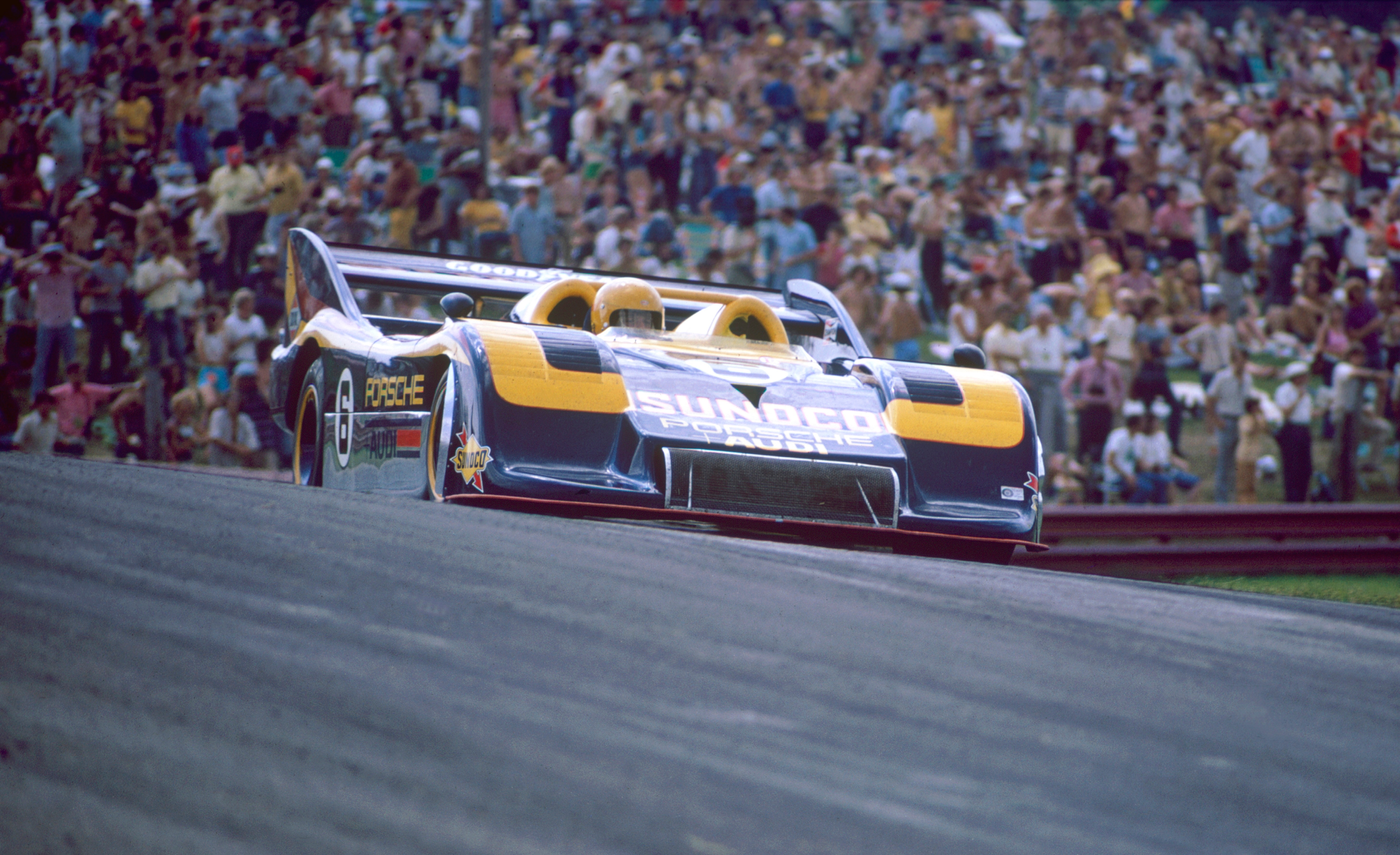
More success followed with the refined (a relative term for such a beast) version of Porsche’s Can-Am concept, 1973’s 917/30. In addition to a 5.4-liter take on the flat-12 that was now good for an o cial 1,100hp – 1,500hp had been seen in flash readings on the dyno –there was a longer wheelbase and revised aerodynamics. Once an aero imbalance was sorted, Donohue and the 917/30 were away. He was on pole for the opener at Mosport by more than a second from a 917/10 driven by Jody Scheckter.
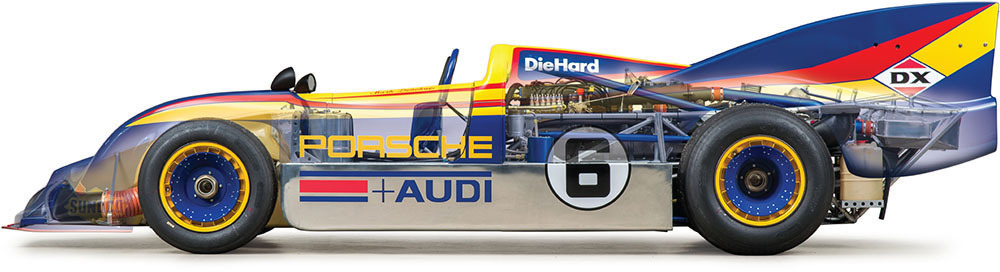
917/30’s lightweight aluminum tube frame chassis wraps around the 5.4-liter flat-12. From the Porsche 917’s original Group 5 days through into its Can-Am guise.
Donohue first tasted victory at round three at Watkins Glen, and would then go unbeaten to the season’s end, claiming the title with more than double the points of outgoing champ Follmer in a privateer 917/10.
But there were storm clouds brewing for Can-Am in the form of the oil crisis that followed the war in the Middle East, as well as a perceived lack of competition that spooked the organizers. A limit on fuel usage in Can-Am (a first for the no-holds-barred series…) that would hit Porsche hard was announced soon after the ’73 season’s end. A maximum of 73 gallons could now be consumed over the course of a 125-mile main event and 75-mile sprint, a new format introduced during the ’73 season. The 917/30 had been designed with a 106-gallon fuel capacity for the traditional 200-mile races.
Porsche announced its withdrawal from the series within weeks, citing "drastic regulation changes." The 917’s front-line career was at an end. As for Can-Am in what’s regarded as its true form, it limped on through five events the following season before its cancellation.
The axing of the factory Can-Am program at the end of 1973 wasn’t quite the end of the 917/30 story. Porsche privateer Herbert Muller got hold of one and maintained Porsche’s monopoly of Europe’s low-key answer to Can-Am, called Interserie.
Interserie had been won in its inaugural 1970 season by a 917K driven by Jurgen Neuhaus and then for the next three seasons by Leo Kinnunen driving a 917/10. Muller grabbed the baton for ’74, taking a trio of wins on the way to the title. Kinnunen would also claim a win in the same chassis.
The 917/30 did make a final Can-Am start, at Mid-Ohio in ’74, when Penske ran its car for Brian Redman in a deal brokered with track boss Les Griebling to help boost the crowd. The Brit won the qualifying heat, but after an off he had to give best to Jackie Oliver’s Shadow in the main event.
But that wasn’t the final hurrah for Penske and the 917/30. It was brought out of retirement in 1975 for an assault on the world closed-course speed record, Mark Donohue driving at Daytona. The initial idea was to try to beat a mark set by A.J. Foyt in a Coyote USAC Indy car, but the engine objected to such prolonged running at full power. After three months of development, Penske tried again at Talladega in August.
A flash fire and light drizzle didn’t nix the attempt this time. Donohue lapped the 2.66-mile tri-oval at 221.120mph. Little more than a week later, he would succumb to the injuries he sustained in practice for the Austrian Grand Prix driving a Penske March.
Technical specifications
PORSCHE 917/30
Category Can-Am (Group 7 regulations)
Chassis aluminum tube frame w/glass-fiber-reinforced plastic body
Engine mid-mounted, air-cooled, 5.4-liter flat-12 w/twin Eberspacher turbochargers; magnesium alloy block & aluminum alloy head
Maximum engine power 1,100hp @ 7,800rpm (official) up to 1,500hp (estimated) at maximum boost (approx. 40psi estimated)
Maximum torque 820ft.lbs @ 6,400 rpm
Transmission Type 920 4-speed manual
Suspension double wishbones, coil springs, shock absorbers, anti-roll bar
Weight 850kg/1,874lbs
Length 4,562mm/179.6 in
Wheelbase 2,500mm/98.4 in
Width 2,085mm/82.1 in
Height 1080mm/42.5 in

Gary Watkins
Read Gary Watkins's articles
Latest News

Comments
Comments are disabled until you accept Social Networking Cookies. Update cookie preferences
If the dialog doesn't appear, ad-blockers are often the cause; try disabling yours or see our Social Features Support.