Richard Dole/Motorsport Images
IndyCar 2025: A turning point in the race to what’s next
I’ve been fan of IndyCar racing since I was nine years old. Viewing the 1964 Indy 500 live on a closed circuit black and white TV broadcast in a theater with hundreds of die-hard racing fans delivered an irresistible emotional gravity that hooked me then and has held me ever since. During the 22,136 days since then, I’ve watched this sport repeatedly soar to triumphant highs and then suffer through some excruciatingly self-inflicted destructive lows.
Racing became my lifelong passion, my way of life and my profession. I began working full-time in racing media during the first week of January in 1975. Since then, I’ve been fortunate to know most of the people who have managed -- or sometimes mismanaged -- the sport of IndyCar racing. And if there’s one key lesson that I’ve learned it’s this: keeping IndyCar racing stable, healthy, growing and thriving is anything but easy.
This was particularly evident during the past 30 years of the sport, that have been predominantly turbulent and persistently disorienting and disheartening to many lifelong Indy 500 and IndyCar racing fans like me, who grew up when the Indy 500 and IndyCar racing was unquestionably America's premier form of motorsport. The hard truth is that division, identity confusion, negative off-track storylines, and progressive diminishment of the technical diversity in the cars and engines have muted the allure of a sport that once set the pace for audience scale and commercial energy. Many of us older IndyCar fans eventually found other things to care about while some of us focused instead on conveying displeasure with the sport’s direction.
Another hard reality is that there simply weren’t enough new fans being exposed to IndyCar racing, and subsequently engaging in it to create fresh, positive cultural energy emanating from the sport. This has unfortunately continued to be the case during the first five years of this decade, despite Roger Penske’s welcome acquisition of the Indianapolis Motor Speedway and the NTT IndyCar Series in 2019, that was unfortunately timed on the eve of the global COVID 19 pandemic. Since then, IndyCar’s progress has been steady but slow, which is not the Penske way. So, the complaining about IndyCar’s leadership team in RACER.com’s comment sections, in RACER’s social media channels and in the RACER Mailbag has become a digital bloodsport that metaphorically eclipses the whine of a twin-turbo 2.2-liter V6 at 12,000 rpm.
But I believe that is about to change because 2025 feels to me like a true turning point year for the NTT IndyCar Series. The new FOX all-network broadcast deal isn’t just a TV contract; it’s a huge and potentially game-changing opportunity to reconnect IndyCar racing with mainstream America. It is also an encouraging external validation of the true potential of the Indy 500 and NTT IndyCar Series to create emotional meaning that can attract audiences.
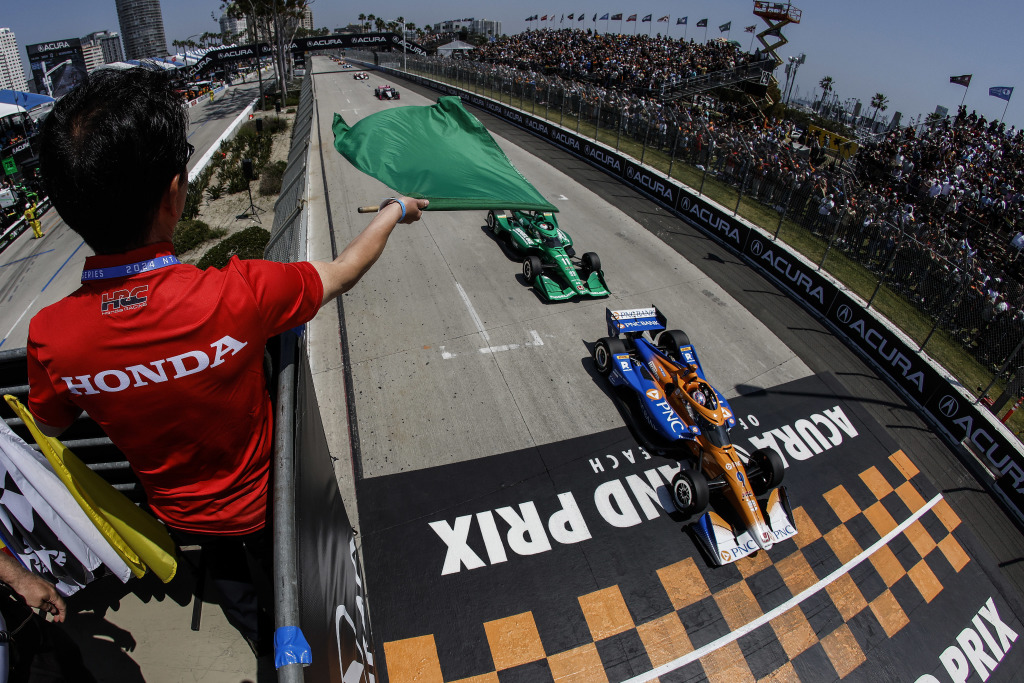
Securing the future of Long Beach as an IndyCar venue is one key to providing a stable platform for long-term growth. Michael Levitt/Motorsport Images
Equally significant are Penske Entertainment’s recent acquisition of the Long Beach Grand Prix Association and the announcement of the upcoming Arlington Grand Prix in 2026. These moves aren’t just about preserving or adding races to the NTT IndyCar Series schedule -- they’re about ensuring stability and signaling a commitment to building the series through modern lifestyle-oriented event weekends that can accelerate growth and build cultural relevance that will attract younger fans to the series. These events also serve as fan data capture opportunities outside of Indiana and Detroit that will directly connect Penske Entertainment to new fans, as well as provide insight into what they like and don’t like about the IndyCar fan experience, that will shape the future of the NTT IndyCar Series.
The Acura Grand Prix of Long Beach, the series' second-most popular event, will celebrate its 50th anniversary this year. I’ve been fortunate to have attended every Long Beach GP race weekend since the inaugural SCCA Formula 5000 event in 1975. I was there when the CART PPG IndyCar Series replaced Formula 1 as the headline show in 1984, and it soon became a defining element in the sport’s uniquely diverse schedule, first for CART, then ChampCar and now IndyCar. This also ensured IndyCar’s continual presence in the USA's second largest Designated Market Area (DMA). The Arlington Grand Prix represents transformational growth potential in the fourth-largest U.S. DMA, through an exciting partnership between Penske Entertainment and Jerry Jones' Dallas Cowboys organization. These moves show that IndyCar isn’t just reacting to challenges -- it's actively building the foundation for a brighter future.
Penske Entertainment CEO Mark Miles and IndyCar President Jay Frye deserve credit for the good things that are now happening for IndyCar. Steering a ship this big, with so many vocal stakeholders and so much history, takes a steady hand and a thick skin. Despite some missteps -- such as the delayed, but ultimately successful introduction of the hybrid package in mid-2024, and the slow reveal of a clear vision for the series' next engine and chassis formula in 2027 -- their leadership has kept the series moving forward.
Ultimately it is Roger Penske who now owns this sport that defines his personal identity and the competitive spirit of his $39 billion business empire. Those critical of Penske cannot deny that the Indy 500 and the NTT IndyCar Series are clearly his lifelong passion. So, as these recent developments illustrate, Roger always plays to win. History shows us that he’s usually several laps ahead of the competition in his strategic thinking, We also should appreciate his obvious urgency to “get it done,” given that he will celebrate his 88th birthday on Feb. 20, so I like his chances in this 115-year race to what’s next,
The intention of Penske Entertainment is clear to many who make the decisions to invest in the sport: They know Roger Penske’s goal for IndyCar is to make it better by every measure, by doing what it takes to reposition, redefine and re-energize the sport at every touchpoint. These partners likely appreciate the reasons why this has been a challenging period for IndyCar racing, but they also understand that this is the sport’s golden opportunity to reset, and that the commitment is there to succeed.
As we roll into 2025, IndyCar’s top priority is to renew both Chevrolet and Honda as engine partners for the next era of the sport that commences in 2027. This is not a slam dunk, as American Honda and HRC’s leadership team have made clear. Honda has been a key player in the sport from 1994 through to the present day. It is also worth reflecting on what would have happened to the Hulman & Company-owned Indianapolis Motor Speedway, the Indy 500 and the IndyCar Series if Honda had exited the series at the end of 2005 to join the rival Champ Car World Series. Instead, on Oct. 16, 2005, Honda and HPD (now HRC) announced that Honda would become the sole supplier for the IndyCar Series. This came into reality via a unique partnership with former rival Ilmor Engineering to supply Honda power to the entire field. It was no small undertaking, and Honda’s remarkable commitment likely preserved the Indianapolis 500, and the IndyCar Series. This decision also likely sealed the fate of the struggling Champ Car World Series that had risen from the ashes of CART’s bankruptcy in 2003.
As 2025 begins, IndyCar’s leadership is reportedly engaged in discussions with several potential new manufacturer partners, while also intensely focused on renewing its current partners. Manufacturer rivalry is central to any top-level racing series. The investment these auto companies make in TV broadcasts, event sponsorship and other crucial marketing activations is essential to growing any racing series.
So are passionate racing fans and performance car enthusiasts. That’s where we come in. At RACER magazine and RACER.com, IndyCar has been our heartbeat since the beginning. Our premier May 1992 issue of RACER featured Emerson Fittipaldi's Penske PC-21 Chevrolet IndyCar on its cover and a special feature on the IndyCar engine war between Chevy and Ford. This set the tone for our steadfast commitment to fans of the Indy 500 and the IndyCar series. Amusingly, less than an hour into RACER's launch party in downtown Long Beach in April of 1992, I was treated to a polite confrontation with the president of CART at that time, who took issue with the (accurate) reporting of our original IndyCar correspondent, Gordon Kirby. I was probably naive in expecting a congratulatory handshake, or a grace period before the inevitable media-versus-sanctioning-body friction commenced. He's long gone, but RACER is still here.
RACER.com made its debut in May 1997, with coverage of the CART Motorola 300 at Gateway in St. Louis and the 81st Indianapolis 500 -- both held during the second year of the disastrous IRL-CART split. So, you won't be surprised to learn that there were countless polite, and sometimes impolite, confrontational conversations with the ever-changing leadership of both series during that dark era, regarding our (accurate) reporting and fact-based commentaries. Most of these leaders are now absent from the scene, but RACER is still going strong.
Then there was the fun era with our late, great friend and much-admired colleague, Robin Miller. By 2013, when Robin joined our RACER team, I was thankfully no longer naive, and fully expected even more polite, and sometimes impolite, confrontational conversations with the leadership of the Hulman & Company-era of the IndyCar Series, and later during the Penske Entertainment era. To my pleasant surprise, quite the opposite happened. They treated Robin and RACER fairly, despite some biting, but deserved criticism of how they operate their series.
Today, our RACER team includes three of the best IndyCar reporters and editors in the business. Marshall Pruett is RACER's Editor-at-Large, with IndyCar as his primary beat. David Malsher-Lopez, also our Editor-at-Large, is contributing his deep experience as an IndyCar reporter, and as RACER's and RACER.com's former editor. RACER.com Editor Mark Glendenning was previously an IndyCar reporter and has led our digital coverage since 2015. Editor-in-Chief Laurence Foster had guided our overall editorial efforts since 2004 and has persistently ensured that IndyCar gets the respect and attention it deserves in all our media platforms, based on the intense interest in the series from RACER’s audience.
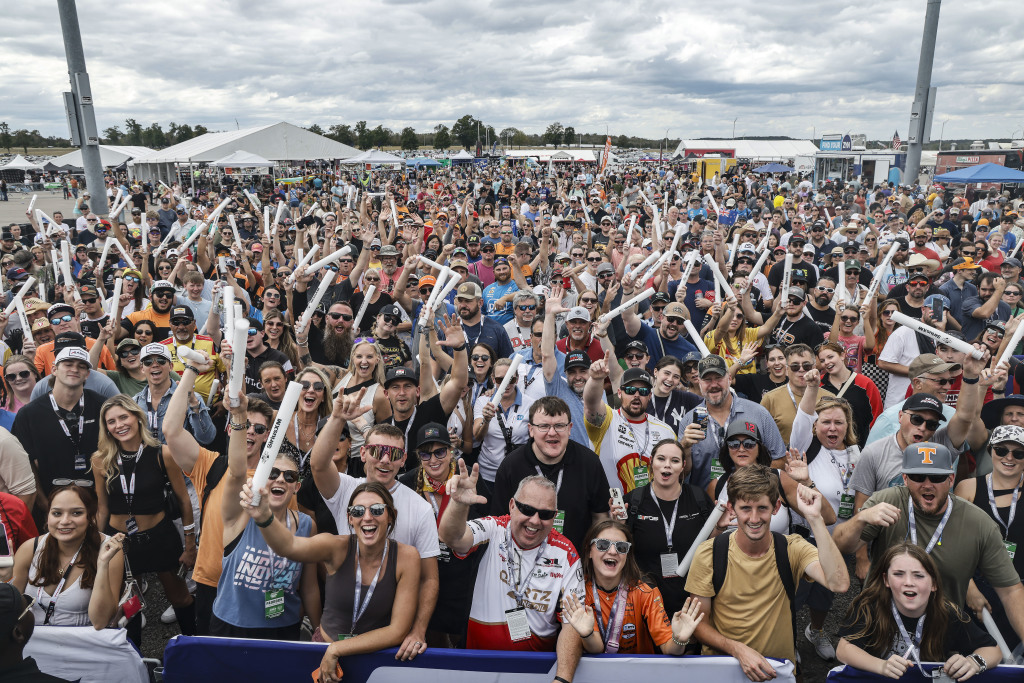
IndyCar fans make themselves heard. Michael Levitt/Motorsport Images
Through it all, IndyCar has remained the most popular content on RACER.com, consistently accounting for 24% of our total annual page views, driving the highest engagement, with the most active conversations in our comments section on RACER.com, in the RACER Mailbag and in our social platforms. We’ve celebrated IndyCar's wins, criticized its stumbles, and kept showing up to tell it like it is -- because our audience, that includes IndyCar’s most loyal fans, deserve nothing less. We know who we work for, and it’s not the sanctioning body; it’s you.
This reality has led to some polite and sometimes impolite conversations in recent years with IndyCar’s leadership. I find it amusing when some within IndyCar's team have dismissed RACER as “only” an IndyCar-centric media outlet. Obviously, we're all-in when covering their series, but we're an audience-centric media and marketing company covering numerous forms of motorsport. In that light, it should also be noted that 76% of the annual page views on RACER.com are for other forms of motorsport. Maybe I'm missing something, but aren't these other motorsports fans worth engaging if growth is IndyCar's objective?
Times change -- IndyCar isn’t operating in relative isolation, like it once was during the first half of the 20th century. In the 21st century Formula 1 has firmly established itself in North America with five marquee events, rising TV ratings on ESPN and a tidal wave of new fans thanks to the Netflix series Drive To Survive. American luxury brand Cadillac is preparing to join the F1 grid in 2026, raising the stakes even higher. But F1 has its own challenges -- will its new regulations deliver on their promise, or will they drain the visceral appeal from the world's most popular motorsport?
IMSA has become the brand battleground of choice for 19 automotive manufacturers, featuring diverse, modern, beautiful and relatable machinery. The racing is consistently spectacular, so IMSA is not only attracting major corporate backing but is also increasingly positioned to compete and win audience share and fan engagement from the other top series. Yet, its core challenge remains translating its multi-driver, multi-class format into something that both new and traditional fans can embrace with the same passion they have for other series and team sports with simpler competition premises. With some of IndyCar's best-known teams in the series, and IndyCar drivers participating in IMSA’s marquee endurance events, there’s a genuine opportunity to bridge that gap and expand the series' appeal.
NASCAR remains by far America’s most popular form of motorsport. It benefited immensely from the IRL-vs-CART split, and the old media rights model. The organization undoubtedly has a long-term strategy for navigating the new, diffuse era of sports rights and lifestyle-driven content. NASCAR is also coping with a serious legal challenge from two of its teams that could reshape the way it does business. But over the years, I’ve learned never to bet against the team in Daytona when it comes to figuring out how to win the race to define American racing -- a lesson those who have owned IndyCar or competed as entrants in either series have likely learned.
To seize this moment, IndyCar must clarify its long-term technical vision. The next engine and chassis formula must balance innovation, cost containment and sustainability. Most importantly, it must visually and viscerally convey IndyCar’s next era's promise of speed, intense competition and leading-edge technology in the race to what's next. Re-equipping the entire entrant base with new cars is not a trivial expense or process, so serious consideration must be shown for the realities of team budgets and manufacturer partner budgets. But IndyCar cannot afford to stagnate. The Indianapolis Motor Speedway was not built for nostalgia -- it was built to drive progress. If the original vision is honored, the Indianapolis 500 remains a race to tomorrow, as does the NTT IndyCar series, and it’s a race that can be won by Penske Entertainment. But you can't do that by rehashing the Dallara DW12 that ran its first of 217 races when IndyCar's youngest driver, Nolan Siegel, was 7 years old.
But hardware alone won’t capture hearts and minds. Nothing new here, but humanizing storytelling matters even more. IndyCar must focus on initiatives to elevate its defining stars like Scott Dixon, Will Power, Alex Palou, Josef Newgarden, Pato O’Ward and Colton Herta -- who should become icons of the sport. These drivers aren’t just talented racers or exceptional athletes; they’re compelling characters who are now central to one of the greatest and longest-running narratives in motorsport. At its best, IndyCar has always been about more than just racing. The Indianapolis 500 and the series it defines were created with the intention of driving progress, not Groundhog Day stasis.
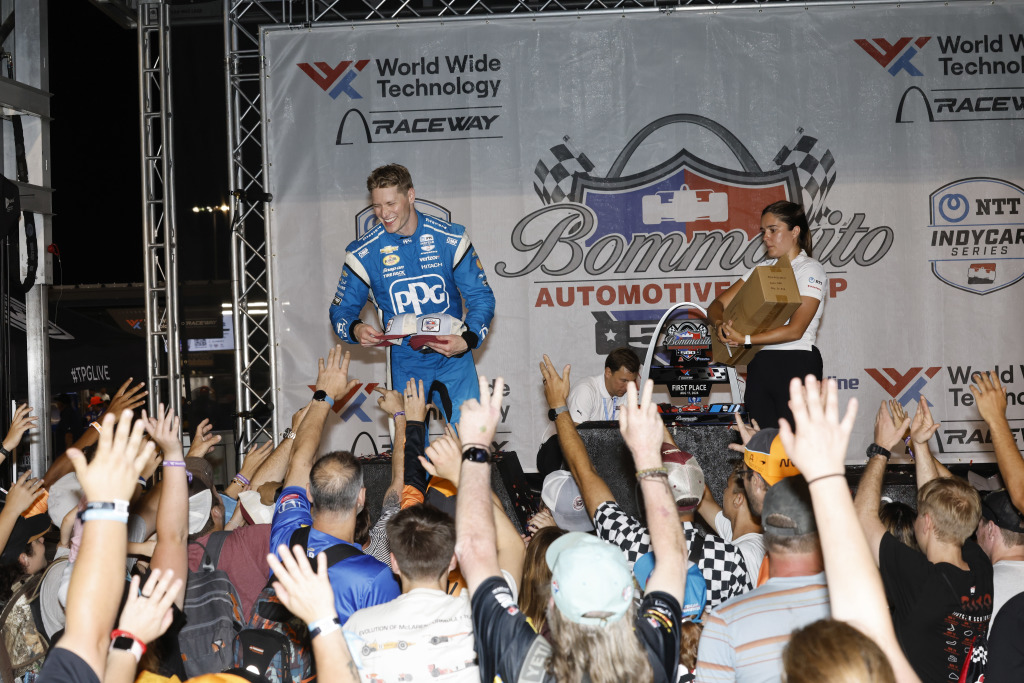
Forging direct connections between the sport's stars and the fans is essential in building a passionate audience. Michael Levitt/Motorsport Images
The 2025 season is indeed a turning point. With a strong FOX network broadcast deal, a talented driver line-up and opportunities to tell its story on a bigger stage, IndyCar has the tools it needs. But tools alone aren’t enough. IndyCar needs bold, decisive action and a willingness to embrace change without losing its soul. Because IndyCar isn’t just a racing series -- it’s an ideal born of, and driven by, the relentless pursuit of something better that is far beyond the ordinary. That’s what I believe IndyCar fans truly want. If this mindset drives every decision, it will create the emotional gravity needed to grow this sport in an era that rewards swift and bold action that transforms the way we see the world. In my view, IndyCar can win the race to what's next if it is fully committed to becoming uniquely worthy of our devotion -- in context of this century, rather than the past.
As RACER approaches its 33rd anniversary, we remain committed to telling great stories, celebrating great racers and championing the sport we all love in the context of the now we all share. Our plans include upgrading RACER magazine, expanding our digital presence, enhancing our multimedia storytelling capabilities and continuing to grow all our platforms to accelerate our engagement with racing's passionate fans in exciting new ways. I can’t wait for the green flag to drop on March 2, 2025, at the Firestone Grand Prix of St. Petersburg. It’s not just another season-opening race -- it’s the start of a new chapter for IndyCar and for RACER.
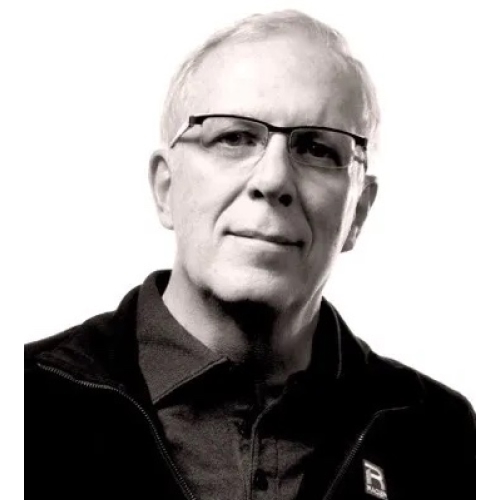
Paul Pfanner
Paul Pfanner is the founder, President and Executive Publisher of RACER magazine and RACER.com and is also the CEO of the Racer Studio creative services and branded content agency. Pfanner began his career in racing media as an art director for FORMULA magazine and later, SportsCar magazine before failing spectacularly as he attempted to become an editor. All of this was a transparent ploy to fund Pfanner’s desire to race but after he proved to be unemployable, he had no choice abandon his racing ambitions so he started his own publishing house and creative agency in 1979 which was the forerunner of Racer Media & Marketing, Inc. Pfanner sold the majority of Racer Communications, Inc in January 2001 to Haymarket Media and re-acquired the company with his original partners Rob and Chris Dyson in March 2012 which now operates under the name Racer Media & Marketing, Inc.
Read Paul Pfanner's articles
Latest News
Comments
Comments are disabled until you accept Social Networking Cookies. Update cookie preferences
If the dialog doesn't appear, ad-blockers are often the cause; try disabling yours or see our Social Features Support.