Nigel Kinrade photo
Kurt Busch looks back on his NASCAR title, 20 years on
The 2004 season of the NASCAR Cup Series was the first running of "The Chase," forerunner of today's playoff format. The 10-race brawl making up that first Chase was fought out between Jimmie Johnson, Jeff Gordon, Dale Earnhardt Jr., Mark Martin and then 26-year-old, fourth-year Cup racer Kurt Busch. With a fifth-place finish in the final round at Homestead-Miami Speedway, Busch took home the title, a memory he savors 20 years on.
“I think it’s appropriate to look back on it being 20 years ago and around this time of year when I was able to win the championship in NASCAR,” reflects Busch. “In 2004 it was just a whole new revolutionizing type of year, with Nextel being the sponsor of the entitlement. Winston was gone and then having a new series point structure... I mean, it was an incredible time to be part of the sport.”
What placed Busch on a trajectory towards that championship day was earning a spot in the Roush Racing 'Gong Show' in 1999. Rookie of the Year in the 1998 NASCAR AutoZone Southwest Series, Busch got the Gong Show invite, and after excelling, won a Craftsman Truck Series job. In the No. 99 Roush Racing Ford F-150, Busch was the championship runner-up in the 2000 Truck Series.
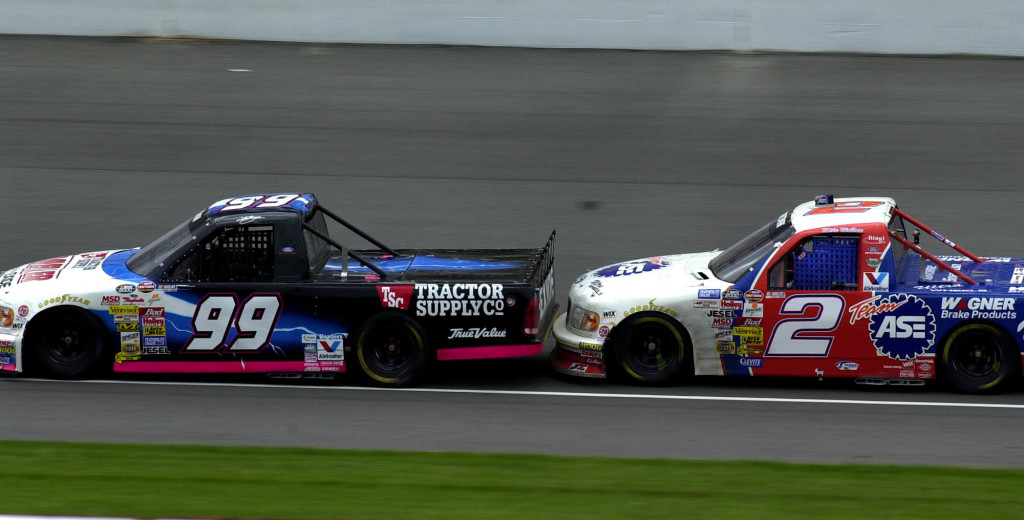
Gong Show success earned Kurt Busch the chance to earn his NASCAR wings in the Truck Series. Here he gets a lesson in bump drafting from Mike Wallace. Phil Abbott/Motorsport Images
“Running and winning the Southwest Tour Championship in 1999, that sort of put some eyeballs on me,” says Busch. “1999 was a banner year that helped me get to the Gong Show, which was named after a TV show from the 1970s. There were five of us. There was the Northwest Tour champion. I was the Southwest Tour champion. There was somebody from the Goody’s Dash Series. There were Modified racers. It was really cool.
"There was a Gong Show tryout in Toledo, Ohio. That was a tough little and mean half-mile. And then there was a second tryout. It was like they weren't quite convinced on who was the top dog. The second tryout was in Phoenix. I had a few laps around that track with my Southwest Tour car, so I felt really confident going into the second Gong Show. At the first one, I was so nervous. I was the fastest, but I blew the tires off the poor truck. So the second time around, I was way more calm. I felt like, ‘The phone is ringing, and there is gonna be other opportunities to possibly make my way up.’ I was really relaxed on the second tryout, and that helped my performance. It was a standout performance.
“So I won the Gong Show, and I go to Daytona to race in my first-ever Truck race, and I wrecked about 100 different times and still somehow finished second. I then settled in with the Trucks. I mean, we almost won Mesa Marin in our fourth race together. I won Milwaukee in in July of that year for my first win in the Truck Series, and at the end of the day, with four wins, four poles and we were second in points to my teammate Greg Biffle. That was one of those dynasty-type years that you felt was happening. It felt like Greg and I went to the track every week and it seemed like it was a one-two finish. It made it so much fun to learn it all and to be in the professional side of it.”
“I won the Gong Show in July, and then in August, Jack Roush says to me, ‘Hey, you want to go Cup racing?’ That was really one of my first sit-downs with Jack and I was just floored. I was just beside myself and going, ‘I just came out of basically a Legends car last August, and you're asking me to do a Cup race. Man, I'm ready if you're ready, but we're probably gonna wreck some s***.’
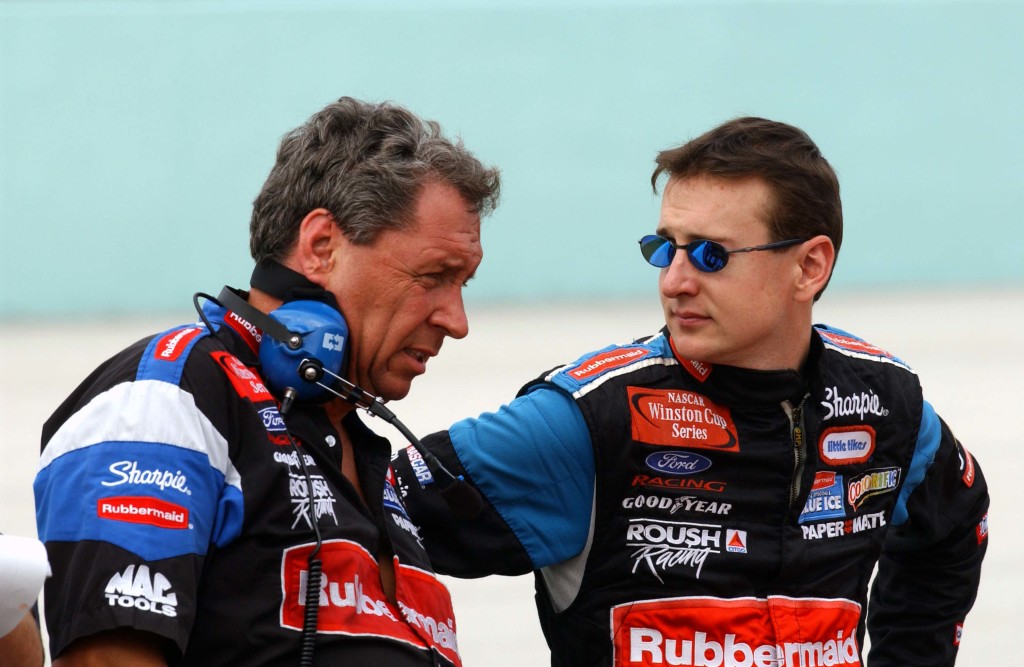
Kurt Busch and Jimmy Fennig, pictured here in 2002, quickly built an effective rapport. Robert LeSieur/Motorsport Images
“And this is what Jack Roush said to me: ‘I'd rather you make mistakes at the top level than be here in the Trucks for another year or in the Busch [now Xfinity] Series for another year. I'd rather you make mistakes at the top level.’ And away we went. It was just such a fast transition from being a local racer in 1998 to being in the Cup Series in 2000.
“It was an opportunity of a lifetime. What was I supposed to say as a 22-year-old? ‘No, I don't want to go to the Cup Series?' I knew it was too soon, and I looked up to guys like Jeff Gordon and Ron Hornaday Jr., who had just made it from the West Coast. The West Coast doors were wide open at the time. And you know, I did OK in my rookie year in Cup.”
By 2002 the Las Vegas native was established at the highest level of the sport and, teaming up with crew chief Jimmy Fennig, managed to pull down his first win at Bristol in March. But it was the following year that things really started to click
“2003 seemed like we were running so strong on the big tracks," Busch remembers. "That's when the coil binding era of NASCAR was starting to pop up as the primary way to set cars up. At Roush, we had all the teams working as hard as we could to figure out the setups for coil binding. We found a system that worked, and it just made us consistent. We were consistent and right in the game every week.
“2003 is when the sport slowed down for me. I could feel the car and I could not get so anxious and nervous about certain situations and I could make clean, good passes. That also made me more confident with the media -- and that backfired. 2003 was probably also my toughest year with different rival drivers, getting in trouble with the media or whatever it may have been. I said to myself, ‘I need to block the media side of this out. I need to become more professional, and I need to keep the same focus with the car that basically has us running a top five every week.’
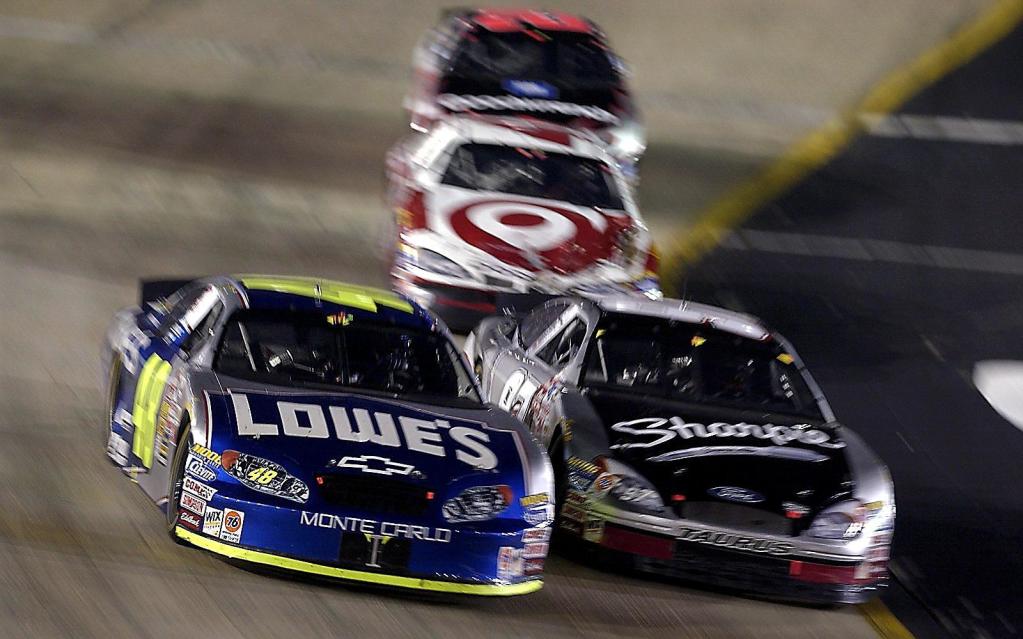
Busch felt the sport slowed down for him in 2003, while he sped up dueling the likes of Jimmie Johnson. Motorsport Images
“That's what led to 2004. It was a nice mental reset of knowing that I was starting to master the cars, master the setups, and then me and Jimmy Fennig, once they announced the new point system, we sat down on Jan. 1 and had a game plan all the way to Homestead that year.
“2004 was truly just a magical year. The way the season started, our overall game plan was to be an underdog and to be kind of a sleeper team, and some of that was to save our test sessions back in the day. You used to be able to pick five or six or seven tracks to go and test at during the weeks of the season. But if you used them up early in the year, you didn't have them later in the year. We used all of our setups for 2003 to start, and then as the season went on, of course, we were advancing. We were running right in the middle of the top 10.”
The September race at New Hampshire International Speedway started the title run for Busch, Fennig and the Roush Racing crew.
“We started testing right before the playoffs started. We started at New Hampshire, Dover, Kansas, Charlotte, Homestead and Martinsville," Busch relates. "We were everywhere and we worked hard. It was so stressful, though. That was the only thing we didn't see coming. It was the extra test sessions and still running up front in the points in the playoffs.
“We won the first-ever NASCAR playoff race in Loudon and we set the tone. We were like, ‘OK, we're done being the underdogs. We're here for the for the show.’
“We were right there in the Chase races. It was pretty wild," Busch says. "I mean, the plan was unfolding perfectly. The pressure had melted. I literally would spend the week going out to the land that I bought outside of Mooresville, N.C. and I would just get on my tractor, and mowed my grandma's grass almost every week. I did it just to stay busy, but also to try to release from the focus and the intensity of the next nine weeks.
“As the weeks progressed, when we got the points lead, that's when I went into see all the crew guys that next Monday for our meetings and everything. I think it was four weeks to go in the season where I said, ‘This is where we don't look back. This is what we planned for. This is what we're doing. I know our tongues are hanging out right now as we're testing during the week and racing on the weekends, but this is part of our plan.’ And our plan all along was just to be consistent and to wear them out with those little extra bonus points from leading a lap or leading the most laps. We were going after a solid average finish.”
Busch and Fennig excelled with speed and consistency in the Chase, reeling off six straight top-six scores to start the series.
“Top-five or top-six consistency, that was the game plan,” said Busch. “I mean, an average finish of seventh in the NASCAR Cup Series -- for decades -- will help you win a championship, so we were going into Atlanta with a huge buffer of points.”
Good thing, because Atlanta brought the effort its lone major Chase setback in the form of a blown engine and 42nd-place finish.
“I was kind of all down and out," he admits. "All of our points and that lead that we had were gone.
“Then we caught a lucky break. We were sitting there on the team plane coming home from Atlanta, listening to the race on the radio. There was a huge wreck with Junior, Jeff Gordon and even Jimmy Johnson. I think everyone just kind of gave us a bunch of points back. To me, that's where everyone saw that the dinner table was open and that they were all going after it hard with us having that problem early in the race."
Still, Busch admits the effect of his setback lingered.
“Yeah, I was feeling the pressure," he says. "It was tough. Martinsville was one of my toughest tracks. We got out of there with a fifth-place finish. We barely survived Darlington. I was nervous in the situation, and lost track of where I was in my surroundings going into Turn 3 and ran over another car and got some right front tire damage and fender damage and so we had to come back from that.
“One bit of advice that I think made the most difference was [from] Jimmy Fennig. His leadership and his experience was so helpful, and a quote from him that I've lived by since was when he said, ‘Kurt, you're young. You're in this tough situation. I've been here many times and was just as nervous as you and you have every opportunity to fold and not come through. However, you're going to have more of these opportunities. This won't be your last one, so just relax a little bit going into Homestead, and things will fall our way.’
“I think that eased a lot of the tension. I thought, ‘You know what? I made it this far in my first chance at a championship run.’ That really helped the mindset and the focus to be the team leader that I knew I could be. And I was only 26 years old.”
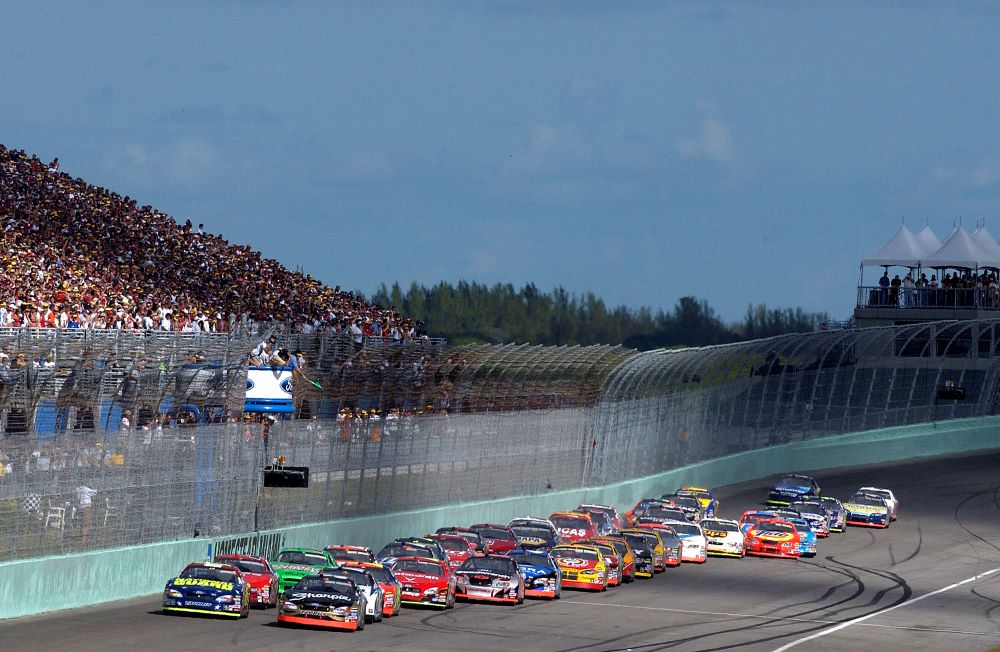
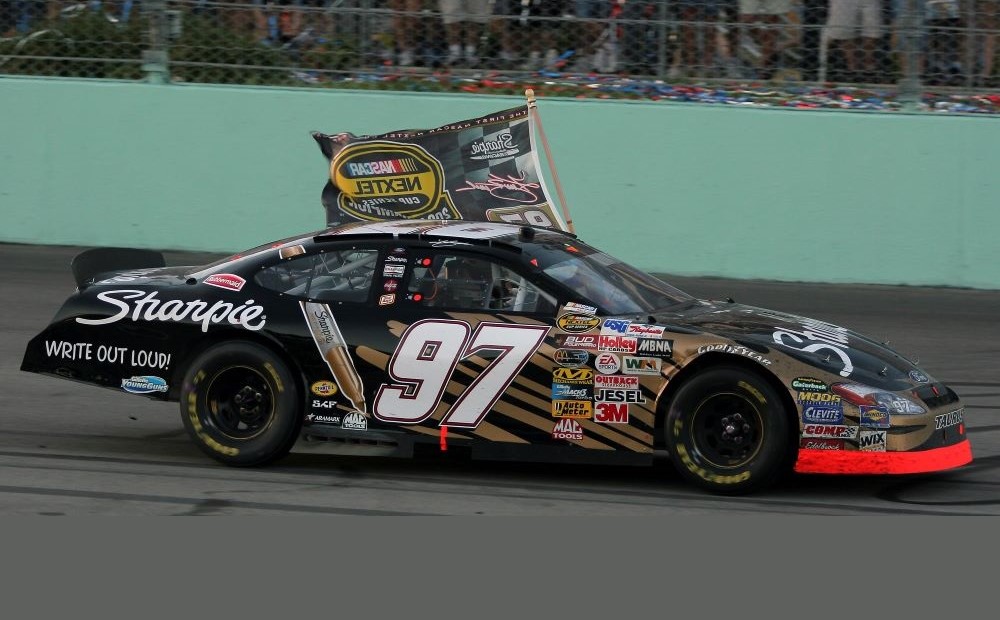
Busch started up front for the decisive race at Homestead but had another secret weapon in his armory as well... Nigel Kinrade
Leading into the finale that November, Busch was 18 points ahead of Johnson and 21 ticks ahead of Gordon. Busch explains what came next.
“We sat on pole and led a lap at Homestead-Miami. But a secret weapon we had that day was Greg Biffle. He was dominant, and he led so many laps that day that others didn't get bonus points for leading laps," Busch recalls. "And he ultimately was able to hold off Jimmie Johnson at the end.
"The way that that last sequence of the race went, I mean, ignore the wheel falling off, ignore the pit crew blunder and whatever else happened the rest of the day. I remember a big moment with about 52 laps to go. Our fuel window was 48 laps. Something was happening. I said to myself, ‘If Jimmie Johnson and Jeff Gordon pit and we’re back here, too, that’s going to put us on the same sequence. We’re all going to race back up to the top five together, or we’re all going to run out of gas together.’ I clearly remember that moment. Ultimately, we pitted, worked our way back up, and we followed Jeff and Jimmie through the traffic to make our way back up with fresh tires.
What does Busch recollect most from the Homestead drama?
“I'd be lying if I didn't say I don't remember a lot because you're in this zone -- you're in this this blur of numbers that are running through your head because of what your points lead is," he says. "You know, I got these guys breathing down my neck on the restart. It's like, ‘Guys, just give me a little space here,’ you know? I did just enough with my nerves, with car speed and making sure that we brought it home in the right position. We used that points cushion to our advantage in the closing laps of the race -- it wasn't like I had to charge and move somebody out of the way to grab some extra points.”
And when it was all over?
“The checkered flag fell and it felt like all my energy was expunged. Just totally left it all out on the track," he relates. "Some of my interviews, I almost passed out. I saw white coming in from the left and the right, because I just left everything I possibly could out on the track. There was the hoisting of the trophy and the team and my family were there and some of that stuff. You close your eyes when all the confetti is in the in the air and the lights are hitting you and you just go off into outer space, man. You feel like you're on top of the world. It's an amazing feeling of teamwork and accomplishment.
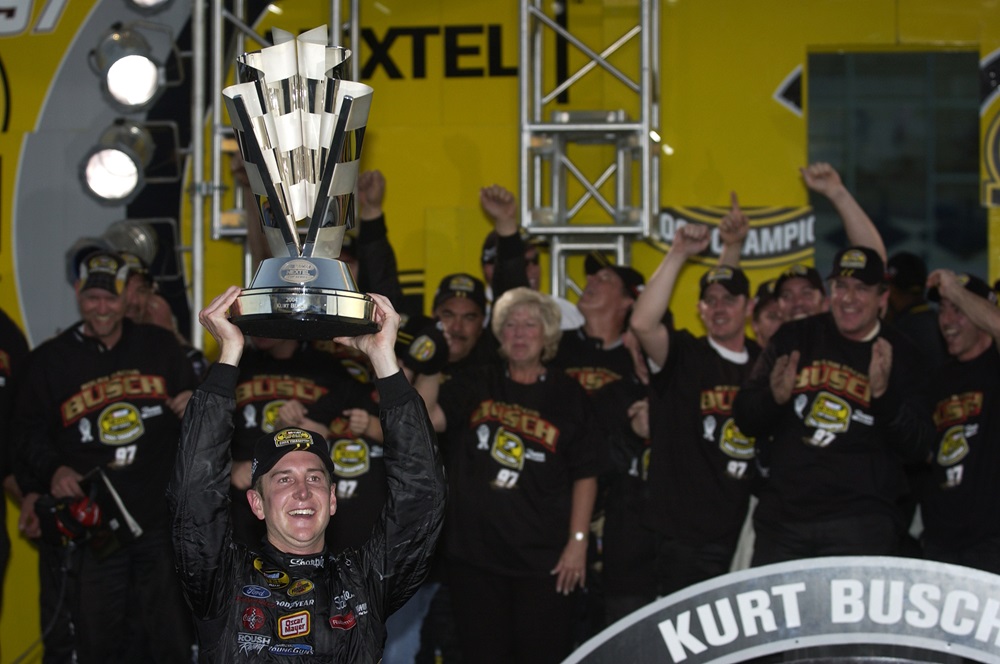
Hoisting the trophy at Homestead after working the plan to perfection. Nigel Kinrade
“It was a challenge. Nothing is easy and some people would fold under that pressure. I tried to do the best I could to find support. My dad was just a local racer. He didn't know anything about the pressures of the professional big time. Jack Roush had a strict type of demeanor in how he operated the team. I can only grab so much information from a teammate like Mark Martin. However, I look back on some of the other little things, and you just piece together some puzzle pieces. It was Matt Kenseth winning the year before that I looked back at -- I followed a lot of his strategy with Robbie Reiser. And, you know, I went back to when I won a Southwest Tour Championship, or a local track championship. You try to go into those moments with as much mental preparation of, ‘I've done this before, and I know I can do it again.'
“Looking back on it all, it just happened so fast. People that I raced against at the local track, I never saw them again after 1998. And with the Southwest Tour, I was in and out of there in two years. The Truck Series, I was only there for one year. I get the Cup ride, and I made it so fast that I didn't realize that this is the ending point. So that's where I was going to all these new tracks for the first time and meeting all these new people. I was living in an apartment in North Carolina and yes, I just felt like I was out on an island trying to sort it all out. The only thing that made sense to me was the gas pedal on the right side.”
What did it ultimately mean to have won the Cup title after all that?
“It was so much fun, I mean, to be treated like NASCAR royalty, and to have different morning shows to talk about the sponsors to talk about the events that had happened was awesome," he says. "I was able to thank people and go to New York and I got my own limo all week long. I was feeling like a baller with all the events and parties, There were the morning shows when you're up at 6 a.m. It was such a fun week.”
“There's the chance to sit there and go, ‘You know what, I did something pretty special and I hope I'm able to do it again with the team and figure out the new challenges of what comes up next.’ Because when you're on top of Mount Everest, it seems like it's easy to get knocked off. That's one thing I should have prepared a little better for.
“It was an amazing opportunity. Again, just to be the young, blue collar kid out of Vegas, I lived a dream and that dream was to drive race cars for a living and get paid to do it. To do it with so many teams and so many different manufacturers, and to win everywhere I went, it was fun.
"However, I wasn't prepared for the big time of professional racing and it took me a while to settle in. I think the second half of my career really was a nice reset and worked my way back up to a top-tier team. We won the Daytona 500! What made that even more incredible was that Monster Energy was a sponsor of mine -- we were together for 12 years. That was the whole second half of my career and I’m so very grateful to them and for what they provided for me with the sponsorship stability.”
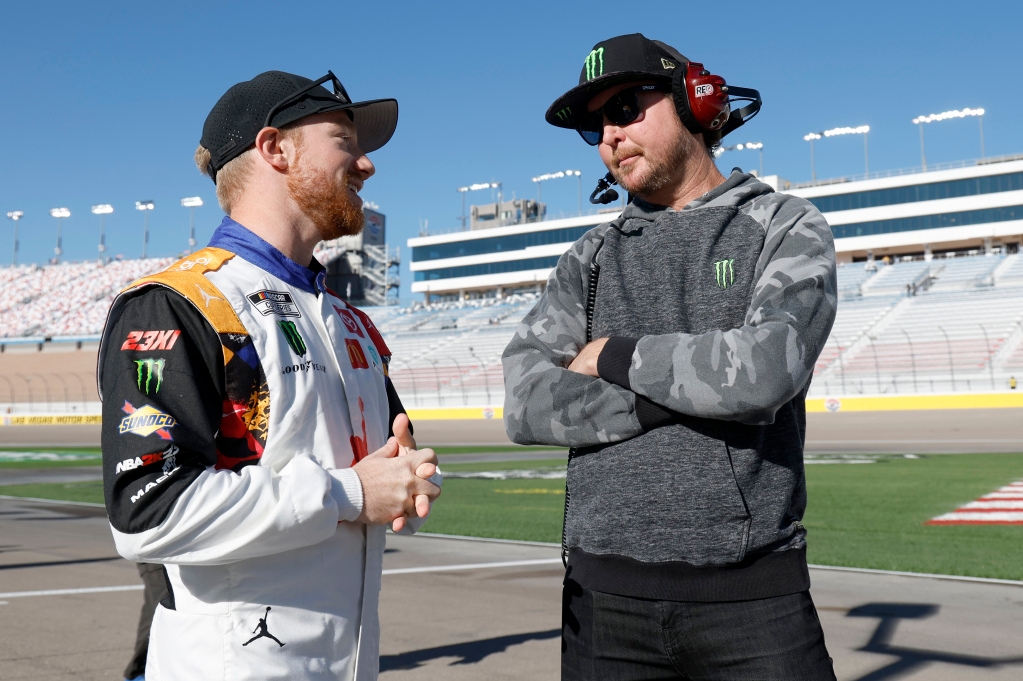
Busch is now enjoying utilizing his "NASCAR PhD" in new ways, supporting 23XI's racers (here with Tyler Reddick) and crew members. Matt Thacker/Motorsport Images
After a wicked crash at Pocono Raceway on July 22, 2022 in which Busch suffered major head injuries, he announced his retirement from the sport in August of 2023. Although he's recovered, Busch admits he is still feeling some ill effects from that wreck.
“I'm feeling much, much better since the summer wreck in 2022 and all of the different physical therapy, different neurologist visits,” he says. “It was taxing for a while. Basically every other day it was a doctor visit somewhere and going to get hearing checked, eyes checked, balance checked. The vestibular movements were what was greatly affected. I still feel the lingering effects but it has calmed down, and it has been through all the physical therapy and all the great doctors who have helped me.”
Although he's no longer racing in Cup, Busch notes that he's still actively involved in the sport and NASCAR culture.
“In 2024, once I knew I wasn't going to be racing full time, I took a little bit of break and took a step back," he says. "It was great to just be on the sidelines coaching a little bit with 23XI Racing and helping Tyler Reddick make the Final Four with just some of the little things that I can add. Bubba Wallace was also playoff-bound for a long while during the season in 2024. It's great to have a home and a place in 23XI Racing to dump some of my years of experience on and to coach the next generation of crew chiefs and engineers, and the marketing team, the licensing team, and the sales team. It's fun to have a PhD in the sport of NASCAR at this point."
And, just maybe, we could yet see Kurt Busch back behind the wheel.
“Right now for 2025, I'm still endorsed with Monster Energy. I'm hopeful to get a light duty type of clearance to race with my neurologist, which would then open up some opportunity for me," Kurt explains. "Whether it's late model races, or I was invited to Race of Champions, which will be in Sydney in 2025. I'd love to go and represent the USA. This would give me an opportunity to go back for my third time.
"I still have to get through some more steps with the neurology. I still need to push my doctors to get that approval. And then too, you can't just jump back in and go ride like a bull rider. If you get hurt, you don't go jump back in and ride the biggest bull, right? You start with a little guy and work your way up. So go-karting, driving with friends, racing schools, using some of my brother's race cars that are current. That would be the way to really step it back up and just see what 2025 can bring behind the wheel. We just have to keep it realistic and to keep it one step at a time.”
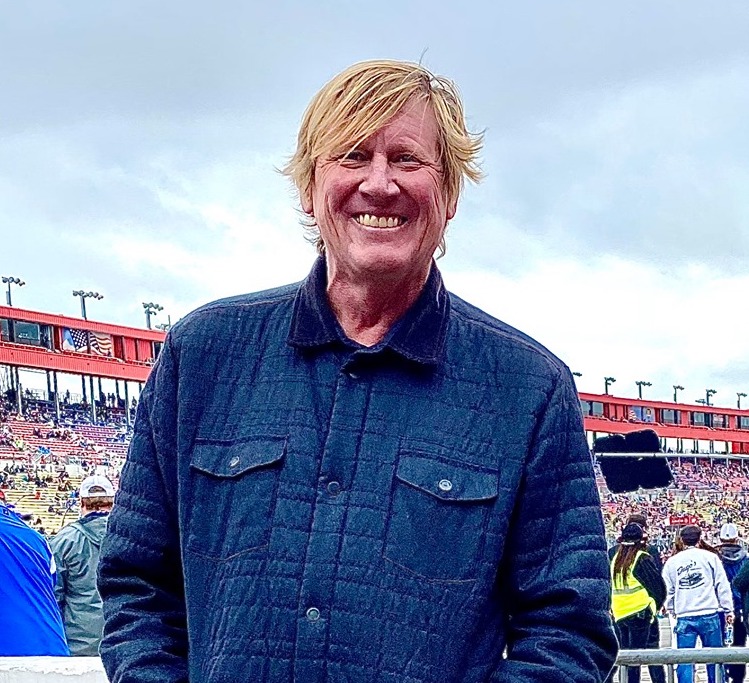
Eric Johnson
Born and raised in the rust belt to a dad who liked to race cars and build race engines, Eric Johnson grew up going to the races. After making it out of college, Johnson went into the Los Angeles advertising agency world before helping start the motocross magazine Racer X Illustrated in 1998. Some 20 years ago, Johnson met Paul Pfanner and, well, Paul put him to work on IndyCar, NASCAR, F1, NHRA, IMSA – all sorts of gasoline-burning things. He’s still here. We can’t get rid of him.
Read Eric Johnson's articles
Latest News
Comments
Comments are disabled until you accept Social Networking Cookies. Update cookie preferences
If the dialog doesn't appear, ad-blockers are often the cause; try disabling yours or see our Social Features Support.